Cities_Old Egypt_5-Till_amarna_

Akhetaton, meaning the horizon of the sun disk.
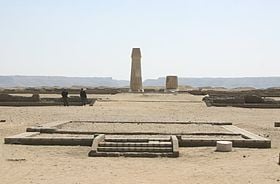
It is an ancient city called Tel el-Amarna in Minya, Egypt.
It is located east of the Nile
Built in 1365 BC
King Akhenaten to be the capital and seat of the Aten monotheistic belief
After his death, its palaces were demolished and plundered

Tutankhamun transferred his successor the capital again to Thebes to revive the Amun doctrine

Tell el-Amarna
Date of Establishment
1346 BC, and 1370 BC
Coordinates
27 ° 39′42 ″ N 30 ° 54′20 ″ E
Tell el-Amarna
(Its name was “Achhataton”, meaning: “the horizon of Aton”)
It is the new capital established by King Akhenaten,
It is located at a distance of forty-five kilometers south of the Bani Hassan Cemeteries in Minya Governorate
Remains of the ancient capital still exist today. In the Middle Ages, after that region was devastated since Tutankhamun rose and changed the capital, the Amarna tribe came and lived there for a long period that included the centuries and its age. After they deserted and returned to their areas, the area was called Tel Al-Amarna because those who returned to life were the Amarna tribe because it was a hill. Ruin, but Tell became a habitable city
Some of the demolished homes of the elite are still present at the northern end of the site, facing the outer wall of the royal palace. The Egyptian Museum includes beautiful examples of the plaster ground cover, which was the source of these dwellings
A group of tombs have also been discovered in Tell el-Amarna, the most important of which are located to the north, such as the tombs of Meri-Ra, Ahmose, Bento, and the royal family cemetery, which is believed to have been excavated for the king and his family.
Site
Tell el-Amarna is located in Deir Mawas, Minya Governorate, in northern Upper Egypt. It stretches along the eastern shore of the Nile for a distance of approximately five miles. And when Akhenaten realized that there was no possibility to continue in Thebes after the priests of Amun showed hostility to his new vocation, which he tried to introduce instead of the religion of Amun and other beliefs in Egypt, he had to search for a new location to move to and invite him to his Lord Aton, that idol that the king wanted – According to some specialists – the unification of the Egyptian gods complex
Thus, King Akhenaten established his new city, and in the fourth year of his reign, he moved to his new capital, the sister of Aton, the “Aten horizon / sun disk”. This place where he settled and is now known as Tell el-Amarna, and is located ten kilometers from Mallawi, on the eastern mainland of the Nile. Leaving both Memphis and Thebes, which were the capitals of Egypt at that time and the royal headquarters in summer and winter
The city of Amarna extends over an area of ​​twenty-five kilometers from Sheikh Saeed in the north to Sheikh Abdul Hamid in the south.
It is an area surrounded by mountain chains on three sides, east, north and south, while its western borders are bounded by the Nile River.
Four villages are built on its ruins:
Al-Houta Al-Sharqiya, affiliated to the Dairout Center in Assiut Governorate, “Al-Amariah Al-Sharqiya, Al-Hajj Qandil, Al-Tal Al-Sharqi, or Tell Al-Amarna, and the three villages belonging to the Deir Mawas Center in Minya Governorate
The label
The name Tell el-Amarna comes from the Bani Omran tribe who lived in the area and established some settlements.
The ancient Egyptian name was the sister of Aton.
English Egyptologist Sir John Gardner Wilkinson visited Tell Amarna twice in the 1820s and called it alabaster, after the contradictory names of the Roman authors Pliny the Younger and Ptolemy, although he was not sure of its location and suggested Kom al-Ahmar as an alternative location.
The city area was an emerging site, and as Akhenaten described this city as the seat of the first celebration for Aton, which he built for himself so that he could rest in it.
Perhaps the hieroglyphic representation of the Royal Canyon with the horizon showed this to be the right place for the founding of the city
The city was built as a new capital for Pharaoh Akhenaten,
To devote his new religion to the worship of Aton.
Construction began on or around the fifth year of his reign (1346 BC).
It may have been completed by the year 9 (1341 BC),
Although it became the capital two years earlier. And in order to hasten the construction of the city,
Most of the buildings were constructed of mud and white brick. And the most important buildings are covered with local stone
It is the only ancient Egyptian city that preserves great details of its internal plan, largely due to the result of the abandonment of the city after the death of Akhenaten, when Ibn Akhenaten decided,
King Tutankhamun, leaving the city and returning to his hometown of Thebes (modern Luxor). The city appears to have remained active for a decade or more after his death, and the Horemheb shrine indicates that it was at least partially inhabited at the beginning of his reign, solely because it was a source of building materials elsewhere. Once deserted, it remained uninhabited until Roman settlement began along the edge of the Nile. However, given the unique circumstances of its creation and desertion, it is doubtful how these ancient Egyptian cities were in fact. Amarna was built in haste and covered an area of ​​about 8 miles (13 km) of land on the eastern bank of the Nile. On the West Bank, the land was allocated to provide crops for the residents of the city. The entire city was surrounded by a total of 14 boundary plates detailing Akhenaten’s conditions for the founding of this new capital of Egypt. It is known that the earliest dated plaque from the new Akhenaten city is the boundary plate (k) dating from the fifth year, of the Bert chapter (or eighth month) , The thirteenth day of Akhenaten’s reign. (Most of the original 14 boundary panels are badly eroded.) It preserves the narrative of Akhenaten’s founding of this city. The document records the pharaoh’s desire to establish several temples to Aton in it, in addition to the establishment of many royal tombs in the eastern Amarna hills for himself and his wife, Queen Nefertiti and his eldest daughter Merit Aton, in addition to his explicit order that when he dies, he should be returned to Amarna for burial.
The boundary panel (k) provides a description of the events celebrated at Tell el-Amarna:
His Majesty climbed on a large carriage of electrum, just as Aton ascended to the horizon and filled the earth with his love and took a wonderful path towards the sister of Aton, the place of origin, which [Aton] created for himself. Perhaps he is happy in it. His son was conscious that Ra [meaning: Akhenaten] who built it as a tomb for him when his father ordered him to make it. The sky was joyful, the earth was pleased, and every heart was filled with elation when they looked at him
Statues to the left of the (U) boundary board in Amarna
Then this text continues to indicate that Akhenaten has made a great sacrifice to the god Aton. ”This is the theme of the [celebration] which is evident in the crescent portion of the painting where he stands with his queen and his eldest daughter before an altar stacked with offerings under the Aton, while he shines upon him, returning the youth to his body through his rays. . “
And that city that Akhenaten ordered to build includes:
Two royal palaces (the northern palace and the southern palace), – the temples of Aton – the residential quarters of the homes of the nobles and a village for the craftsmen – the royal cemetery located in the northeast of the city – 25 of the individual cemeteries divided into two groups (north and south) located in the far north of the city and including 25 graves of high-ranking state employees during the reign of Akhenaten. The king has defined his city with fourteen boards known as “panels of borders”.
This was found in the city on the letters of Tell el-Amarna.
Ancient life in Tell el-Amarna
Much of what we know about the founding of Tell el-Amarna is due to a series of memorial plaques in the vicinity of the city. These paintings record the events of the Aton sister from the founding until just before her fall
To move from Thebes to Amarna, Akhenaten needed the support of the army. Ay, one of Akhenaten’s chief advisors, had a great influence in this region because his father Yuya was an important military leader. In addition, all members of the army grew up together, and they were part of the richest and most successful period in the history of Egypt during the reign of Akhenaten’s father, so the loyalty between them was strong and steady.
Religious life
Although Akhenaten’s reforms were directed towards a kind of unification. Archaeological evidence indicates that other deities were also revered, even in the Aten cult center, at least by the people who lived and worked there.
the art
The Amarna art style broke well-established Egyptian traditions. In contrast to the strict idealistic formalism of Egyptian art in earlier stages, art in the Amarna era portrayed subjects more realistically. These included casual scenes, such as portraying the intimate passion within the royal family and playing with their children, and they no longer portrayed women as being lighter than men. Art also had a realism that sometimes limited cartoons.
Rediscovery and exploration
The explorations of the eighteenth and nineteenth centuries
A piece of limestone. Akhenaten era. From Amarna, Egypt. Petrie Museum of Egyptian Archeology in London
The city was first mentioned in the West in 1714 by Claude Sicard.
He was a French Jesuit priest who was traveling through the Nile Valley,
He described the memorial plaques in Amarna.
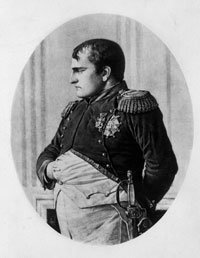
Napoleon scholars visited the city in 1798-1799,
They prepared the first detailed map of Amarna, which was later published in the book The Description of Egypt between 1821 and 1830.
European exploration of the city continued in 1824 when Sir John Gardner Wilkinson explored and mapped the remains of the city
A Prussian expedition led by Carl Richard Lepsius visited the site in 1843 and 1845, and recorded the visible monuments and terrain of Tell el-Amarna on two separate visits over the course of twelve days using graphics to create an improved map of the city. Although these drawings were less accurate, they were considered the basis for knowledge of the city and the interpretation of many scenes and inscriptions in private tombs and some memorial plaques for the rest of the century. Records recorded by teams of early explorers were of great interest because many of these remains were later destroyed or lost.
Explore the king’s tomb
Between 1891 and 1892 Alessandro Barsante discovered the king’s tomb, although it has been known to locals since about 1880. Around the same time, Sir Flinders Petrie worked for one year in Amarna. He excavated mainly in the central city, undertaking work on the Great Temple of Aten, the Great State Palace, the King’s House, and the Pharaoh’s Correspondence Office.
.
Twentieth century explorations
In the early years of the twentieth century (1907 to 1914), the German East Institute expedition, led by Ludwig Borchardt, undertook extensive excavations throughout the northern and southern suburbs of the city. The famous Nefertiti statue, now in the New Berlin Museum, and which was found among other sculptures was discovered in the workshop of the sculptor Thutmose. The outbreak of World War I in August 1914 ended the German excavations
From 1921 to 1936, an expedition returned to the excavations at Amarna under the direction of Sir Leonard Woolley, Henry Frankfurt. This mission focused its work on religious and royal structures. During the 1960s, the Supreme Council of Egyptian Antiquities carried out a number of explorations in Amarna
Twenty-first century explorations
The exploration of the city continues to the present, under the direction of Barry Kemp who is Professor Emeritus of Egyptology, University of Cambridge, England.
In 1980, a separate expedition led by Geoffrey Martin described and copied the inscriptions from the Royal Cemetery, and later published the mission’s findings.
History of Excavations at Akhet-Aten (Tell el-Amarna)
Numerous operations were carried out to reveal the capital of “Akhenaten” and the center of his religious mission, after it had fallen into oblivion.
In the year 1714 AD:
Description of a French Jesuit priest
Claude Sicard
Cloud Sicard ‘border panels
In the year 1798-1799 AD:
The French expedition, led by Napoleon Bonaparte, visited the site and drew a map of the city.
In the years 1824 AD and 1826 AD:
Visit
Gardner Wilkinson’
Gardner Wilkinson ‘English Egyptologist twice signed, and defined it like
Alabastron
Classical Roman Writers
.
In the years 1843AD and 1845AD
the Prussian Expedition
The “Prussian” excavation mission headed
Karl Richard Lepsius
Karl Richard to Pseus, visited the site, and recorded and published many scenes and inscriptions of the Amarna tombs carved into the rocks.
———–.
In the year 1887 AD:
An Egyptian peasant discovered 337 plaques (small stela) of dried clay inscribed with cuneiform inscriptions
(Vernacular Akkadian language) – ‘Tal al-Amarna letters’, which represent international diplomatic relations (foreign policy)
From exchanged correspondence between Egypt and the princes of Upper Syria, Palestine, Babylon and others loyal to Egypt,
During my reign, he “gave me the third” and his son “gave me the fourth” (Akhenaten).

This discovery drew attention to that forgotten city

The years 1891-1892 AD

: Alessandro Barsanti
Alessandro Barsante ‘from
Egyptian Antiquities Service
The Egyptian Antiquities Authority cleaned the tomb of King (Akhenaten) in Amarna
————-.
The years 1891-1892 AD:
William Mathew Flinders Petrie
William Matthew Flinders Petrie discovered parts of the city, including the palace
Royal, and prepared a comprehensive survey of the area with the help of
Howard Carter
Howard Carter
The outcome of this campaign was 132 boxes that found their way to the Ashmolean Museum.
In the British city of Oxford
1892 AD: He visited
Howard Carter

Howard Carter, the Royal Cemetery, has copied and published some of the scenes

The year 1893 AD:

Petrie cleaned the rock tombs.
1902 AD: The Egypt Exploration Society begins
(EES) “The Egyptian (Archaeological) Findings Society” in London, its work on the site
————–.
The years 1903-1908AD: He rose
Norman de Garis Davies
Norman de Garis Davies publishes individual gravesites
Amarna in six parts
(Davies 1903; Davies 1905a; Davies 1905b; Davies 1906; Davies 1908a; Davies 1908b)
.
1907-1914: Discover the German expedition of the Deutsche Orient-Gesellschaft
(DOG = German Oriental Society)
The German Oriental Society ‘under supervision
Ludwig Borchardt
Ludwig Borchardt ‘parts of the city, I revealed

The eastern neighborhood of the city in the years 1911-1914 AD.

And in 1912:

They found the head of the famous Queen Nefertiti, which is now on display in the Berlin Museum

The years 1921-1936 AD: Excavations

Egypt Exploration Society (EES)
The Egyptian (Archaeological) Discovery Society, under the supervision of many specialists
Thomas Eric Peet
Thomas Eric Pitt
Leonard Woolley
Leonard Woolley
Francis Newton
Frances Newton
Henri Frankfort
Henry Frankfurt
J.D.S. Pendlebury

‘.D.s. Gundlebury

Since 1977 AD: Mission excavations

Egypt Exploration Society (EES)
The Egyptian (Archaeological) Lists Association, headed by
Barry J. Kemp’Barry چ. Km ‘,

Its work is still continuing until now

References
“Information about Tell el-Amarna on d-nb.info.” d-nb.info. Archived from the original on December 15, 2019.
“Information about Tell el-Amarna on ne.se.” ne.se. Archived from the original on January 26, 2020.
Information about Tell el-Amarna on geonames.org. geonames.org. Archived from the original on March 18, 2020.
“Amarna”.
http://www.ucl.ac.uk.
Archived from the original on August 2, 2018. Retrieved January 06, 2021.
Sir John Gardner (1828).AAldred (1988), p. 48
Turner, Philip (2012-10-24).
“Seth – a misrepresented god in the Ancient Egyptian pantheon?”
[Thesis]. Manchester, UK: The University of Manchester; 2012
“Mapping Amarna – Survey.”

  • Recent Projects
  • Amarna Project “.
    http://www.amarnaproject.com.
    Egypt Exploration Society – Fieldwork –
    Tell El-Amarna “. Web.archive.org.
    Basem Samir Al-Sharqawi, Minya Governorate:
    Archaeological sites and religious shrines, contributed to the preparation d. Hoda Abdel-Maqsoud Nassar and the archeology of Maryam Kamel Boutros, reviewed by Prof. Suad Abdel Aal, Presented by: Prof. Zahi Hawass, Supreme Council of Antiquities Press, 2008 AD.

Cities_Old_Egypt_3_Atrib

Cities_Old_Egypt_3

_Atrib

14-4-2021
Province of Al-Galubeiah
Coordinates
30 ° 28′00 ″ N 31 ° 11′00 ″ E
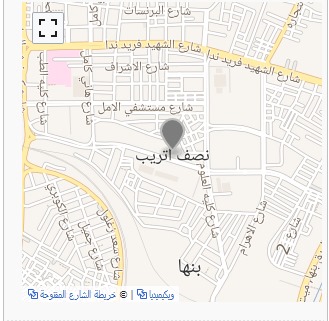
Aribe is a small part within the city of Benha
Which no one knows about
Which had a high status in the distant and near past as it was a city of no less importance than the city of Thebes in the era of the Pharaohs, nor Alexandria in the era of the Ptolemies and the Romans
Then, with the passage of time, buried its history
Meaning of the word Atrib
I miss the word “Attrip”
From the ancient Egyptian language (hieroglyphs), as its name at the time was “Hatt – Hari – Ibb”
Egyptologists have considered its meaning “the palace of the Middle Territory.”
Then the Assyrians, during their rule of Egypt in the late Pharaonic eras, derived the name “Hatrib” to indicate it
As for in the Coptic era, it was called “Atribi”,
As for the scientific community concerned with Egyptology, it is called “ATRIPS”.
It is the name given by the Ptolemies and the Romans during their rule of Egypt
In our research, we will refer to it by its Arabic name “Atrib.”
Omar of the city of Atrib
Egyptologists have confirmed that the history of the city of Atrib dates back at least to the Fourth Dynasty of the Era of the Pharaohs
It is a family that was founded by Pharaoh Senefru around 2613 BC
This means that the history of Attrib goes back to at least 4,500 years from now
As for the place of Atrib in the administrative division of the Delta in that period of time,
The ancient Egyptians divided the delta into twenty provinces
Each province had a capital and a symbol indicating it
Atrib’s share in this division was that it was the capital of the tenth district,
The symbol of the province was the black bull, also called the great black bull
(kem-wer)
As one of the forms of the god Horus, the favorite deity of Etrib
The Religious Center of La Tribe in the Middle Ages
The ancient Egyptians worshiped a large number of gods
And each city or county had its favorite idol
As for the tribe as the capital of the tenth province or the province of the country as it was called
Her favorite idol was the god Horus
And the god Horus is the son of the gods Isis and Osiris
And they worshiped him in various forms
He saw him in the picture of a child with a lock of hair and a finger in his mouth, an indication that he is still in his childhood
And he put it in the image of a young man with the head of a falcon or a sacred bird, indicating that he is in the stage of manhood and youth
Etrib in the ancient Egyptian dynasties
The Twelfth Dynasty (1991-1780 BC)
A granite statue, 63.5 cm high, was found in Atripe
It is not an inscription, but the study has proven that it belongs to the Twelfth Dynasty
The statue is from the British Museum
The Thirteenth Dynasty (1786-1633 BC)
In Atrib, a stone tablet of the pharaoh “Sanakh – Tawi – Sekham Kare” was found in Atrib
In the form of a crested falcon receiving an offering from the Nile god
The painting is of a prince named Mary Ra, and it is from the British Museum
The Eighteenth Dynasty (1575 – 1308 BC)
Atribe was an active contributor to the monumental architecture of the Eighteenth Dynasty
Through genius and height, the fate of one of the sons of the city of Atrib, Amenhotep bin Hapu
He is considered by Egyptologists to be the most important civilian figure who occupies a prominent place in the Eighteenth Dynasty
Amenhotep bin Hapo Al-Atribi
Although this family is rich with a group of the most famous pharaohs of Egypt, such as Ahmose I, Hatshepsut, Tuthmosis III, Amenophis III, Akhenaten and Tutankhamun, the greatest of them in the art of architecture of his majesty is Pharaoh Amenophis III “1425 – 1375” BC,
It is also called Amenhotep the Third, the creator of the magnificent Luxor Temple, the colonnade of the Karnak Temple, the Rams Road between the Luxor and Karnak temples, the Colossi of Memnon and his palace in the city of Happi in the West Bank of Luxor, and its huge statues.
And all the great architectural facilities
Behind her is Amenophis III’s right forearm
The first question, designed and created, is Amenhotep bin Habu Al-Atribi
In this he says: The Pharaoh appointed me as director of his business in the Red Mountain quarry near Ain Shams, so I moved his huge statue that represented his pictures of His Majesty with all the accuracy of his art. I have to erect this statue in the temple of Amun, because he knows that I possess his hand forever
Atrip temple:
Egyptologists note that despite Amenhotep’s concerns and huge responsibilities in Thebes and others
He was fiercely loyal to his hometown of Attrib in the north
This fulfillment was marked by a practical method by asking the pharaoh to undertake architectural constructions in the city of Atribe
The Pharaoh responded and agreed to establish a temple to worship the region’s god, Horus – Khunta – Khatti.
An artifact bearing the name of Amenophis III was found in excavations in Atribe
It is believed that it was part of the temple wall
The Pharaoh gave Amenhotep bin Habu an honorary title, and he is “High Priest of Atrib”
Mister Breasted, an English Egyptologist, equated this title with the title Lord
That is why he was called Amenhotep bin Hapu, Lord of Atribe
The Nineteenth Dynasty (1308 – 1200 BC)
Ramses II is the most famous pharaohs of all of Egypt. Throughout his reign of Egypt over the course of 67 years, whether in his youth or in his youth, he made many great conquests and various facilities throughout the valley from its south in Nubia to the far north in the delta
As for his facility in Atribe, they were all destroyed by time and by the soft terrain
However, it was possible to infer it from what could be found from its remains, the most important of which are the following:
Two obelisks in Atribe In 1937, the German expedition, while excavating the hills of Atribes, managed to find a granite base for an obelisk attributed to Ramses II, and then they found a part of the obelisk itself.
As for the second obelisk, its base and part of it were found in some architectural buildings in the city of Fustat, the capital of Egypt, for use in building the city in the seventh century AD.
A blogger on Al Qaeda found information about Ramses II
As well as about the goddess of Atrib, “Horus-Khunta-my-sister”,
One of the two obelisks is currently in the Berlin Museum, Germany
As for the other with the two obelisk bases, it is located in the Egyptian Museum
Ramses II Temple:
The finding of the remains of these two obelisks indicates the presence of a temple in front of which these two obelisks were standing, but the German mission was unable to find evidence of that, but years later, the Liverpool mission managed to excavate them during 1938 to find this evidence, which is a base from a granite column One of the pillars of the temple engraved on it indicates that it is part of the temple
The mission also found a granite statue of a lion from the reign of Ramses II
It is currently the property of the British Museum
Stone painting of Ramses II with his son, Prince Merenptah:
In 1898, a stone tablet was found in the Atribe Hills, which had been deposited in the Egyptian Museum
It is an imperfect panel that was used in architectural processes
But after deciphering it, it became meaning to Egyptologists a lot
On the first side of the painting there is an engraved drawing of Ramses II offering an offering of bread to the god Ptah with the description of Ramses II with his usual royal descriptions behind him stood his son, Prince Merenptah, with his titles written as the chief of the army, bearer of seals, and the executor of his father’s orders. Merenptah makes offerings to the goddess Hathor, while at the front of the painting the titles of the pharaoh and the titles of the prince are written with the gods’ invitations to prolong life and to prosper in the country during the reign of the pharaoh
Scholars have noted that modifications that had been made to the painting are limited to
Addition of Prince Merenptah, who was making offerings to the gods. –
Removing some gods and replacing them with others.
A piece of the wall of the Atrip Temple:
In 1938, the University of Liverpool excavations found a piece of stone that was considered to be part of the wall of the Atrip Temple.
Two engraved images of tan were found on it, one of which was of Pharaoh Ramses II
He makes offerings to the goddess and the second to his son, Prince Merenptah, while he is doing the same work
ATrip Panel:
This painting was found in “The Red Kom” in 1882
It is a witness made of pink granite, two meters high, and written on its face an explanation of the wars that Merneptah fought against the enemies coming from the islands of the Mediterranean and with the Libyans coming from the west.
The words of the painting are located in 20 lines on the face of the painting and 21 lines on the reverse
The Twentieth Dynasty (1200-1090 BC)
After Merneptah’s death, the country prevailed for several years due to the internal conflict over power
Until this conflict was resolved by the Pharaoh Seth Nakhti, who was able to control the country
But his reign did not last long, so his son Ramses III came after him, who was more powerful and brave than him
Therefore, the foundations of the Twentieth Dynasty
Inhabitations of Ramses III of the Temple of Atrib:
It was stated in the “Harris Papyrus” that the works, grace and gifts that Ramses III granted to the Temple of Horus in the city of Atrib were mentioned without numbers according to the following text:
(Many blessings of sacred livestock were given to the god Father “Horus-Khunta-Khatti”, the god of Atrib, and repaired the walls of his temple and renewed it so that it became polished and multiplied the divine offerings, making them a daily sacrifice in front of his face every morning …. In the end, Ramses III concluded the text by clarifying the amendment that he introduced to the administration The temple against the corruptors and the removal of the minister who offended the temple, as follows
I watched the intruders, so I removed the minister who spoiled everything, seized all his followers, and promised the people who had been expelled from service, and thus the temple became like great temples protected from evil and forever preserved.
The Twenty-Fourth Dynasty (722-712 BC)
After the end of the reign of Ramses III, factors of weakness and decay began to creep in the country. Nine kings, all of whom were from Ramesses, ruled in a short period, and the last of them was Ramses the Twelfth. Thus ended the Twentieth Dynasty and the rule of Ramesses ended the country.
At those times, a strong and organized kingdom appeared in Nubia and took its capital, the city of “Nabta” near the current city of “Meroe”, and during the reign of its king, “Anakhi”, it began to march on Egypt from the south and seized Taiba, Manf and Ain Shams, and became on the outskirts of the delta.
The arrival of the king in Ankhi to Atribe:
And Ankhi began to march north to seize the delta, where the princes who would rule the north of the country could be ruled
Its first direction was the city of Atrib, the capital of the tenth district, and it had its powerful prince, Buddy Isis
And when the princes of the states felt that the end of their king was approaching and that the fight against this king was about them being eliminated, the opinion settled with them that they would meet in Tribe with its ruler to present to this king the obligations of obedience upon entering Tribe
Treaty of ATIB
The king accepted to visit Atrib and to complete the ceremony of the treaty between him and the rulers of Atrib and Lower Egypt
The first thing he visited was the temple of the god “Horus – Khenti – Khatti”
He presented an offering to him, then he went to the seat of government in Atribe, where the kings and princes of the Delta met him, headed by King Osorkon, and all of them fell down before him prostrated
The Twenty-Fifth Dynasty (712-654 BC)
After the agreement was reached in Atrib, the king returned to Ankhi, to the capital of his country, Napa
But soon the Prince of Sayis rebelled against him in the western delta, and other princes of the delta followed him, and soon the country disintegrated again, especially after the death of Ankh.
Then came King Shabaka, who took over the king of his country to succeed his brother in Ankh, and extended his authority over Egypt
Then he undertook great works towards various temples
In Atribe, he found artifacts bearing the name of his coronation, which indicates that his works have reached this region
However, a new power appeared in the east of the country, the Assyrians
Who soon seized the Levant and threatened the country from the east
But due to the wisdom of Shabaka, there was no confrontation with them during his reign
Rather, the confrontation occurred after his death between Taharqa Ibn Ba’nakhy and the Assyrians
Then they were completed after his death, Tanub Amon, his nephew, who fought many battles with them under the leadership of their leader Ashurbanipal.
Who won some of them and defeated others
The wars ended with the return of Tanon Amun to his country’s capital, leaving the Assyrians to wreak havoc and plunder in the country.
The ruler of Sais facilitated their mission
Assyria rewarded him for that by making his son Ibsamatek the first ruler of Atribe around 663 BC.
Rather, the entire province becomes his fiefdom, which he controls as he wishes
These events were mentioned in hieroglyphic language
On Tanube Amun’s painting “Dream Board”
Exhibited on the ground floor of the Egyptian Museum
The Twenty-sixth Dynasty
But Basmatic, the governor of Atribe, had also been assigned to the principalities of Sais and Manf
And then he became of great influence, especially after the death of his father, Prince of Sais
He had the opportunity to be preoccupied with the Assyrians in the war with Babylon, so he took advantage of this opportunity and expelled them from the country and set himself up as Pharaoh over Egypt, north and south.
Thus, historians considered him the founder of the Twenty-sixth Dynasty
He was known as the first epsmatic
The fact of the matter is that Egypt lived in the era of a bright era that it had not lived for several centuries, and historians have considered that the glory of ancient Egypt and the height of its affair and its civilizations had returned again with the beginning of this family,
And Ipsmatik the first ruled the country from the capital of his king Sais in Lower Egypt, and his reign was 54 years
As for his son Nekhau, he ruled the country for only 15 years
Then came the second Basmatek Ibn Nekhau
Who had a strong connection with the city of Atrib, confirmed by the following disclosure
Queen Tachot, wife of Basmatik II, in Atrib
: Serendipity alone was the main reason for this discovery. In 1949 AD
Some peasants from Atrib found a granite sarcophagus while they were working on repairing a plot of land that was part of Tell Atrib, and it was revealed from the inspection that on the coffin the name of Queen Takhut, one of the queens of the Twenty-Sixth Dynasty, although it was not apparent at first sight that the owner of the mummy is the wife of Basmatic II except That it was confirmed later that this was compared to the coffin that had been found in the Ramesseum temple at Thebes of his daughter, called Ankhs Nafar An Ra, and written formulas on it were written confirming her lineage to her father, Pharaoh Basmatic II, and to her mother, Queen Takhout.
As for the wording written on the sarcophagus of Queen Takhot, which was found in Atribe, this is the text:
“He decided that the king would present it to the first minister of the people of the West, and to the great God, the Lord of power, to give an offering of incense and perfumes. Everything is beautiful from which God lives to the spirit of the hereditary princess.

As for inside the coffin, the mummy of the queen was hidden in it, and it was completely embalmed
It also had a collection of funeral and traditional jewelry,
The coffin and its contents were deposited in the Egyptian Museum
King Ahmose II (570-526 BC)
After Basmatic II came his son, King Abris, who increased his dependence in the army on foreigners, increasing their influence and not surprising in that he himself was a foreign descendant, but a man from among the people who held the position of army chief named Amazis was able to end the rule of Apres and set himself king of the country and continued The rule of 44 years
The country rose in his time in a great renaissance, so its prosperity and growth increased, and he was interested in constructing luxurious buildings and various temples, and to his reign some relics go back. In England
And that the most important thing that was found was a sarcophagus that the king made especially for the temple of Atrib
The sarcophagus temple atrip:
Some archeologists call the naos a deep roofed mihrab in which a statue of the god is placed in the temple and usually it consists of a single stone or granite piece whose dimensions differ according to the interest and ability required to manufacture it, and no one was allowed to enter the naos except for the most senior clergymen, as the naos had a door that closed on a statue of the god and placed In the most holy of holies in the temple
The first sarcophagus:
This naos can be found in the Louvre Museum in Paris
It is a single piece of granite and it was found in the sea in Alexandria
It is clear in its inscriptions that it was located in the temple of Atrib, to worship the god “Horus Khunta Khatti”
The sarcophagus was dedicated by King Amazis to the god Osiris and to his son Horus
The second sarcophagus:
This sarcophagus is in the Egyptian Museum and was found in 1907
Nothing remains of it except its ceiling, and the image of the ceiling shows the magnitude of the naos and the accuracy of its work. It is of granite granite and was given by King Amazis to the god “Km-Ro” (the black bull). On the outer wall on the right is a horizontal line that says: Long live Horus, the king of the tribal face Al-Bahri and he made it as a remembrance of his son (Kam-Ro), the greatest god
Attrip treasure:
Etheroin coined the term “trap treasure.”
According to the discovery encountered at Tel Atrib on September 27, 1927
When some farmers were reclaiming some land on the hill,
And they launched this name because of the huge amount of silver that Anitan contains from pottery
And its weight reached about 50 kg
Atrib in the Ptolemaic Roman era
The share of Atribe from the archaeological discoveries of the Pharaonic era far exceeds its share of the Ptolemaic Roman era, and the reason for this may at first glance be the length of time that Atribe lived
In the first era, when it reached 2290 years, i.e. from the fourth dynasty to the Ptolemaic era (2613 – 322 BC)
For about 960 years, i.e. from the Ptolemaic era to the Islamic era (322 BC – 640 AD)
In the second era, or the reason for that may be the type of rulers of the first era who are known for their Egyptian affiliation with the people of Egypt and the soil of Egypt. They are its people and its people, except for a few extraneous ones.
This is in contrast to the type of rulers of the second era, as they were strangers to Egypt, either from the Greeks or the Romans, and all of them looked at Egypt and its people with the view of the exploiting colonist who focused his activity on the reconstruction of the country to the extent that it would benefit him and take its benefits
Despite the small number of archaeological discoveries for the second period
However, what was revealed from it clearly reflects the nature of social, economic and political life in Egypt
And its implications for life in the city of Atrib
Atribe under Ptolemaic rule – 322-30 BC
Ptolemaic rule of Egypt began about ten years after Alexander the Great conquered Egypt in 332 BC
As after the death of Alexander in Babylon in 323 BC
The empire was divided on itself, so Ptolemy, one of his leaders, ruled Egypt in 322 BC
Thus began the rule of the Ptolemies of the country from the new capital Alexandria, starting from Ptolemy the First to Queen Cleopatra. Ptolemy the First ruled Egypt for nearly forty years, during which he laid the foundations to ensure the continuation of the rule of his family after him, and the exploitation of the country’s wealth for the benefit of them and his Greek and foreign followers with continuity and benefit.
In the early days of Ptolemy’s reign, a powerful religious figure appeared in the city of Atrib
Derived from the power of Ptolemy, the ruler of the country, the name of this character – ZHare
Zhair, nicknamed the Savior:
All the information about this character is derived from a statue of him found in September 1918 near the Coptic Cemetery in the village of Atribe. It is made of black granite in fine manufacture and in excellent condition and dates back to the era of Ptolemy I.
The statue consists of two separate pieces
First
It is a statue of Zed Hare, the owner of the statue, while he was sitting cross-legged with his hands bent on his knees, and he wore a robe engraved on it and on every place of his body the words of a hieroglyph
As for his legs, there is a vertical panel, which is part of the statue, with a drawing of the god Atrib, “Horus, my sister, my sister.”
He is in the image of a child standing with a braid of hair hanging on his chest and standing on a crocodile
As for the second piece
It is the base of the statue, but it differs from the usual in that it has a gap in which the statue is fixed, so that most of the base becomes in front of the statue and is engraved with channels that end in an oval-shaped basin for the water to settle in. The statue was deciphered and explained by the scholar, Egyptologist Miso Darsi, and Darsi says in his research that the statue is a wonderful piece of art, as well as the texts written on it are a new addition to our information about the ancient Egyptian religion.
As for the owner of the statue, it is of a civilian man who made a statue of himself in pride, vanity and vanity
But it goes back and says that it was commissioned by King Ptolemy the First
He also commissioned him to build a temple in Attrib, to the south of the original temple
From one of the statue texts:
I am the faithful to Osiris, the master of (at-quantities) and (Rosati) the two holy ones located to the south and north of Etrib and I am the guard and responsible for the gates of (Horus, Khunta, my sister) and the chief of Atrib, who is in charge of the sacred birds.
And about recording everything related to her, I am the savior.
And that all the texts recorded on the statue and its base in which Zed Hare speaks about himself as if he was the first and last administrator in the affairs of the city of Atribe and in its temple, and he mentioned his family names and also the name of the example for which the statue was made
Finally, it was found that this statue was used in religious rituals
This is to pour water over it and use the water collected from it in the basin for healing
And to receive blessings from the gods through the savior Zhair
Remains of a burning building in Atrib:
The Polish expedition reached during its excavations around Tell Sidi Youssef in Atrib, which took place in November 1985
From the discovery of the remains of a building built in the third century BC, that is, in the Ptolemaic period
It has burned from about the beginning of the first century BC
The mission determined the location of the building and the effects it contained by using the method of change in the electrical resistance of the components of the earth. It was also able to determine the date of the fire by applying the radiocarbon theory to the carbon components of the charred wood pieces.
As for the contents of the building, the mission found the remains of many statues of the Greek god Aphrodite
What the mission considered to be an indication of the influence of Atribe at that time with the Greek religion. The mission also found many remnants of pottery and ceramics made or imported from southern Italy.
It dates back to the second and third centuries BC
This view was also confirmed by finding among the contents of the building coins dating back to that period of history
Refugee protection right for the Atrip Temple:
After about 200 years of the rule of Ptolemy the First, conflicts, weakness, and mismanagement were characteristic of the rulers of Egypt from the ptolemies, and therefore their closeness to the people of the country increased through priests and clerics who could control the people. BC
These authorities stipulate that the king gave the temple of Atribe the right to protect those who resort to him, and it is a protection above the law that makes the refugee to the temple immune to any rulings issued against him. Trilingual stony is Hieroglyphic, Democrat, and Greek
Atribe under Roman rule (30 BC – AD 640)
Egypt was at the end of the Ptolemaic rule in its worst economic and political conditions, which paved the way for the Roman occupation of Egypt in the year 30 BC. With the entry of the Romans, they focused on internal reforms such as reclamation of arable land with the improvement of agricultural methods by cutting canals and clearing canals. The capital of one of the regions of Egypt, and for its existence at the crossroads of several roads within the agricultural area
This was proven by the Liverpool mission in its excavations and studies in Tel Attrib during 1938, which is as follows
A system for the delivery of drinking water to the city of Attrib:
The University of Liverpool mission found an integrated system with a high level of accuracy to deliver drinking water from the Nile to the city of Attrib, as it consists of a group of water channels roofed with red bricks and connected to each other with small and open wells to extract water, and these wells are used at the same time as connections between the channels branching from them.
The mission noticed that the canals are in good condition and parts of them are still working, and the measurements of the parts that were studied on the ground are a covered part about 18 meters long.
It is located at a depth of one and a half meters from the surface of the earth and its walls were 40 cm thick and 180 cm high
Social life and population density:
The University of Liverpool mission noticed the enormity of pottery remnants in the ruins of Atrib, in addition to a group of statues, scarabs, and sound-lit pathways. It also found a large number of Roman tombs known with their domed ceilings. This indicates that this city was very populated at the time.
Dr. Karol Muslevik, head of the Polish mission, confirmed that the archaeological references issued in Italy on the history of the Roman Empire mention the city of Atrib in the Nile River Delta
However, it was one of the four large cities of the eastern Mediterranean countries
It depends on it to supply it with various products
The inhabitants of the city of Atrib were made up of two classes, the foreigners and the Egyptians
Arc de Triomphe
When the University of Liverpool mission carried out its excavations in Tel Atrib in 1938, it found a part of the Arc de Triomphe in the form of a Roman-style square gate dating back to 374 AD and it has a gift written in Greek to three Roman emperors. Who did the work
Roman temple Patrieb:
The Liverpool mission also found the remains of the Roman temple that was standing in the city of Atribe, and the mission determined its location from studying the remains of the marble columns and some of the remaining parts, but could not continue the excavation because the rest of the temple was located under the new road extending from the conciliatory wind to the new Benha Bridge (at that time). Maqam on the Nile
Attrib from the Islamic conquest to the French campaign
I see the compromise plans
Description of the city of Atrib:
It came in the description of Atrib, quoting Iyas, Ibn Kinda and al-Maqrizi, and what was mentioned in the books of the following Franks:
“Attrip is from the great cities on the shore of the Nile, and it is called” Atrips “, its length is 12 miles
It also had twelve gates, and it had a bay in which the waters of the Nile flowed from which small canals branched from which it carried water for the dwellings, and its houses were very good and its largest street was perpendicular to the Nile line and had a brilliant park and a street smaller than it was perpendicular to it penetrated the south and north
As for its urban features, it was mentioned in the following plans:

  • In Atribe, there was a monastery for the Virgin, known as the Monastery of Mary Mary, located on the coast of the Nile near Benha
    An annual feast was held for it on the eleventh day of Baouna, as it had a bishopric and a house for the rulers to reside in the provincial capital Atrib, which was followed by many villages that reached one hundred villages and eight –
    As stated in the compromise plans
    Also, Al-Maqrizi was quoted in his letter on the Arab tribes from Yati
    Atrib was among the cities that the Arabs settled in, and the people of the city used to dig in its hills, and if they found marble or stones in it, they made joints to build from it, and accordingly they found many ancient things with traces of domed graves resembling the graves of Muslims
    The story of the attempt to burn Attrip:
    Came in the compromise plans, quoting the historian Tariqa of Alexandria
    When the Caliph learned that the French armies had arrived in Parma in the east of the country, he directed a campaign of soldiers in boats to the maritime authorities and ordered them to burn whatever they found useful to the enemy, including ships and supplies, and he also sent another load by land, whose mission was to hinder the advancement of the enemy and burn everything they find useful for them. They carried out what they were ordered in the farms, villages and cities on the way
    Their path
    And when they reached the city of Atrib and were about to burn it, they were terrified of what they would commit, given what they saw of the goodness of the city and its order and the five waterways in it, apart from the Gulfs, so they refused to implement their plan
    The city escaped from burning
    The holy bird returns to Atribe:
    Before the Egyptians converted to Christianity, Latreeb was her favorite deity, Horus
    One of his pictures was a white bird in the shape of a gentleman, and that is why the people of the Attrib district considered him a sacred bird
    They took care of him and performed his ministry, which was undertaken by the priests and servants of the Temple of Atrib
    In South Attrib, he had a private barn for him called (At – Kimat)
    In it, his offspring is hatched, cleanliness is carried out and food is provided to him
    We go back to what came in the conciliatory plans for those who preceded him, who brought them
    A white dove comes every year on a specific date during the celebration of Saint Mary’s Day in Atribe
    She enters a monastery and settles on the altar and stays in its place for several days, then leaves and does not return
    Except on the same day of the next year in the Coptic calendar
    Muharram Kamal comments on this event in his book
    “Traces of the Pharaohs civilization in our current life”
    That what is happening is an extension of what was happening in Atribe of reverence for this bird in the past
    Atribe was worshiping the god Horus, who was represented by this bird
    The deterioration of the conditions of Atrib:
    Although the city of Atribe was at the beginning of the Islamic conquest an extension of the Roman system, as it was the capital of a large administrative region, as it is described in the book “Description of Egypt” of the French campaign around 1800 AD, that is, after about 1160 years
    From the end of Roman rule, Atribe was a village belonging to the Eastern District, and it was located on the edge of wide hills of an ancient village bearing the same name, which was in the past one of the holy cities in ancient times.
    Thus, it became a normal village belonging to others, and thus its luck was forgotten
    As for when this neglect happened to her, it came in the Geographical Dictionary of Professor Muhammad Ramzi
    That this happened in the seventh century AH, starting from the Mamluk era
    Atrib in the era of the family of Muhammad Ali Pasha
    The deterioration that occurred in the Pharaonic city of Atribe during the Mamluk and Ottoman eras
    Its features appeared in the decline of the lands of Tel Atrib, as it was mentioned in the geographical dictionary, citing victory and masterpiece
    The financial unit of Atrib, as it was mentioned in the money books in the old documents, amounted to 758 acres, after which it was mentioned in the conciliation plans that the area of ​​these hills during the period of Muhammad’s rule over Pasha and his family until the date of issuance of the plans around 1886 CE was about 300 acres, then this amount decreased and arrived in 1900 M to about 200 acres
    Only as stated in the geographical dictionary
    Although Atrib had become during the French campaign one of the villages of the Eastern District, the village affiliated to it, which was Benha, was separated from it as well.
    It came in the book describing Egypt for the French campaign
    There are two villages in the vicinity of Tereb, belonging to the Qalyubia governorate, one of them is Kafr Benha (Abu Zikry) and the other is Banha Al-Asal
    Abbas I Watrib (1849-1854-)
    When Abbas I took power in 1849 AD
    He built a palace for him on the Nile in Benha Gharibi, the ancient Tel Atrib, while the village of Atrib was located to the east of the hill
    Accordingly, the Atrib hills were located between the west and the village in the east
    Abbas I was known for his volatile mood, and he did not like what he heard about the conflicts in the village of Atrib, whose effects extend to the roads of the hill and among its ruins, which was a shelter for the disputants, so he decided to move Hali Atrib to another place several kilometers to the east, and the people of the village lived in a place called the same one, which is near the village Dead sebaa
    The rule of Abbas I did not last for long. After his assassination in his palace in Banha, for several years, the people of Atrib sought from the administrative authorities to return to their original home, Atrib, so he allowed them to do so, and there were still two villages with the same name. West Half Atrib or Tel Attrib
    Benha Watrib
    On the contrary, what happened to La Trib, an improvement in Benha’s conditions
    Which was nothing but two small villages, Kafr Benha and Banha Al-Asal, belonging to the Qalyubia District and its capital, Qalyub.
    So Abbas I issued a decision in 1850 AD to make Benha the capital of the Qalyubia District instead of Qalyub
    This is until it takes a better administrative situation to suit the presence of the king of the country in his palace in Banha and what he needs in terms of reception, hospitality, and services for the palace and the courtiers. The western village of Tal Atrib, belonging to the Eastern District, continued until a decision was issued to transfer its subordination with some of its neighboring villages to the Qalyubia District, thus the village of Atrib became one of the subordinate villages. For the city of Benha
    Aitrib in the contemporary era
    We are now at the end of the Pharaonic city of “Hat Harra Ib”
    Or the Egyptian Ptolemaic Roman Atrips
    And it is, as archaeologists say, buried at different depths of the surface of the earth, because the nature of the land on which this city was based is composed of sediments of Nile River silt, which are soft, heavy deposits that are easy to dive into the depths of the earth.
    This was confirmed by the excavations that took place in them, as their effects were found at a depth of more than two meters from the surface of the earth
    On the surface of the land and in its place, urbanization has swept over the area from all sides. The Cairo-Alexandria Agricultural Road was established, which bisected the hills of Tell Atrib into two parts, one in the north of the road and the other in the south of it.
    And when the headquarters of Qalyubia governorate and its administrative, cultural and other apparatus were moved to where Abbas was the first and the construction began to gradually move towards areas of Tal Atribe, the sports stadium was established, hospitals and Benha University buildings were established, and many residential constructions were made so that a few years did not pass until the archaeological sites of the city were completely finished and nothing remained The archaeological area of ​​Kafr El Saraya is next to Atrib and three small hills, the largest of which is used as a Muslim cemetery
    As for the other two, they are known as Tal Sidi Youssef and the other, Tal Sidi Nasr
    And now the curtain has fallen on the ancient city of Atrib
    Other people or dynasties of its former people now live on its ruins and have been swept away by the current of life
    Today and tomorrow’s problems overwhelm them, so they don’t have the opportunity to look back to take a lesson
    Or searching for the roots for inspiration
    And how many people in the world today are looking for roots and not finding them at all
    So they try very hard to make for them a history that is a few hundred years old
    Let them set them in mind, to be a beacon to illuminate the way for them
    Sources
    The End of a Pharaonic City / Written by: Al-Husseini Saleh
    Year of publication: 1991 Number of pages: 92 pages

Pharaoh Menes and the Unification of Egypt

Pharaoh Menes and the Unification of Egypt

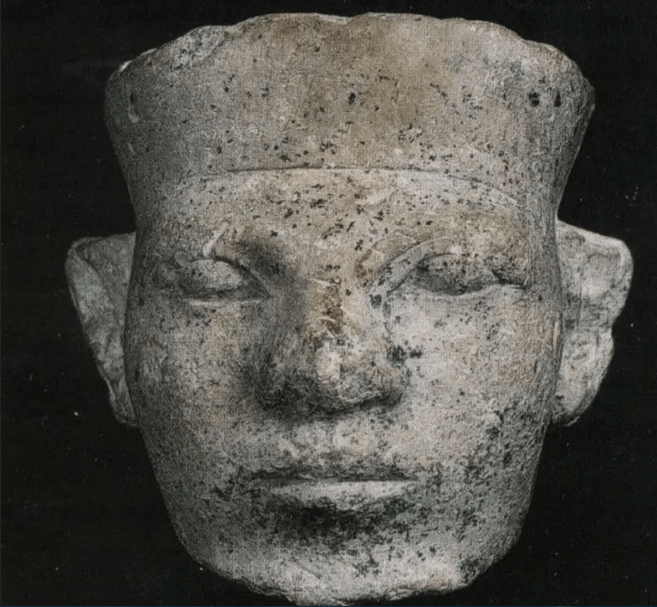
Pharaoh Menes was the first or second pharaoh of the 1st dynasty of Ancient Egypt. There are many theories and conjectures about the personality of Menesbut he can be perceived as the son of the pharaoh Narmer or Narmer himself – this fact is not exactly established. The name Menes was first mentioned one and a half millennia after his alleged reign in the temple of the woman-pharaoh Hatshepsut, where it is written next to her name. Mena (Menes) acts as the founder of Egypt, from which all the pharaohs lead. In the Turin list, his name pops up twice: once as an ancestor of the pharaohs then as dead pharaoh. Thus, they began to consider him as the first human ruler of the country after the era of the gods, who directly received power from the hands of the Choir. pharaoh menesMenes appears even in the annals of Herodotus and Manetho, in Greco-Roman novels. It is noteworthy that the early royal annals and lists do not mention a pharaoh with that name. Some scholars believe that Menes is the pharaoh of Narmer or Hor-Aha, since the terms of their reign coincide, moreover, in the annals of the Manetho, he is listed as the unifier of Upper and Lower Egypt, which Narmer is considered to be. The question remains open to this day. Some scholars reject the fact that he existed. By the middle of the 1st-millennium, mythical information about Menes turned him into a cultural hero in the memory of the Egyptians. The myth of Menes entered the Greeklater Roman historical tradition, Herodotus, Diodorus, Manetho, Pliny the Elder, Plutarch, and Elian have messages about it. He is credited with the foundation of Egyptian statehood by uniting the warring kingdoms of Upper and Lower Egypt and in particular the foundation of Memphis, the establishment of cults, and the invention of writing.When did Pharaoh Menes become PharaohIt is not entirely clear when Pharaoh Menes became the Pharaoh of Egypt. According to the late Egyptian and ancient traditions, Pharaoh Menes was an experienced military leader and an energetic politician. Apparently, he subjugated Lower Egypt and merged both kingdoms, thus completing the long process of centralization of Egypt. His hometown was Tin, in Upper Egypt,but he did not lie close enough to the Delta to serve as his residence. Therefore, in this case, we can believe Herodotus, who claims that Menes carried out a large embankment, rejected the Nile, and built the Inebu-hedge fortress, which became the royal residence. A sanctuary was built south of the wall to the local god Ptahwhich remained the patron god of this city throughout its ancient and long history. On the day of its discovery, Pharaoh Menes first performed the symbolic rites of the union of papyrus (symbol of the north) and lotus (symbol of the south). He crowned himself with white and red crowns, introduced the title “King of Upper and Lower Egypt”. Until the end of Egyptian civilization, they had the corresponding title, repeated this ritual at their coronation. One legend, drawn on a stone stele in the temple of Amon at Thebes at the order of Tefnaht, cursed Menes for changing the lives of the Egyptians for the worse, surrounding himself with luxury and splendor. According to another legend, Pharaoh Menes established the order of worship and temple rites. His name was also associated with the idea of ​​the first legislator, the installer of cults. The historical tradition that tells of the first Egyptian pharaoh was retold by Diodorus, but his narrative is fabulous and therefore has very dubious value. According to this ancient author, the king, hunting in Fayyum, was suddenly attacked by his own hunting dogs and escaped only because he rushed into the lake, where there was a Nile crocodile that carried him to the opposite bank. In order to mark this supernatural salvation, he built a city in that place and dedicated the lake to a crocodile. Diodorus also reports that the king built himself a pyramid in its vicinity and that the Egyptians first learned from this king how to worship the gods and live in a cultural manner; the latter, perhaps, is a peculiar echo of his activity to pacify the country after a long period of anarchy and bloodshed during the struggle for unification. George Stanley Faber in 1816 based on this story of Diodorus interpreted the word campsa as “ark” instead of “crocodile” and identified the Egyptian Menes with Noah and the history of the Flood. According to the Manetho, quoted by African, the great king died in the 63rd year of his reign from wounds inflicted by a hippopotamus during a hunt. This story no longer seems as incredible as the previous one, for we know that the hippo hunt was a popular entertainment that the ancient Egyptian kings allowed themselves to. It is possible, however, that this story and the story of Diodorus are just two versions of the same legendary plot.
Sources:

History of the Ancient East. The origin of the oldest class societies and the first foci of slave civilization. Part 2. Jürgen von Beckerath. Handbuch der ägyptischen Königsnamen. – München: Deutscher Kunstverlag, 1984. Mina, Egyptian Pharaoh // Encyclopedic Dictionary of Brockhaus and Efron : in 86 volumes Menes // The Real Dictionary of Classical Antiquities

The Lost Sarcophagus – التابوت المفقود

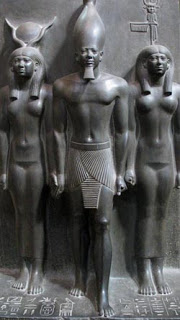
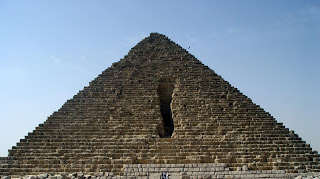
The Lost SarcophagusThe sarcophagus of the Fourth Dynasty pharaoh Menkaura is one of history’s vanished treasures, lost in 1838 when the ship transporting it to the British Museum sank, probably in a storm.After one hundred and sixty-eight years, questions are still being asked about the loss and where exactly the ship sank.It was the autumn of 1838 when the English merchant ship Beatrice set sail from Malta bound for the port of Liverpool. She never arrived. The news of the loss of the ship was reported in Lloyd’s ‘Loss and Casualty Book’.The entry for Thursday, 31st January 1839 reads: “Beatrice, Wichelo, [the skipper of the vessel], sailed from Alexandria 20th Sept. & from Malta, 13th October for Liverpool, & has not since been heard of”.The vessel, it seems, had simply vanished, and along with it disappeared one of history’s priceless and unique relics –the sarcophagus of the Fourth Dynasty pharaoh Menkaura, builder of the third pyramid at Giza,who ruled more than four thousand years ago.Today, the story of the Beatrice and the lost sarcophagus is only mentioned in passing, a footnote in the history books about ancient Egypt. Somewhere the sarcophagus, almost forgotten, rests on the seabed.But in early June 2008news broke that Dr Zahi Hawass, secretary general of the Supreme Council of Antiquities, had approached the National Geographic Society to fund a search from the sarcophagus off the Spanish coast near the port of Cartagena.The Egyptian Ambassador in Madrid had met Spanish officials this month to seek their co-operation in the search, it was claimed.It was further reported that American ocean explorer Robert Ballard, famous for his discovery of the sunken R.M.S.Titanic and who is president of the Institute for Exploration, scientist emeritus from the Woods Hole Oceanographic Institution, and director of Institute for Archaeological Oceanography at the University of Rhode Island, has been approached to lead the search. Both Dr Hawass and Dr Ballard are ‘explorers-in-residence’ with the National Geographic Society.Dr Hawass told the Cairo-based newspaper Al-Ahram Weekly (29th May – 4th June)that old maps and newspaper reports have helped pinpoint the wreck off the Spanish city of Cartegana. And in The Times (14th June) quoted Dr Hawass as saying:“I will seek a formula for co-operation with the Spanish Government and we will agree to return the sarcophagus to Egypt.”Salvage – even if technically possible given the logistical difficulties and cost – of the Beatrice and her cargo will present a legal minefield about ownership of the wreck and cargo. This was a British ship carrying Egyptian artefacts now lying in Spanish territorial waters.Hawass believes the sarcophagus was removed from Egypt illegally. “Stolen by the British in 1837,”he maintains (The Spectator, 17th May 2006).Academics, Egyptologists and historians have put forward various locations for the loss of the Beatrice.


Ernest A. Wallis Budge (The Mummy, 1893) wrote:“The stone sarcophagus of Mycerinus, of which only a small fragment has been preserved (B.M. No. 6646), and parts of the coffin and mummy, were lost by the wreck of the ship in which they were being brought to England, on the Spanish coast, on the western side of the Straight of Gibraltar. ”German Egyptologist Heinrich Brugsch-Bey (Egypt Under the Pharaohs, 1902), more or less agrees with Budge. This “valuable memorial of antiquity, ship and cargo sank to the bottom of the sea off Gibraltar.”American Egyptologist Bob Brier (Egyptian Mummies, 1996) says: “The sarcophagus, a masterpiece of Old Kingdom workmanship, was sent to the British Museum in 1838 on the merchant ship Beatrice. The ship stopped at Malta for supplies and then left that port on October 30, 1838, and neither the ship nor its precious cargo were seen again. It sank in deep water somewhere near Cartagena.” And in a later book (The Encyclopedia of Mummies, Checkmark Books, 1998) he reaffirms this: “The Beatrice sank in deep waters somewhere near Cartagena. ”Peter France (The Rape of Egypt, Barrie & Jenkins, 1991) suggests: “The sarcophagus “was lost off Carthagena in October 1837, and today remains on the seabed with its ancient cargo.”Christine Hobson(Exploring the World of the Pharaohs, Thames and Hudson, 1994)opts for a wreck site even farther a field. Beatrice sank in the Bay of Biscay, north of Spain, she writes.And then we come to the Italian scientific journalist and photographer Dr Alberto Siliotti(The Pyramids, George Weidenfeld, 1997)who tells us intriguingly:“The basalt sarcophagus was later lost when the ship taking it to England sank in the Mediterranean off the coast of Spain, in an area only recently identified.” Just one year later Dr Siliotti(Egypt Lost and Found, Thames and Hudson, 1998) writes that the sarcophagus “was sent to the British Museum, but never arrived because the ship that was carrying it sank in a storm off the Tuscan coast. ”Peter A. Clayton(Chronicle of the Pharaohs, Thames and Hudson, 1994, reprinted 1999):The “ship carrying the sarcophagus sank in a storm in 1838 shortly after leaving Leghorn. Efforts made in recent years using highly sophisticated technical equipment have failed to locate the ship.”Nicholas Reeves (Ancient Egypt: The Great Discoveries, Thames and Hudson, 2000) says: The “exquisite” basalt sarcophagus was “subsequently lost at sea, either off Malta or close to Cartagena, when the ship carrying it to England sank.”Salima Ikram and Aidan Dobson(The Mummy in Ancient Egypt, Thames and Hudson, 1998),describe the sarcophagus as “perhaps the finest of all sarcophagi with this decorative scheme”.They add:“Regrettably, we can only appreciate its quality from nineteenth-century engravings, for it was removed from the burial chamber under the Third Pyramid at Giza in 1837 and lost at sea off the Spanish coast. ”
Timothy R Roberts(Gift of the Nile, Metro Books, 1999) says:“The basalt sarcophagus bore designs on the outside that represented a temple.” And then he adds a twist: “Unfortunately, this magnificent container fell overboard off the coast of Spain while being transported to the British Museum. It was never recovered, and we only know what it looks like because some curious observer had made a sketch.”


So suggestions as to the wreck site include: somewhere off Gibraltar; between Malta and Spain; off the Spanish port of Cartagena;off the Tuscan coast of Italy; and the Bay of Biscay. They cannot all be right.
The story of the Beatrice and the lost sarcophagus needs to be placed in context of what was happening in Egypt and England in 1838. Queen Victoria had just succeeded to the English throne and Egypt, ruled by the Turks, was a land ravaged by plague and the plundering of its antiquities, as well as being of great strategic importance to the expansionist plans of competingEuropean powers.
Into that world came Richard William Howard Vyse (1784-1853), soldier, politician and explorer. It was he who led the expedition to enter the pyramids of Giza, including that of Menkaura. His use of gunpowder as an excavation tool on the pyramids has earned him much condemnation by modern scholars.
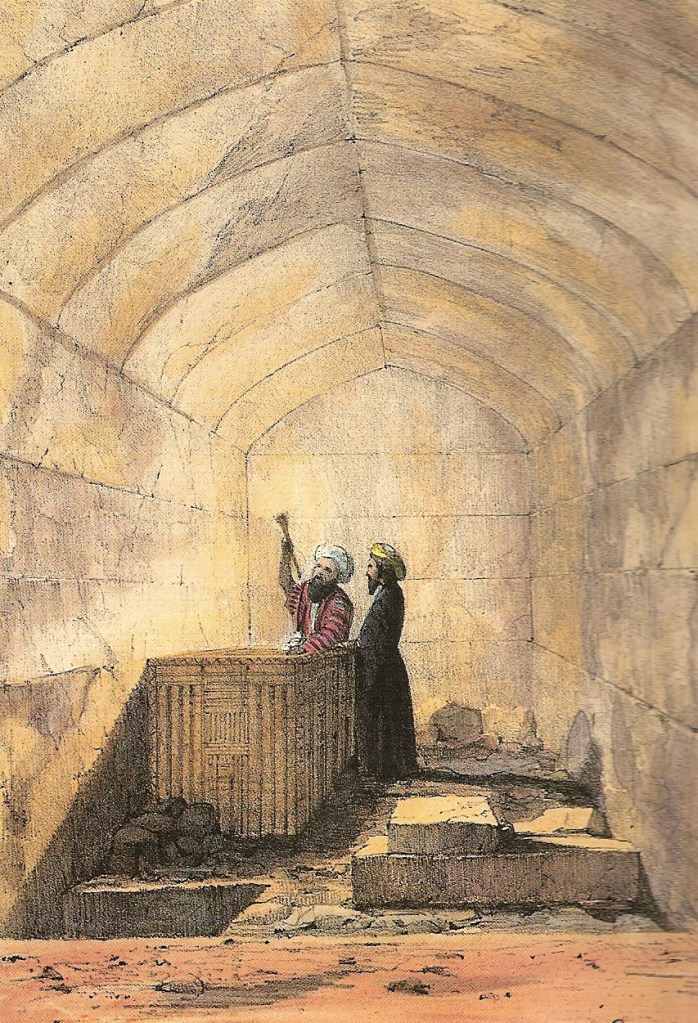
In 1840, Vyse’s book Operations Carried on at the Pyramids of Gizeh in 1837 (James Fraser, London) was published. In it Vyse describes finding the sarcophagus of Menkaura in what he called the “sepulchral chamber”, now generally referred to as the permanent burial chamber. The container “was entirely empty, and composed of basalt, which bore a fine polish of a shaded brown colour, but was blue where it had been chipped off or broken,” he wrote.
Besides sand, stones, rubbish and assorted débris, Vyse noted that there was a “black dust” in the chamber, which he put down to insect and bat droppings.The dung of large birds – probably vultures, thought Vyse – “appeared in many places, particularly on the sarcophagus, and seemed to have been there for many years.”(It is hard to imagine vultures inside the pyramids, so ornithology might not have been one of Vyse’s skills.)
Vyse thought that “some sharp substance”, such as emery powder, had been used in constructing the sarcophagus, and it appeared to have been sawn. This, he thought, was “remarkable, as the art of sawing marble was not known as Roman till a late period.”
The sarcophagus lid had been originally fixed in place by two pins, and also by a dovetail. Vyse said that a plate of metal seemed to have been applied “so carefully underneath it, that in order to insert a lever for its removal, it had been found necessary to cut a groove across the rim of the sarcophagus.”The stone sarcophagus was eight feet long and three feet one inch wide. Its height was two feet eleven inches. The inside dimensions were six feet five inches long, two feet and one half an inch wide and two feet and one half inch deep.Vyse estimated its weight at nearly three tons.
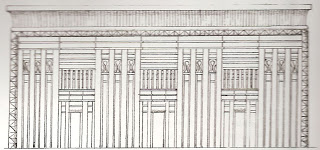
There was no inscription or hieroglyphs, but it had finely carved decoration in a style Egyptologists refer to as ‘palace-façade motif ’. The lid was broken and pieces of it were found in the burial chamber and elsewhere in the pyramid.
The burial chamber was twenty feet eight inches in length on it north-south axis with an east-west breadth of eight feet seven inches. The height was eight feet nine inches at the sides, rising to eleven feet three inches at the centre. Originally placed in the centre of the chamber, Vyse thought that at some stage in antiquity the sarcophagus had been moved, for, as can be seen in the illustration below, it was found against one wall of the burial chamber. Perhaps it was moved by robbers who thought that it might have concealed treasures buried beneath it?


“As the sarcophagus would have been destroyed, had it remained in the pyramid, I resolved to send it to the British Museum,” wrote Vyse. Just why he thought it would have been destroyed remains a mystery, but this was often a convenient (and sometimes valid)excuse at this period to remove objects.
By 9th August, Vyse was in Alexandria preparing forhis return voyage to England. He sent a message to colleague Henry Raven, still working at the pyramids, ordering him remove the sarcophagus, a task which Vyse later admitted, was “not trifling”. On 27th August, Vyse sailed for Malta on the first leg of his journey home to England.Meanwhile, inside the pyramid one of the ramps in the inclined passage had to be removed in order to getthe sarcophagus into a larger space, where it was placed upon wheeled trucks. Blocks in the anteroom were also removed in order to get the sarcophagus to the bottom of the entrance passage.
Using sheer muscle power and a ‘crab’ erected at the mouth of the pyramid, the stone casket was hauled up the passage, but the going was not easy. Half way up, the truck on one side of the sarcophagus gave way. Space was too tight to allow any repairs. Now the sweating labourers resorted to using levers to lift the sarcophagus up the passage. At last this “arduous undertaking” was over and the sarcophagus was safely hauled out of the pyramid into daylight for the first time in over four thousand three hundred years. It was then placed on a carriage and with planks of wood positioned beneath the carriage wheels, the sarcophagus was pulled over the rocks and sands to the expedition’s tents. Later the sarcophagus was “cased with strong timbers” and sent to Alexandria, presumably by boat along the Nile, although Vyse gives no details of this operation.Vyse made only one reference to the loss of the sarcophagus.“It was embarked at Alexandria,” he wrote,“in the autumn of 1838 on board a merchant-ship, which was supposed to have been lost off Carthagena, as she was never heard of after her departure from Leghorn on the 12th October in that year, and some parts of the wreck were picked up near the former port.”The loss of the sarcophagus was not exactly a loss to everyone, for in June 1839 the British Museum received a payment of £148 10s. 0d. from an insurance claim on the transport of the sarcophagus. At today’s prices thatwould be around £10,000.
At the time Vyse was in Egypt, everything found at the Pyramids, and indeed at any other site, was acknowledged to be the property of the ruling Pasha, and it is not clear what permission Vyse had for the removal of items; butthere was an established routine for obtaining the requisite permissions, which one must assume that Vyse might havefollowed. Two lists exist(published in Vyse’s book),one naming items to be sent to England(mostly bits and pieces, historically interesting and valuable, but not spectacular),and the other of items to remain in Egypt(again mostly bits and pieces, historically interesting and valuable, but not spectacular).Interestingly the sarcophagus does not appear on either list.The sarcophagus was clearly a well known and important object and its arrival in Britain was eagerly awaited. The British Museum’s Egyptian collection was growing impressively at this time.In 1824, Rev. Josiah Forshall (1795-1863)was appointed Assistant Keeper of Manuscripts at the British Museum. In a letter to Forshall from British Consul Patrick Campbell, written in Alexandria and dated 2nd July 1838, the following, passage occurs: “I beg to inform you that the sarcophagus taken by Colonel Vyse out of the 3d. Pyramid at Ghizeh, and which in your letter to Viscount Palmerston of 7th February last you requested His Lordship to instruct me to send to England, has this day been embarked on board of the English ship the Beatrice, bound forLiverpool and LondonThe Beatrice was a type of vessel known as a snow. These were two-masted European merchant ships used between the sixteenth and nineteenth centuries. As well as having large square sails on both masts, a snow carried a small triangular sail behind the mainmast.The term snow is derived, apparently, from the Dutch word snaauw, meaning snout, a reference to the bluff shape of the ship’s bows.These sturdy vessels had U-shaped hulls which maximised their cargo carrying capacity. The largest snows could be up to one thousand tons, although the Beatrice was small, at 224 tons.Built in Quebec in 1827, her overall length was 87 feet 9 inches and her breadth 24 feet 2 inches. The hold had a depth of 15 feet 1 inch. Carvel-built(the planks of the hull fitted to the ship’s frames with no overlap, giving the ship smooth sides)she was square-rigged, squaresterned, had a standing bowsprit, sham quarter galleries and the bust of a woman for a figurehead. In 1830, she had been registered to the Port of London. Lloyd’s Register for 1838 and records show her stated voyage was between Liverpool and Alexandria.Her master and co-owner was Richard Mayle Whichelo, or according some sources, Wichelo. Born in Brighton, Sussex, on the south coast of England, he was about fifty-two in 1838. In 1805, he had served on the hundred-gun First Rate ship, H.M.S. Britannia, as a clerk at the Battle of Trafalgar and had been awarded the Trafalgar Medal.From copies of Lloyd’s List between 1830 and 1838, it is possible to chart the Beatrice’s voyages between England and Egypt. Her route was always between Liverpool and Alexandria. Regular ports of call included Gibraltar,Leghorn, Genoa, Civita Vecchia and Malta.
From Lloyd’s List we know that on 20th September 1838, Beatrice left Alexandria’s harbour, ultimately bound for Liverpool. If she sailed with a full complement of crew, there were about twenty men and boys aboard, on a journey and route they should all have known well. From this point the vessel’s movementsbecome hard to track with any degree of certainty.Vyse says the Beatrice visited the Italian port of Leghorn and departed on 12th October, and that wreckage was later spotted off the Spanish port of Cartagena. Lloyd’s List, on the other hand, records the Beatrice as being hundreds of miles to the south of Leghorn, leaving Malta on 13th October. Clearly it is impossible for Beatrice to have left Leghorn on the 12th, to arrive in Malta on the 13th and sail back to the Spanish coast in a day or so.It is in this confusion of ‘facts’ that the Beatrice and Menkaura’s sarcophagus disappear, the victim, perhaps, of a sudden storm. It is often assumed that the Beatrice vanished along with her crew, but this may not betrue. The Beatrice’s skipper definitely survived.
Despite, Lloyd’s List stating that the Beatrice and Whichelo sailed from Alexandria on its last, fateful journey on 20th September 1838, the truth is that Whichelo was not on board. We know that he died in 1858; so why was he not on board his own vessel when it sailed? This question will probably never be answered. We do know that twenty days after Beatrice sailed, on 10th October, Whichelo boarded H.M. Steamer Blazer as a passenger in Alexandria bound for Malta.This nugget of information was reported in the Malta-based newspaper Il Mediterraneo. On 14th October, the Blazer and Whichelo docked in Malta – just one day after the Beatrice had sailed. Presumably, if Whichelo remained on board the Blazer, he would have arrived home in England in late October or early November.There the story would end, were it not for the fact that in recent years many people have said that they believe they have solved the ‘mystery’ of the lost sarcophagus, or at least think they know where the vessel might be found.
Spanish Egyptologist Esteban Llagostera Cuenca is convinced that he knows where the Beatrice sank. In an interview with the Spanish magazine La Clave (10-16th Jan. 2003) he says the Beatrice sank off the Spanish coast near Cartagena and that he has researched the loss of the vessel in Italy, Egypt, Cartagena and in London.
Among the claims he makes are that the Beatrice sailed under an Italian flag, but cites no source for this statement. He further claims a movement of the ship’s cargo caused the vessel to sink and that Lloyd’s sent inspectors to Cartagena. He says the crew survived and swam ashore and, because they were able to do this, he estimates the wreck could be no more than a mile offshore.
The Professor hints that the wreck now lies within the sea-access routes of a Spanish submarine base, and that any search in a military zone has been vetoed.
The writers say Vyse chartered two ships to return his ‘booty’ to England, the sarcophagus being loaded on the Beatrice. After leaving Alexandria, the ship visited Cyprus where she experienced problems with moving cargo. The authors add that there was another rumour that the sarcophagus was disembarked on the island, but dismiss this as unlikely.On 13th October, a sudden and violent storm hit the Beatrice as she neared the Spanish coast. The captain decided to maintain a course for Cartagena but hit rocks that ripped open the wooden hull. The crew were saved, but the cargo was lost. Despite the survival of the crew, it seems no one was able to know the exact location of the wreck. However, it is rumoured that a local diver in Cartagena has discovered the location of the wreck in the entrance to the harbour. He has even recovered a small bell from the vessel. The precise location of the ship remains his jealously guarded secret.There is also another intriguing question about the Beatrice:what else was in its hold. It is surely unlikely that the sarcophagus was the only antiquity onboard.
Dr Ivan Negueruela of Spain’s National Museum for Maritime Archaeology in Cartagena, told the Spanish newspaper Laverdad (6th June): “The sarcophagus is somewhere on the coast between Cabo de Palos and Mazarrón.”
It is, he said “very important”, but then he adds intriguingly: “so are other objects that are at the bottom of the sea with it. Yes, there may be some surprises.”
The “surprises”, suggests the article, include 200 boxes of antiquities, containing funerary, pink granite sphinxes and gold pieces.
Whether there is any truth in any of these stories, or whether they are the fanciful tales that inevitably get attached to rumours of lost treasure, remains unknown.
If a search is indeed made, it will certainly not be easy, even using the latest technology. International maritime courts might be needed to determine who legally ‘owns’ the sarcophagus: Britain, Spain, Egypt or theinsurance company.
Time has wrapped the story of the lost sarcophagus in romance, rumour and conjecture, fuelled by the prospect of recovering an amazing treasure. It is clear, from the few images that have survived, that the sarcophagus is a splendid item and of course historically important too. Will it ever be recovered from its watery grave? Only time will tell.

5 Ancient Egyptian Cosmetics

Egyptian men wore primitive eyeliner.
The ancient Egyptians fascinate us. Our modern culture devotes museums, books and movies to the study and celebration of Egyptian society and traditions. From King Tut mania to Elizabeth Taylor’s Cleopatra, we’re obsessed. This is likely because they left behind so many well-preserved artifacts and we have so much to sift through and admire.
One facet of the ancient Egyptian culture we find particularly interesting is their use of makeup. Even for the afterlife, the Egyptians found cosmetics important. It’s not uncommon for archaeologists to find small clay pots of makeup in even the most humble tombs. Yes, beauty was important to the Egyptians, but makeup served another purpose. Some of their beautification rituals also helped protect them from the elements — repelling insects or warding off the sun’s burning rays. Many times, the application of makeup also served as a ritual to honor their gods or goddesses.
So what sort of makeup and beauty items did our ancient Egyptian friends favor?
How do our cosmetics today compare?
Keep reading to find out.

5: Eye Paints
Probably the most distinctive look among the ancient Egyptians is the eye paint. The Egyptians used both black and green paints to decorate the area around their eyes. The black eye paint came from powdered galena (a type of crystal rock). Today, we call the galena powder kohl. The dark lines around the eyes helped protect them from the sun — similar to why today’s football players put black smudges under their eyes during play.
The green came from malachite powder
(an emerald-colored mineral). Interestingly, scientists later found that the malachite powder actually helped protect the eyes from infection — another good reason to wear this makeup
To make the paints, Egyptians would powder the minerals on a palette and then mix them with something that would help the color adhere to the eye. Researchers believe they used ointments made from animal fat, judging from what’s been discovered in ancient tombs. Egyptians applied this eye paint using either a finger or a custom applicator — usually a little stick of bone or wood.
Rich Man, Poor Man
In ancient Egypt, everyone wore makeup. However, you could tell who was rich and who was poor by the quality of their applicators and pots. Wealthy people typically had ivory applicators and jeweled containers. Poor people used clay pots and small sticks to apply their eye makeup.

4: Perfumes
Perhaps because fragrance was so abundant in Egypt — from scented flowers along the Nile to imported oils and tree resins — the ancient Egyptians created a lot of perfume.
Their tastes ran toward things like frankincense, myrrh, cassia and cinnamon. Artisans would distill these with oils or fats to extract the scent. Using a method called enfleurage, they would soak flowers, resins or roots in layers of fat. After a while, they’d have lumps of scented creams or pomades. Egyptians would actually wear these pomades in the shape of a cone on the tops of their heads. As the day or evening progressed, the pomade began to melt and fragrant oil would run down the face and neck, scenting the hair and body.In another process called maceration, Egyptians heated oil or fat to 149 degrees Fahrenheit (65 degrees Celsius). They added flowers, herbs or fruits to the hot mixture and then ran it through a sieve. After allowing the mixture to cool, they shaped it into cones or balls. This is the sort of solid perfume we still use today.These oils also protected the skin against harsh elements like sun and sand.

3: Soaps
In addition to perfumes, ancient Egyptians also used soaps. They believed that an unclean body with unpleasant odors was undesirable and impure. The soaps they used were not like the bars or body washes we use today. Many of these soaps were a paste of ash or clay, mixed with oil, sometimes scented. This resulted in a material that not only cleaned the body, but also soothed any skin disease or damage. The reason these soaps helped heal the skin was that the Egyptians often used olive oil for their cleansing rituals. Olive oil provides many benefits to the skin and body. It moisturizes and nourishes the skin, rather than drying it out — something very important in a dry climate like Egypt. Also, olive oil contains polyphenols. Polyphenols can actually help the skin recover from sun damage and stress.More wealthy Egyptians had several washbasins and water jugs at their disposal. Mixing sand in jugs filled with water and salt helped scour the body clean.Soap Trick- Ancient Egyptians also used soaps to prepare wool for weaving, making it more pliable and easier to work with.

2: Body Oils
The blistering sun and windswept sands of ancient Egypt caused dry skin, burns and infections for its people. Because of this, skin care was an important regimen for the Egyptians. Body oils were so central to their well-being that workers actually received them as part of their wages. Both men and women used moisturizers on their skin to protect it from the arid climate. Sometimes people used honey on their skin — both for the fragrance and its ability to hydrate. Additionally, evidence shows that women sometimes used oil to remove stretch marks after pregnancy. And men rubbed certain oils on their heads to stimulate hair growth or ward off baldness. Not so different from today!
Although oils were a necessity for day-to-day living, the addition of fragrance transformed them into luxury items. The most valuable oils were those blended with flowers and other scents. The ancient Egyptians even anointed statues of their gods with aromatic oils to honor them.
It Does a Body Good
Some historians claim that Cleopatra’s secret to supple skin and youthful glow was bathing regularly in the milk of donkeys

1: Henna
Still used today for body decoration and hair coloring, henna is a natural dye. It comes from the dried leaves of a shrub called Lawsonia inermis. Its leaves are green, but after drying and crushing, they form a deep orange-red powder. The powder is mixed with water to form a paste. Henna is a temporary dye and lasts on the skin or hair for several weeks before fading away.Archaeologists report discovering traces of henna on the fingernails of mummified pharaohs. The henna not only decorated the nails of these members of royalty, but conditioned them as well. Henna, as well as being decorative, has medicinal properties. Physically, Egyptians felt henna improved the quality of hair and nails. Spiritually, they believed henna provided good fortune. This belief still holds true in many parts of the world — for example, the henna ritual for brides of many cultures. Both women and men also used henna to stain their lips a deep red. Cosmetics companies offer henna-based lip stains even today, touting the long-lasting effects of the natural dye.
Sources
“Ancient Egyptian Beauty Aids.” EMuseum at Minnesota State University. April 29, 2009. (Oct. 30, 2009) http://www.mnsu.edu/emuseum/prehistory/egypt/dailylife/beautyaids.html
“Ancient Egyptian Hairstyles.” EMuseum at Minnesota State University. April 29, 2009. (Oct. 30, 2009) http://www.mnsu.edu/emuseum/prehistory/egypt/dailylife/hairstyles.html
Conger, Cristen. “Why did ancient Egyptian men wear cosmetics?” HowStuffWorks.com. April 28, 2009. (Oct. 30, 2009) https://history.howstuffworks.com/ancient-egypt/ancient-egyptian-cosmetics1.htm
Dollinger, Andre. “Personal Hygiene and Cosmetics.” An Introduction to the History and Culture of Pharaonic Egypt. 2009. (Oct. 30, 2009) http://www.reshafim.org.il/ad/egypt/timelines/topics/cosmetics.htm
“Eye paint.” The Global Egyptian Museum. 2009. (Oct. 30, 2009) http://www.globalegyptianmuseum.org/glossary.aspx?id=151
Filer, Joyce. “Health Hazards and Cures in Ancient Egypt.” BBC History. Nov. 1, 2002. (Oct. 30, 2009) http://www.bbc.co.uk/history/ancient/egyptians/health_01.shtml
Illes, Judith. “An Introduction.” Tour Egypt Monthly. June 1, 2000. (Oct. 30, 2009) http://www.egyptmonth.com/mag06012000/mag4.htm
Illes, Judith. “Ancient Egyptian Eye Makeup.” Tour Egypt Monthly. Sept. 1, 2000. (Oct. 30, 2009) http://www.touregypt.net/magazine/mag09012000/mag4.htm
Illes, Judith. “Henna.” Tour Egypt Monthly. Jan. 1, 2000. (Oct. 30, 2009) http://www.touregypt.net/magazine/mag01012001/mag4.htm
Illes, Judith. “Perfumes of Ancient Egypt.” Tour Egypt Monthly. Aug. 1, 2000. (Oct. 30, 2009http://www.touregypt.net/magazine/mag08012000/mag4.htm
“Olive oil polyphenols and antioxidants.” The Olive Oil Source. Aug. 20, 2007. (Oct. 30, 2009) http://www.oliveoilsource.com/oliveoildr-polyphenols.htm
Ruiz, Ana. “The Spirit of Ancient Egypt.” Alogora Publishing. Sept. 2001. (Oct. 30, 2009)

How the Rosetta Stone Works

Ancient Egypt conjures up ima­ges of bearded ­pharaohs,
mighty pyramids and gold-laden tombs. Centuries ago, before archaeology became a legitimate field of science, explorers raided Egyptian ruins, seizing priceless artifacts. Collectors knew that t­hese items were valuable, but they had no way of understanding just how much they were worth. Because the civilization’s historical records and monuments were inscribed with hieroglyphics, a language no one — Egyptian or foreigner — could read, the secrets of Egypt’s past were hopelessly lost. That is, until the Rosetta Stone was discovered.
The Rosetta Stone is a fragment of a stela,
a free-standing stone inscribed with Egyptian governmental or religious records. It’s made of black basalt and weighs about three-quarters of a ton (0.680 metric tons).
The stone is 118 cm (46.5 in.) high, 77 cm. (30 in.) wide and 30 cm. (12 in.) deep —
But what’s inscribed on the Rosetta Stone is far more significant than its composition. It features three columns of inscriptions, each relaying the same message but in three different languages: Greek, hieroglyphics and Demotic. Scholars used the Greek and Demotic inscriptions to make sense of the hieroglyphic alphabet. By using the Rosetta Stone as a translation device, scholars revealed more than1,400 years of ancient Egyptian secrets
The discovery and translation of the Rosetta Stone are as fascinating as the translations that resulted from the stone. Controversial from the start, it was unearthed as a result of warfare and Europe’s quest for world domination. Its translation continued to cause strife between nations, and even today, scholars debate who should be credited with the triumph of solving the hieroglyphic code. Even the stone’s current location is a matter of debate. This artifact has long held a powerful grip over history and politics.
Since 1802, the Rosetta Stone has occupied a space in London’s British Museum. While most visitors acknowledge the stone as an important piece of history, others are drawn to it like a religious relic. The stone is now enclosed in a case, but in the past, visitors could touch it and trace the mysterious hieroglyphics with their fingers.
In this article, we’ll learn how the world came to regard this piece of stone as a harbinger of Egypt’s secrets.
We’ll also discuss its history and the circumstances surrounding its discovery, as well as the long and difficult task of deciphering the Rosetta Stone’s inscriptions. Last, we’ll examine the field of Egyptology and how it evolved from the Rosetta Stone.
We’ll begin with the history of the Rosetta Stone in the next section.

  • The message recorded on the Rosetta Stone isn’t as significant as the languages in which it’s written. The stone is dated March 27, 196 B.C., and is inscribed with a decree from Egyptian priests endorsing the pharaoh as a good, humble ruler and respectful worshipper of the Egyptian gods
    Written beneath the decree is a mandate on how the message should be shared: Clearly, the priests wanted to get the word out because they ordered that it be written in three languages and carved into stone.
    In itself, the Rosetta Stone is no more remarkable than the other stelae of its time. But its preservation helps us to understand Egypt’s past as well as shifting powers during the Greco-Roman period when Egypt was ruled by the Macedonians, Ptolemies and the Romans. The pharaohs, of whom Cleopatra was the last, would be succeeded by Coptic Christians, Muslims and Ottomans from 639 to 1517 A.D.
    These fundamentally different rulers caused changes in all aspects of Egyptian life, and the most apparent evidence of these changes can be found in the written language. New rulers brought new religions, and the old gods were replaced by new ones. As a result, the most sacred of all writing, hieroglyphics, was replaced, too.
    For centuries, Egyptians recorded their history in hieroglyphics. Hieroglyphics were sacred characters reserved for religious or governmental mandates. The language was used to inscribe tombs, temples and other monuments. Because hieroglyphics was such an intricate and sacred language, the Egyptians developed hieratic, which was like an abbreviated version of hieroglyphics. Hieratic was used to record some governmental decrees and business transactions, but it wasn’t used for sacred purposes.
    By the Ptolemaic Period, when the Rosetta Stone was inscribed, Egyptians had turned to Demotic — an even more simplified version of hieroglyphics. When the priests commissioned the decree on the Rosetta Stone to be written in three languages, they ensured that all of Egypt would be able to read it
    And until the fourth century A.D., the Rosetta Stone was perfectly readable. But as Christianity became more widespread in Egypt, hieroglyphics was abandoned for its association with pagan gods. Demotic wasn’t a taboo language like hieroglyphics, but it eventually evolved into Coptic. Coptic was based off of the 24 letters in the Greek alphabet as well as a few Demotic characters for Egyptian sounds that weren’t represented by the Greek language.
    When Arabic replaced Coptic, the last frayed thread to hieroglyphics finally snapped. More than a thousand years of Egyptian history became lost in translation. Egypt made way not only for a new language but also for new politics and religion. The sacred temples inscribed with hieroglyphics no longer had any meaning for the Egyptians or their new rulers, and they were stripped bare and demolished to obtain raw material for new buildings. Among this rubble was the Rosetta Stone, which was rebuilt into a wall.
    The Rosetta Stone would later be resurrected as that civilization came down and a new one erected in its place. Only then would its significance be realized. In the next section, we’ll learn about the events leading up to the Rosetta Stone’s discovery and the lucky accident that revealed the stone.
    Discovery of the Rosetta Stone
    In the late 18th century, Napoleon Bonaparte launched the Egyptian Campaign. The purpose of the campaign was to claim Egypt[ for France — colonizing the country would give France a greater authority in the East
    Strategically, this would prepare France for domination over the most valuable territory in the East: India. Napoleon strategized that cutting off Britain’s access to the Nile River would cripple British troops and their Eastern settlements.
    Napoleon didn’t just plan a military attack. He prepared for a thorough infiltration of Egypt by assembling a think tank whose job it was to gather information about Egypt’s past and present people, environment, culture and resources. Napoleon shrewdly reasoned that to rule a country, one must know everything about it. He called his scholarly squadron the Institute of Egypt, also known as the Scientific and Artistic Commission. It included mathematicians, chemists, mineralogists, zoologists, engineers, illustrators and art historians
    Its purpose was highly covert, and members were ordered to reveal nothing more about their work than that they were acting for the good of the French Republic.
    Napoleon and his forces landed off the coast of Egypt at Aboukir Bay in August 1798. The British navy crushed the French and destroyed all of Napoleon’s ships. The French were stranded in Egypt for 19 years
    Making the best of a bad situation, the French settled in around the Nile Delta. While the military built forts and conducted reconnaissance, the Institute collected artifacts, explored ruins and became acquainted with the local population. The palace of Hassan-Kashif was overtaken as the Institute’s headquarters. Royal rooms were converted into libraries, laboratories and even menagerie — where harems once danced and entertained, local fauna grazed under scrutinizing eyes.
    In the summer of 1799, Napoleon’s soldiers razed ancient walls to expand Fort Julien in the town of Rosetta. A soldier noticed a polished fragment of carved stone. Pulling it from the rubble, he recognized that it might be something significant and handed the stone over to the Institute.
    The Institute’s scholars determined that the stone was some kind of decree and immediately began translations, a long and tedious process. Scholars named the stone the Rosetta Stone, in honor of the town in which it was discovered. They had the foresight to make several copies of the inscriptions, which served them well after the British acquired the stone — along with several other artifacts — under the terms set forth in the Treaty of Capitulation .
    Both the French and the British knew they had something valuable on their hands, but it would take years to crack the code inscribed on the Rosetta Stone. Only then would its true worth be revealed.
    Next, we’ll learn about the struggle to decipher the Rosetta Stone.
    The Institute of Egypt
    The Institute was an essential component of Napoleon’s plans for French domination of Egypt. It operated on the premises of a 26-part document that defined its mission as bringing principles of enlightened thinking to Egypt, compiling comprehensive observations and conclusions about Egypt’s past and present and serving as an advisory board to the French Republic about matters pertaining to Egypt [source: International Napoleonic Society].
    Translating the Rosetta Stone
    Scholars began attempting translations of the Rosetta Stone as quickly as they could get their hands on it — or a copy of it. It didn’t take too long to translate the Greek and Demotic portions of the text, but the hieroglyphics seemed to be an indecipherable mystery. An intellectual battle over hieroglyphics ensued between a British scholar, Thomas Young, and a French scholar, Jean-François Champollion, both of whom wanted to crack the code first.
    Their respective countries were equally as competitive, and even today Britain and France debate about the true victor in hieroglyphic translation as well as which country owns (or should own) the stone. When the Rosetta Stone was displayed in Paris in 1972 for the bicentenary of its discovery, rumors flew that Parisians were planning to secretly steal the stone. The British and French also argued that the portraits of Young and Champollion, displayed alongside the stone, were of unequal sizes, glorifying one scholar above the other .
    The Greek inscription was translated by the Reverend Stephen Weston. He completed his work on the stone in April 1802. While knowledge of the Greek language and alphabet were certainly limited among certain professionals and academics, the Western world had become acquainted with Greek centuries ago, when the Renaissance incited Europeans’ interest in the Greco-Roman civilization and culture. Therefore, Weston’s contribution stirred less attention than the events that would follow .
    Undoubtedly, the hieroglyphic portion of the stone was the most challenging to decipher, but early scholars who translated the Demotic and Greek established some important precedents. French scholar Antoine-Isaac Silvestre de Sacy (who taught a young Champollion linguistics) and Swedish diplomat Johan David Åkerblad each successfully interpreted the Demotic inscription in 1802.
    While de Sacy detected proper names — Ptolemy and Alexander — in the text and used those as a starting point for matching up like sounds and symbols, Åkerblad’s methodology depended on his knowledge of the Coptic language. Åkerblad noticed some similarities between the Demotic inscription and Coptic, and by comparing these similarities he was able to discern the words “love,” “temple” and “Greek.” Relying on these words to form a skeletal outline of the Demotic alphabet, Åkerblad went on to translate the entire portion.
    In the next section,
    we’ll learn about the painstaking process of deciphering the Rosetta Stone’s hieroglyphics.
    A Modest Proposal
    The debate over the Rosetta Stone’s ownership has taken a new twist. Egypt has requested that the Rosetta Stone be temporarily returned to its indigenous country for the 2012 opening of the Grand Egyptian Museum. As of April 2007, the British Museum had denied the request, saying it would be too dangerous to transport the artifact. Egyptian curators continue to pursue the loan and remain hopeful that this important piece of Egyptian history will be on display for the museum’s opening day
    The earliest attempt at translating hieroglyphics came well before the discovery of the Rosetta Stone.
    A fifth-century scholar named Horapollo set up a translation system based on hieroglyphics’ relation to Egyptian allegories. After Horapollo’s hypothesis, 15 centuries of scholars dedicated themselves to a false translation system
    De Sacy, who had translated the Demotic portion, tried his hand at the hieroglyphic inscription, but he failed, too.
    Thomas Young made a significant breakthrough in 1814 when he discovered the meaning of a cartouche . A cartouche is an oval-shaped loop that encloses a series of hieroglyphic characters. Young realized that these cartouches were only drawn around proper names.
    Identifying the name of the pharaoh Ptolemy, Young was able to make some progress with his translation. Reasoning that a name sounds similar across languages, Young parsed out a few sounds in the hieroglyphic alphabet using Ptolemy’s name and the name of his queen, Berenika, as guides. But because Young was counting on Horapollo’s premise that pictures corresponded to symbols, he couldn’t quite make sense of how phonetics fit in. Young gave up the translation but published his preliminary results . His discovery built the foundation of Jean-François Champollion’s successful translation.
    Champollion began his linguistic education in 1807 under de Sacy and became familiar with the languages and skills that would aid in his translation of hieroglyphics. After Young’s breakthrough in 1814, Champollion picked up where he had left off . Champollion reconsidered the connection between the hieroglyphics and phonetics. He thought that the images might have some symbolic meaning, but that they also probably had some connection to phonetic sounds, like most languages do.
    In 1822, Champollion got his hands on some very old cartouches. He started with a short cartouche that contained four characters, the last two of which were identical. Champollion identified the last two characters as the letter “s.” Examining the first character, a circle, he guessed that it might represent the sun. In Coptic, another ancient language, the word for sun is “ra,” and by spelling out the cartouche phonetically as “ra – s s”, Champollion could see only one name that fit the bill: Ramses.
    Determining the connection between hieroglyphics and Coptic proved that hieroglyphics wasn’t based on symbols or allegories: It was a phonetic language — one that corresponded to sounds. Champollion was so overwhelmed by his discovery that he fainted on the spot
    Next, we’ll learn about the vast world that opened up after hieroglyphics could be read.
    Champollion, Champion of Hieroglyphics
    When Champollion was a born, a magician prophesied that he would become famous. Even his appearance foretold his connection to Egypt — his bone structure, yellow corneas and dark skin earned him the nickname “the Egyptian”
    At a young age, Champollion became fascinated with hieroglyphics and declared that he’d be the first person to translate them. He studied linguistics under Antoine-Isaac Silvestre de Sacy and applied to s­chool in Paris. The admissions board was so impressed with his thesis that he was asked to join the faculty. A devoted academic, Champollion nearly became a recluse. His brother Jean-Jacques supported him, even protesting on his behalf to keep him out of the military. In the end, Champollion served his country better by focusing on hieroglyphics.
    The Rosetta Stone made it possible to read more than a thousand years of Egyptian history. The West used to marvel at the civilization simply because it was old, but this new wealth of information inspired an enthusiastic interest in Egypt. Aided by innovations in travel during the Industrial Revolution, Egypt became a popular destination for Westerners to visit. Doctors even recommended the country as a healing site for its warm, dry weather. Westerners pored over books about Egypt and others adorned themselves in Egyptian-inspired fashions.
    Part of Napoleon’s master plan was for France to reveal Egypt’s mysteries to the world. His Institute was rather limited by not being able to read hieroglyphics. Many of the scholars’ findings were based on empirical evidence, or conclusions drawn from their observations. Not all of their conclusions were accurate. For instance, they estimated the temple at Dendra to be very ancient, but it was actually built in the Greco-Roman period (332 B.C. through 395 A.D.)
    Despite errors and holes in their research, Napoleon’s scholars pooled their observations together into 19 volumes. The Institute’s compilation was completed in 1822 and published under the name “A Description of Egypt.” It was displayed in the Louvre in 1825 and accompanying maps were added to it in 1828
    The compilation became enormously popular throughout Europe. Egypt became a subject of intrigue for the masses as well as the scholars — tales of mummies, magnificent tombs and immeasurable riches appealed to everyone. Cracking the hieroglyphic inscription on the Rosetta Stone was just the first step: It would take years to sift through the stacks of papyri and scan the walls of monuments to get a bigger picture of ancient Egyptian history. Plenty of scholars were willing to devote themselves to the study of the civilization. As a result, Egyptology, or the study of ancient Egypt, evolved into a legitimate science as well as a topic of popular culture.
    Scholars flocked to Egypt to study the ruins, archives and artifacts. Writers like Gustav Flaubert and Charles Dickens brought Egypt into the imaginations of people who could not travel there. Many artifacts were shipped to Europe for safe-keeping. Egyptians who didn’t realize the value of their artifacts had been selling them to collectors for years. During the Middle Ages, countless mummies had been sold to European doctors, who believed that ground-up mummified remains were a cure-all for disease.
    Egyptologists argued that if artifacts weren’t shipped to Europe and placed in museums, they’d be sold or lost forever. Champollion campaigned to have these items placed in the Egyptian National Museum. He countered that scholars didn’t know how to properly care for them, either. Papyrus, for instance, should be stored in bamboo containers in non-humid environments: When Egyptologists transported them by ship to the West, the papers crumbled to dust

In 1895, the Egypt Exploration Fund was established to support museums’ acquisitions of Egyptian art and antiquities. Developments in archaeology allowed scholars to piece together even more of Egypt’s mysterious past.

Today, Egyptologists engage in studies and excavations to reveal new aspects of ancient Egyptian culture. Many universities include Egyptology as a degree program. In popular and academic culture, our fascination with ancient Egypt is in no small part due to the Rosetta Stone.

How King Tut Became a Pharaonic Rock Star Only After Death

When famed British archaeologist Howard Carter unearthed the treasures of what is now known as dig KV62 in Egypt’s Valley of the Kings in November 1922, his discovery was almost instantly recognized as a cultural, historical, scientific and — (as it turned out) — very literal gold mine. Now, almost a century later, the frenzy over Carter’s find — KV62 (the letters stand for Kings’ Valley) is better known as the tomb of the young Egyptian Pharaoh Tutankhamun, best known in the Western world as King Tut — has managed only to intensify.

The tomb of Tutankhamun, though modest in size compared to other Egyptian rulers, remains the main tourist draw in the Valley of the Kings. Scientists and scholars continue to piece together the mysterious story of the “Boy King’s” life and death. And many of the thousands of artifacts found inside Tut’s tomb are again being displayed to huge crowds in a worldwide tour, perhaps the last time they’ll ever venture outside of Egypt.

“People always wonder about the great treasures of ancient Egypt,” says Tarek El Awady, the curator of “King Tut: Treasures of the Golden Pharaoh,” which makes a long U.S. stopover in Boston beginning in June 2020. “The surprise on their faces when they see these beautiful artifacts, the first thing [they say] is ‘How? How can people make these wonderful objects?’ When they see the perfection of these tiny objects, and the jewelry of the king, it’s amazing. Amazing designs and amazing manufacturing. It’s very sophisticated work.”

King Tut’s tomb
The tomb of King Tut contained the gold coffin of the pharaoh, which held his mummified remains.
The Boy Behind all the Commotion
Since Carter’s stunning discovery of the nearly intact tomb — something almost unheard of in Egypt, where tomb raiders had their way for centuries — Tutankhamun has been a source of fascination both for the general public and Egyptologists like El Awady.

Born around 1342 B.C.E., Tut ascended to the throne when he was only 9 years old. He is not considered by historians as a particularly influential ruler. But he did make some marks during his brief lifetime: shutting down his father’s move away from polytheism and back toward the old ways, returning the royal court to Thebes, and continuing the construction of the largest religious building ever, the temple of Karnak.

Tut also famously married his half-sister (a thing, evidently, in Ancient Egypt), was unsuccessful in siring anyone to take over his throne and died, mysteriously, sometime in his teens, probably somewhere around 19. From the Rosicrucian Egyptian Museum in San Jose, California:

Apart from the transition away from monotheism, there is not a lot of documentation about King Tut’s rule. He is not listed among the classic kings in the Egyptian records like his relatives. Tutankhamun only ruled for nine years and died when he was about seventeen years old. The cause of his death is not known, although there are many theories ranging from malaria to a chariot accident, however assassination has largely been ruled out.
To Egyptologists and to the simply Egypt-curious, Tut undoubtedly has found more fame after death; more than 3,000 years after his death, in fact, once Carter discovered Tut’s largely hidden tomb and exposed his story (and those untold riches) to a rapt public.

King Tut’s tomb
Famed British archaeologist Howard Carter discovered the tomb of King Tut in Egypt’s Valley of the Kings in November 1922 nearly intact.
LIBRARY OF CONGRESS
The Tomb of Tutankhamun
“If we try to answer the question why people are fascinated with the treasure of Tutankhamun and the exhibition of Tutankhamun, the answer I think, first, is the amount of gold discovered in the Tomb of Tutankhamun,” El Awady says. “This is, in my opinion, the first thing which captures the heart of the people: this shiny, beautiful gold.”

Almost nothing in the Tomb of Tutankhamun screams riches and royalty more than the pharaoh’s coffin, which the painstakingly precise Carter didn’t excavate until 1924. When he did, he announced the finding of a heavy stone sarcophagus, with three coffins, each nested inside the other.

The last coffin — the one that contained the mummified remains of Tut — is a tad over 6 feet (1.8 meters long), weighs more than 240 pounds (about 110 kilograms) and is made entirely of solid gold. It is, of course, priceless. But the gold alone, at $1,500 an ounce, would be worth more than $5.8 million.

On top of the mummy’s wrapped face, Carter found another priceless antiquity, perhaps the most famous and iconic piece of artwork ever crafted: the mask of Tutankhamun.From Matthew Shaer’s 2014 article in Smithsonian Magazine:

Seeing it up close is not unlike viewing the Giza pyramids or the Taj Mahal — no matter how much you’ve prepared yourself for the moment, the reality outstrips your expectations. Not because the object is more magnificent than you expected (although it is), but because its beauty is of a kind that feels incongruous with its history. How could something so perfect have been fashioned over 3,000 years ago?
The coffin and the mummy of Tut were first revealed to the public a few years ago. The mummy still resides at the tomb in the Valley of the Kings. Many of the more than 5,000 other artifacts found in the tomb, including Tut’s mask, were transferred to the Museum of Egyptian Antiquities in Cairo (where Shaer viewed the mask in 2014) and will be displayed in the new $1 billion Grand Egyptian Museum, scheduled to open by the end of 2020.

The objects that are now making their way around the world — this is the latest (and Egypt says last) of a few worldwide exhibits through the years, including one in the late 1970s that is forever enshrined in U.S. pop culture because of a musical tribute by a certain comedian on a certain weekend night comedy show — are worthy of wow in their own right. That was evident when the Tut show stopped in Paris in 2019. Some 1.4 million people lined up to see the exhibit, reportedly the most-visited cultural exhibition in the country’s history.

“The ancient Egyptians, they made sure that the kings would be well-equipped for the trip to the afterlife,” El Awady explains. “We chose 150 objects from the treasure of Tutankhamun in order to introduce the whole treasure. This is the biggest exhibition of King Tut since the discovery of the tomb. This is the first time Egypt allowed this number of artifacts to travel outside Egypt. Among the 150 objects in this exhibition, we do have 60 objects travelling for the first time outside Egypt.”

King Tut’s mummy
Egypt’s antiquities chief Zahi Hawass (center) supervises the removal of the linen-wrapped mummy of King Tut from his stone sarcophagus in his underground tomb in the Valley of the Kings in November 2007.

Seeing King Tut
Among the artifacts making the trip is one of the two wooden statues that stood at the entrance to the burial chamber in the Tomb of Tutankhamun, the so-called “guardian” statues. “The guardian statue [the other remains in Egypt] is one of the masterpieces found inside the tomb,” El Awady says. “It is traveling for the first time outside of Egypt, and it is the only life-sized statue found inside the Tomb of Tutankhamun.”

But everything on the trip is not big and magnificent. In fact, one of El Awady’s favorite objects in the show is only about 2.7 inches (7 centimeters) tall.

“It is a small, solid golden statue of Amenhotep III,” El Awady says. “Amenhotep III was the grandfather of Tutankhamun. It’s a beautiful, beautiful piece of art. It represents Amenhotep III sitting on the ground, holding the royal regalia in his hand, wearing a beautiful crown.

“It’s a very, very important artifact. The reason that Tutankhamun kept this object was as a memory of his grandfather and also evidence that he belonged to this great family from ancient Egypt. This small statue was very important to the king because it gave the king a sort of protection in the afterlife, protections coming from his ancestors.”

The Boston exhibition, to be held at the Saunders Castle at Park Plaza, is expecting sellouts throughout its run. After that, the show heads to Australia in 2021, with additional showings after Sydney expected to include Asia and North America. After that, it’s back to Egypt and a new home in the shadows of the Giza pyramids.

It promises to be a fitting final resting place for the vast treasures of Tutankhamun, a pharaoh who didn’t make much of an impression in his time on Earth. In the afterlife, though, Tut rules.

Anubis Was Ancient Egypt’s Jackal-headed Guard Dog of the Dead

Anubis
Anubis was the ancient Egyptian guardian of graves and supervisor of the mummification process. The jackal-headed deity was responsible for weighing the hearts of people who had passed on and were seeking judgment. This is a detail from a wooden sarcophagus, Egypt, around 400 B.C.E.
ANDRE/FLICKR (CC BY-SA 2.0)
Death isn’t exactly a comfortable topic of conversation in our modern culture. But in countless societies around the world and throughout time, death has been openly discussed, revered and even celebrated. Ancient Egypt is no exception — case in point, the deity Anubis, otherwise known as Inpu or Anpu, aka the god of death.

“Anubis is the Egyptian god of mummification, and one of the many deities related with the afterlife,” says M. Victoria Almansa-Villatoro, Ph.D. candidate in Egyptology at Brown University. “He is usually depicted as either some sort of canid, or as a cynocephalus god.”

Often represented by a man with the head of a jackal
(cynocephalus literally means “dogheaded”),
Anubis is said to have that feature because jackals specifically were associated with death and were known to lurk around cemeteries looking for meals of decomposing flesh. Ancient Egyptians hoped that by appointing Anubis as the patron deity of jackals, he’d act as a protector of the dead.

“Egyptians were very observant of their environment,” Almansa-Villatoro says.
“In most cases, the animal aspect of their gods is chosen due to a specific connection. Jackals are scavengers, and therefore they were probably seen very often wandering around the cemeteries while seeking food, or even digging corpses out, and maybe carrying body parts around! This probably resulted in one of Anubis’s earliest epithets: ‘the lord of the necropolis.’ Furthermore, these canids would probably have meant a big problem for the first attempts at dead body preservation, since the animals were destroying burials and corpses. Therefore, it would have made sense for the Egyptians to worship a jackal god of mummification in order to keep jackals away from harming tombs.”

The ‘Guardian of the Scales’
Anubis had a couple of important jobs, however. In addition to guarding graves, Anubis was tasked with weighing the hearts of people who had passed on and were seeking judgment. Often called “the guardian of the scales,” Anubis was said to weigh the hearts of the dead against the weight of a feather which represented truth. If the scales tipped in favor of the heart, a female demon named Ammit would devour the deceased person. If the feather won out, Anubis would bring the person to Osiris, the king of the underworld, who would bring them to heaven. While some sources claim Anubis was the son of Osiris and was, in a sense, demoted to the role of the god of mummification so Osiris could take over as the ultimate deity of death, Almansa-Villatoro says that’s version of events is not quite right.

“His role was never usurped by Osiris,” she says. “This is a common misconception. Egyptians worshipped many different gods associated with the afterlife, and each one of them tended to have specific roles. Sometimes these roles could be overlapping, and one deity would be especially popular at a local level. In the case of Anubis and Osiris, their functions were clearly distinct since their earliest textual appearances.

“On the one hand, Osiris is the king of the dead, just like his son Horus is the king of the living. The previous and dead pharaoh was called Osiris since the Old Kingdom, while the current pharaoh would be Horus. From the Middle Kingdom also non-royal individuals were called Osiris after their death. On the other hand, Anubis was the god of mummification and cemeteries. According to Egyptian mythology, Osiris was also the first mummy, and in some later traditions, Anubis helped in the embalming process of Osiris.”

Anubis Is One of the Oldest Egyptian Gods
Text references to Anubis can be found dating back to the Old Kingdom of Egypt
(c. 2613-2181 B.C.E.)
also known as the Age of the Pyramids, but his legend may have an even longer history. “Anubis is one of the oldest gods in the Egyptian pantheon, since he appears depicted on administrative seals as early as the first Dynasty of Egypt (ca. 3100 B.C.E.)
Almansa-Villatoro says. “His worship continued until the Roman period at least, when he was assimilated with Hermes (Hermanubis) as the one who guided souls to the netherworld. It has been argued that Anubis was adapted even during Christianity as the dog-headed martyr St. Christopher, protector of travels and transportation
.

With all this discussion of death, decaying flesh, protection, fate and more, you might be confused about whether Anubis is considered a hero or villain. Neither, according to Almansa-Villatoro. “Egyptian gods were never good or bad,” she says. “No moral judgements were ever applied to gods during pharaonic Egypt.”

To illustrate the ambiguity, Almansa-Villatoro points to the god Seth, Osiris’s brother. “Seth murdered his brother Osiris in order to usurp the throne of Egypt, and then was fought by the legitimate heir, Horus,” she says.
“Although Seth has clearly evil connotations in religious texts, he was still worshipped, and people would name their children after him. The same thing happened with demons, who were on one side feared, but on the other side invoked as protective entities

(especially for pregnant or nursing women and young children).
All that said, Almansa-Villatoro believes Anubis was most likely perceived as a “benign” entity since his role was to provide the dead with a sound body to ensure their survival in the afterlife.

“For Egyptians the interactions with their deceased is less of a taboo than it is for modern western cultures,” she says.
“They would write letters to their deceased relatives asking for help or complaining about their bad luck and would go to visit tombs and ‘feast’ with their dead parents in specific festivities.”

Now That’s Interesting
Almansa-Villatoro believes one of the most compelling details of Anubis’s legend is its longevity. “I think it is especially interesting how Anubis’s history is so long and continuous,” she says. “We are talking about more than 3,000 years of worship, or maybe much more if his tradition is embedded in St. Christopher’s. Throughout the entirety of that period, he has remained constantly associated with mummies, cemeteries, guidance of souls and canids. I think it is time for Anubis to get his modern recognition as an important, benevolent and distinct god from Osiris.”

Egypt successfully repatriates smuggled artifact of goddess Bastet from Canada

CAIRO – 10 March 2021:
In line with the efforts made by Egypt’s diplomatic missions and the Ministry of Tourism and Antiquities to repatriate Egyptian antiquities smuggled abroad, Ambassador Ahmed Abu Zaid, the Egyptian ambassador to Canada, received a bronze artifact of the Goddess Bastet belonging to the ancient Egyptian civilization, in a ceremony of a limited number in the residence of the Egyptian Ambassador, due to the safety and precautionary measures taken because of the pandemic.
This ceremony was attended by senior officials of the Ministries of Heritage and Foreign Affairs, the Canadian Border Services Agency, and correspondents from major news channels in Canada.
Ambassador Abu Zaid indicated that the recovery of the artifact came as a result of joint efforts and close cooperation between the Egyptian Embassy in Canada and the Ministry of Tourism and Antiquities and the concerned Canadian authorities, which continued for several months to verify the soon to be repatriated artifact after it was detained by the Canadian Border Services Agency to verify the illegality of its departure from the Egyptian territories.
Secretary-General of the Supreme Council of Antiquities Mostafa Waziry participated in the ceremony of receiving the piece through a virtual speech he gave from Luxor, in which he talked about the artifact and its historical background, thanking the Canadian government for its keenness to return the Egyptian piece as a first of its kind to repatriate artifacts from Canada, inviting Canadian tourists to visit Egypt and its archaeological sites, including the Grand Egyptian Museum, which he described as “Egypt’s gift to the world in the 21st century”.
Ambassador Ahmed Abu Zaid delivered a speech during the ceremony, during which he emphasized the great interest the Egyptian state and its institutions attach to preserving its heritage and cultural history, as the efforts of the Ministry of Tourism and Antiquities, in cooperation with Egypt’s diplomatic missions abroad, succeed in returning artifacts from many countries of the world.
He praised the distinguished relations between Egypt and Canada, which contributed to the success of efforts to repatriate this important piece.
The Canadian Assistant Minister of Heritage expressed her happiness to participate in the ceremony of handing over this artifact that was proven to have been illegally moved from Egypt, confirming the Canadian government’s keenness to return it to the Egyptian authorities, in compliance with the UNESCO treaty on means of prohibiting and preventing illegal trade, import, export and transfer of cultural property ownership, and the treaty is signed by the two countries.
At the end of the ceremony, the Egyptian ambassador received a certificate signed by the Canadian Minister of Heritage to return the artifact to the Egyptian government.
General Supervisor of the Repatriated Antiquities Department Shaaban Abdel-Gawad said that the cat symbolizes the goddess Bastet, the daughter of the sun god Ra, who was depicted in the drawings in the form of a woman with a cat’s head.
Egyptians cherished their relationships with cats and when any of them died, they mummified them and made statues for them from various stones and metals.
A cemetery was found that contains thousands of mummified cats with brilliant precision, which indicates the importance of cats in ancient Egypt.

Tantah

Tanta was mostly written and pronounced as Tantah until the first half of the 20th century and particularly in French. The Egyptian town is the capital of Gharbia Governorate. The website started on 28 August 2016 and explores Tantah in the Belle Époque of modern Egypt (mid-1800s to mid-1900s), a long forgotten history of a golden era. Tantah was a centre for the cotton-ginning industry at the time.

Design a site like this with WordPress.com
Get started