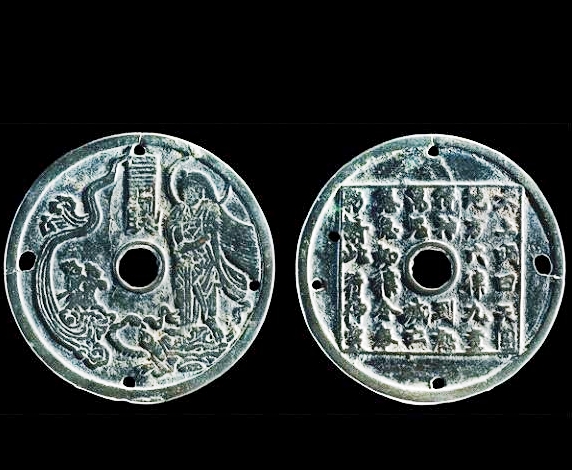
Bronze coin shaped charm From China

Bronze coin-
shaped charm
From China
Qing dynasty, 19th century AD
Fighting evil
Touch the animation button to see the traditional process of casting East Asian coins.
The scene on this coin-shaped charm refers back to a legend of the Song dynasty in the twelfth century. The legend tells how the Emperor Huizong (reigned 1101-25)
had a vision of the God of the North standing on the back of a snake and tortoise, holding a sword in his hand.
The God of the North was considered to be the master of evil spirits and therefore able to control them. Along with the symbols of the North, he was thought to be a particularly powerful force for exorcism. The tortoise is a symbol of longevity, strength and endurance. It is also known as the ‘Black Warrior’, presiding over the North and symbolizing winter. In Daoism the sword is a symbol of victory over evil.
Other symbols of the North often found with the snake, tortoise and sword are the Plough (the constellation) and clouds.

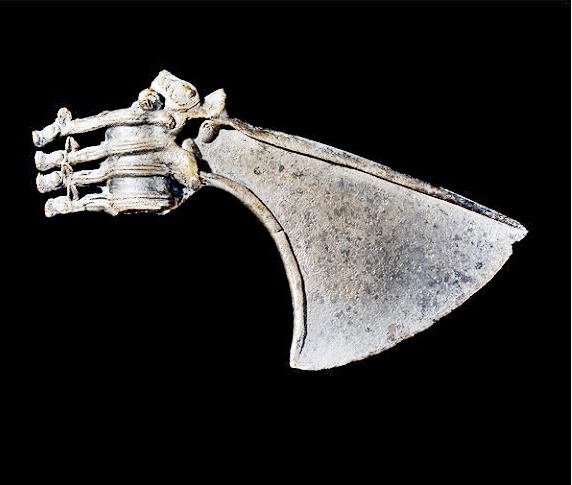
Bronze axe-head

Bronze axe-head
Luristan culture
10th-7th centuries BC
From Luristan, western Iran
The style of this cast bronze axe-head links it to the region of Luristan in western Iran. Bronzes of this kind were plundered from the cemeteries and shrines of the area from the 1920s onwards. Many of the graves were rich in bronzes, and even the poorest male graves appear to have contained a few weapons.
The blade of this axe is set at an angle that made it impractical for use, so it was presumably made specially to be left either in a grave or as a votive offering in a shrine or sanctuary. The symbolism of the animal forms is a mystery, as there are few inscriptions from this region. Similar spike-butted axes are known from the twelfth century BC, but spikes tipped with bird, human or, as here, animal heads developed between 1000 BC and 700 BC. In this example the blade emerges from the jaws of an unidientified animal.
The mountains of western Iran were home to a long tradition of metalworking. By the first millennium BC the kingdom of Elam, which had dominated Luristan, was weakened and the bronze workers of Luristan were free to develop their industry. The decline in the production of Luristan bronzes, some time in the later seventh century BC, was possibly due to the growing political unity of the Medes and Persians and their increasing influence on the area.

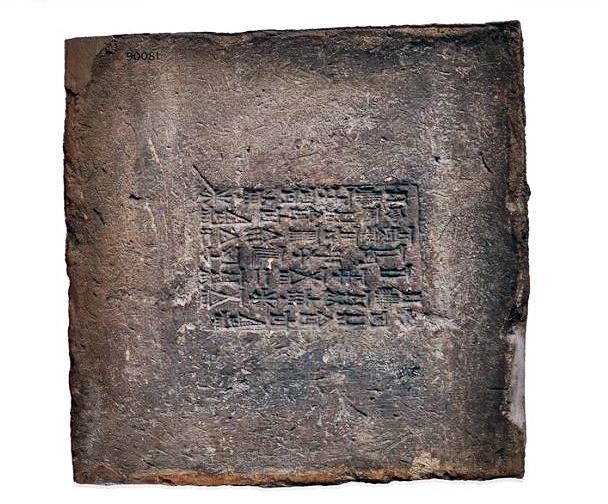
Brick of Nebuchadnezzar II

Brick of Nebuchadnezzar II
Neo-Babylonian dynasty,
about 604-561 BC,
From Babylon,
southern Iraq
Following the defeat of the Assyrian Empire by the Medes and Babylonians between 614 – 609 BC, Nebuchadnezzar II rebuilt the city of Babylon on a grand scale. It has been estimated that 15 million baked bricks were used in the construction of official buildings. The bricks are usually square and often bear cuneiform inscriptions, generally made with a stamp (as here), but occasionally written by hand.
The inscription on this brick translates: ‘Nebuchadnezzar, king of Babylon, who cares for Esagila and Ezida, eldest son of Nabopolassar, king of Babylon’. Esagila was the temple of the supreme god Marduk in Babylon, while Ezida was the temple of Nabu, god of writing, in the neighbouring city of Borsippa. The king’s most famous construction works were in Babylon where, along with Esagila, he built the famous Ishtar Gate and the ‘northern’ palace. He also rebuilt the ziggurat (temple tower)
called Entemenanki.
Babylon is described by the Greek historian Herodotus
(about 485-425 BC).
The writer Berosus also credits Nebuchadnezzar with the construction of the ‘Hanging Gardens’ which supposedly he built to remind his wife of her home, in the mountains of Iran. No evidence survives for the Gardens at Babylon, however, but there was a long tradition of extensive royal parks and gardens in Mesopotamia.

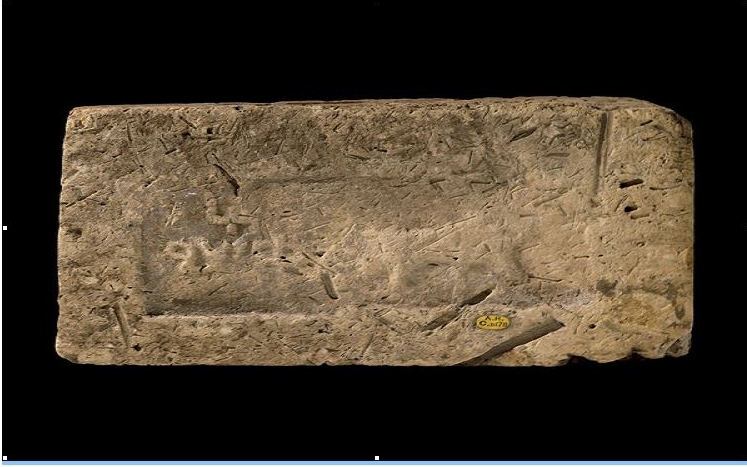
Babylonian brick

Babylonian brick
Babylon (Kasr)
about 8th-7th century BC
This was one of a number of items collected by Sir Robert Ker Porter (1777-1842)
a Scottish artist, traveller and diplomat. Ker Porter was appointed historical painter to the Russian Tsar in 1804 and recorded and drew ruins at Persepolis and other sites in Iran for the Russian Academy of Fine Arts (1817-20).
While travelling in the Near East, Porter stayed with Claudius Rich (1786-1821) in Baghdad, and was guided around the newly identified site of Babylon. Ker Porter presented a small collection of items he collected during his travels to the British Museum in 1821. These were mostly remains of ancient Babylonian buildings: bricks, mortar, bitumen and reeds.
This brick was originally at least 30 cm across, but Ker Porter cut it down to make it portable. The faint impression shows a lion with an Aramaic inscription. Aramaic gradually replaced cuneiform script in Mesopotamia after the ninth century BC but Aramaic brick inscriptions are not common, and Ker Porter recognised that this brick was ‘a very rare specimen’. The inscription gives the letter M, possibly a personal monogram, above the short word ‘QŠB’, which possibly translates as ‘B has presented’. ‘B’ may be an abbreviation of a god’s name.

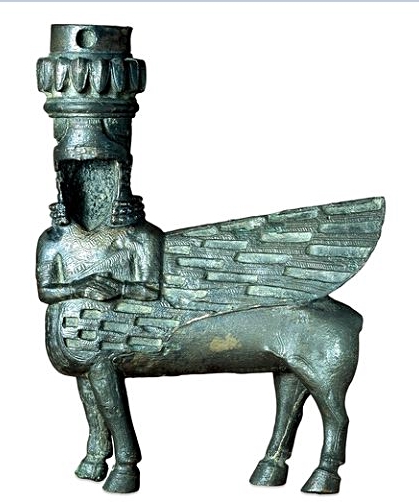
Winged bull with human torso and head and clasped hands

Urartian, around 700 BC
From Toprakkale (ancient Rusahinili), eastern Anatolia (modern Turkey)
A fine bronze from a throne
This bronze figure of a winged bull with a human torso and head was part of the decoration of a throne. It would have supported the arm-rest or seat. It comes from Toprakkale (ancient Rusahinili) in Urartu, the site of a major temple of the god Haldi, and was acquired in 1877. The missing face and horns were probably made of ivory, and the sockets in the wings once contained inlay, while the bronze itself was covered in gold leaf. Only the front of the wing was inlaid: presumably the back was not meant to be visible. The original effect must have been both rich and colourful, which seems to have been typical of important ancient furniture.
Urartu, centred on Lake Van, was the northern neighbour and rival of the Assyrian empire during the ninth to seventh centuries BC. It had disappeared before 600 BC, possibly destroyed by raids of horse-borne warriors known to the Greeks as Scythians, associated with the Medes from western Iran. The name survives, however, in that of its highest mountain, Ararat.
We know from Assyrian documents that the peoples of eastern Anatolia exploited the rich copper deposits found there. In the first half of the first millennium BC the Urartian kingdom had the most highly developed bronze production of Anatolia and the ancient Near East. The tin required for the production of bronze was probably imported from Afghanistan

The Other Sphinx

The Other Sphinx
The ancient Egyptians imagined one constellation as a Sphinx. Today,
we call it
Centaurus
since the Greeks later imagined that it was a Centaur.
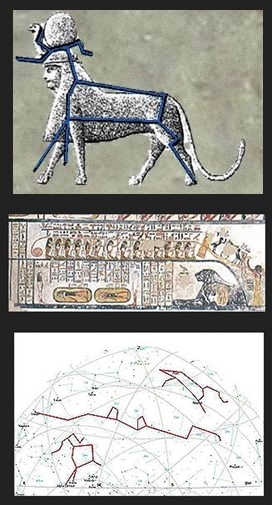
There is a zodiac in the temple of Esne in Latopolis that shows this illustration of a Sphinx in place of the constellation Centaurus.
This suggests that there was a Sphinx constellation before the Sphinx monument was created.

Both civilizations imagined that the constellation represented a being with the head of a man and the body of a quadruped. The constellation perfectly fits within the illustration of the Sphinx from zodiac at Esne.

From The Book of Aker (Ramses VI)

Next, we wanted to understand about the “guards” mentioned in the readings.
The readings say:
“Those who were left as guards may not be passed until after a period of their regeneration in the mount.”
(5748-6)
This illustration shows the top of a pyramid,
with the ancient Egyptian word “top” in the center at the point of the pyramid.
It also shows an oval that was the ancient Egyptian word for “horizon.”
This may hold the key.

The two Sphinx gods at opposite sides of the horizon are the constellations of Centaurus on the left (East) and Leo on the right (West). The flying serpent in the center of the horizon is Hydra, the largest constellation in the sky. The head at the tail of the serpent represents the planet Venus.
The readings explain that Giza was formed according to that which had been worked out by Ra-Ta in the mount as related to the position of the various stars …
and] the constellation Libra
(294-151)
This is the exact configuration of stars, planets, and constellations over Cairo, Egypt. In order for it to fit,
you have to go back to the time of Ra-Ta, 10,390 BC.

At the tail of the flying serpent is the planet Venus positioned within the constellation Libra.

SkyGlobe: 10,390 B.C. over Cairo, Egypt
Edgar Cayce provided many clues to the location of the Hall of Records:
“The one in the Atlantean land, that sank, which will rise and is rising again; another in the place of the records that leadeth from the Sphinx to the hall of records, in the Egyptian land; and another in the Aryan or Yucatan land, where the temple there is overshadowing same.”
(2012-1)
“For the entity’s tomb then was a part of the Hall of Records, which has not yet been uncovered. It lies between—or along that entrance from the Sphinx to the temple—or the pyramid; in a pyramid, of course, of its own.”
(2329-3)
“Hence we find the entity…was the first to set the records that are yet to be discovered…and for the preservation of the data, that as yet to be found from the chambers of the way between the sphinx and the pyramid of records.”
(1486-1)
Cayce tells us that the second pharaoh, Araaraart “will be found…in the North Corner of the second Pyramid…”
(341-1)
In a subsequent reading, he said the same entity, Araaraart,
will be found “in the upper chamber of the northeast corner of the first pyramid builded.”
(341-8).
In another reading, he said, “In the first of the pyramids built in the Valley of the Shadow, there still may be found unto this day portions of data as was preserved with the ruler, who afterward was worshiped as the representative of God made manifest in earth. These will be found in the northwest corner or chamber of this mound.”
(5748-4)
It is our conclusion that the first and second pyramid refer to the same pyramid and that it is the pyramid of Khafra. Today it is known as the second pyramid, but we believe that in reality it was the first. We base this belief upon evidence from Edgar Cayce’s reading (993-1,#23)
which explains that the first of the pyramids was constructed in Egypt long before the lifetime of Ra Ta and long before the construction of the Great Pyramid.
This pyramid was underwater for nearly a quarter of a million years before Ra-Ta entered Egypt
(341-9,#4).
We look forward to the time when the Hall of Records may be opened:
“Yet, as time draws nigh when changes are to come about, there may be the opening of the three places where the records are one, to those that are initiates in the knowledge of the One God.
“The temple of Iltar will then rise again. Also there will be the opening of the hall of records in Egypt.
“The RECORDS are ONE.”
(5750-1)
Design a site like this with WordPress.com
Get started