Ramose’s tomb 212 at Deir el-Medina
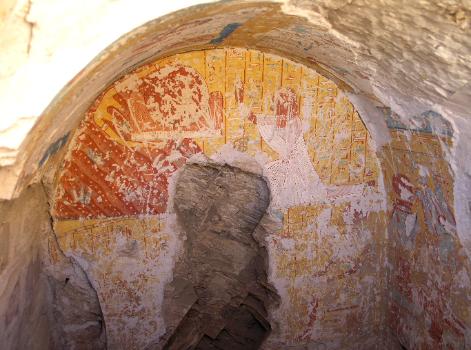
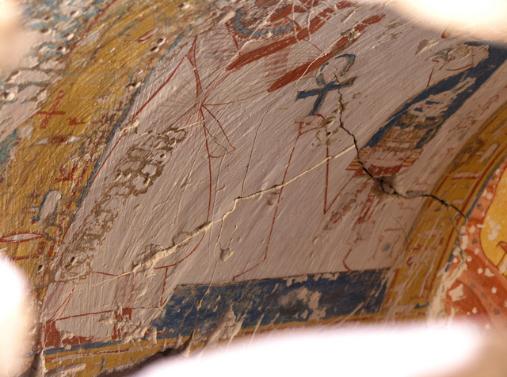
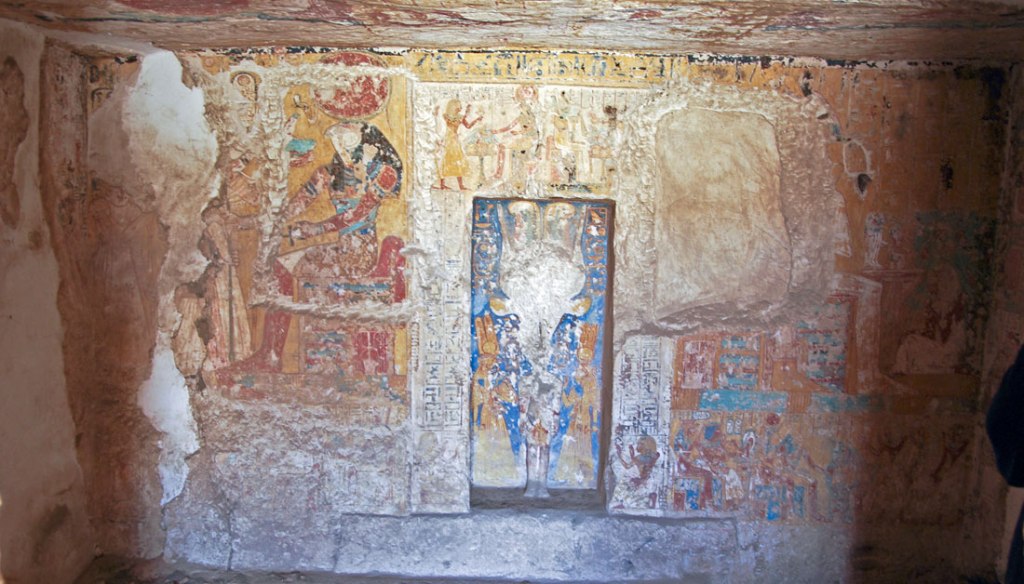
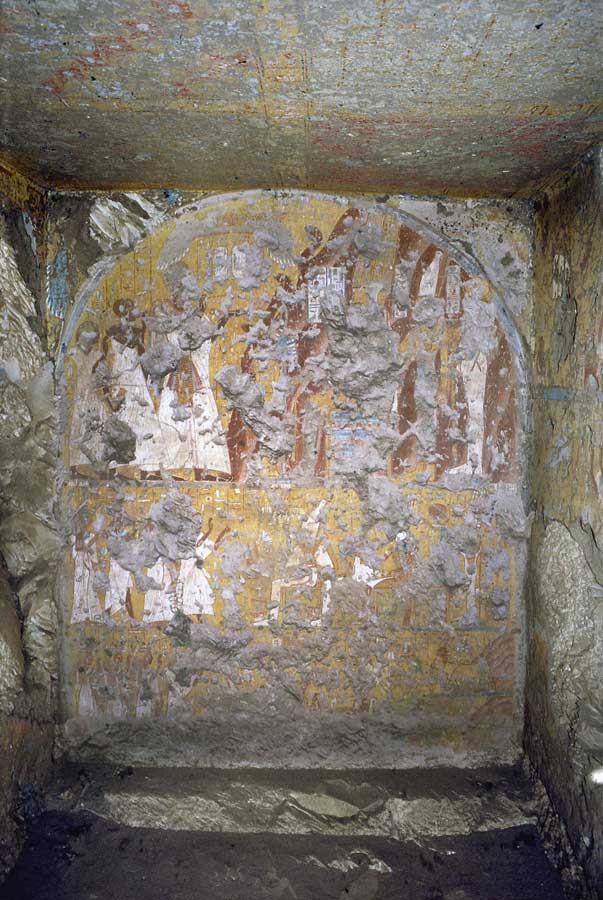
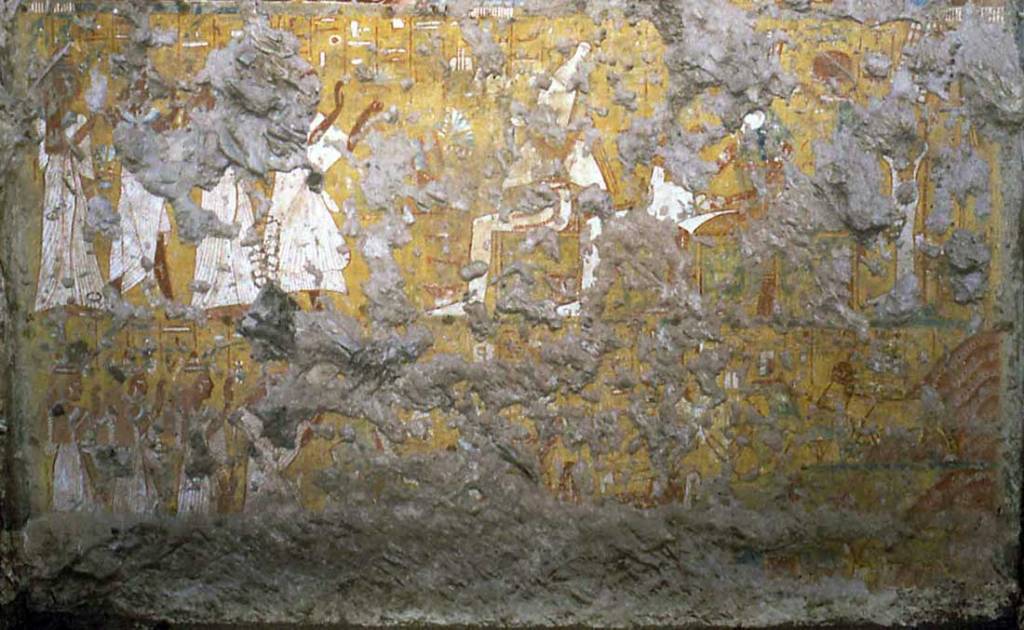
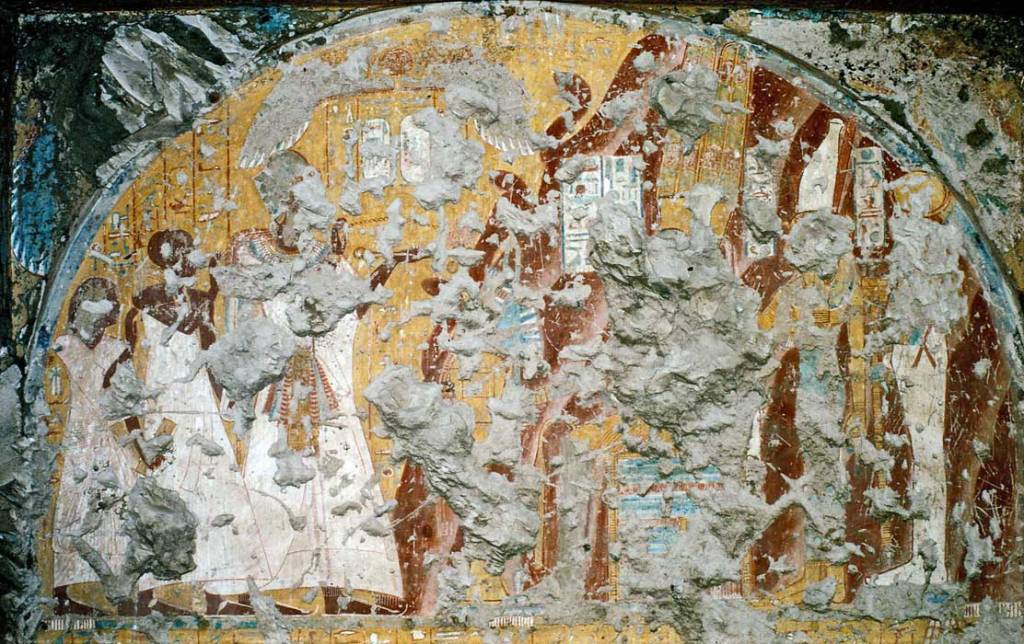
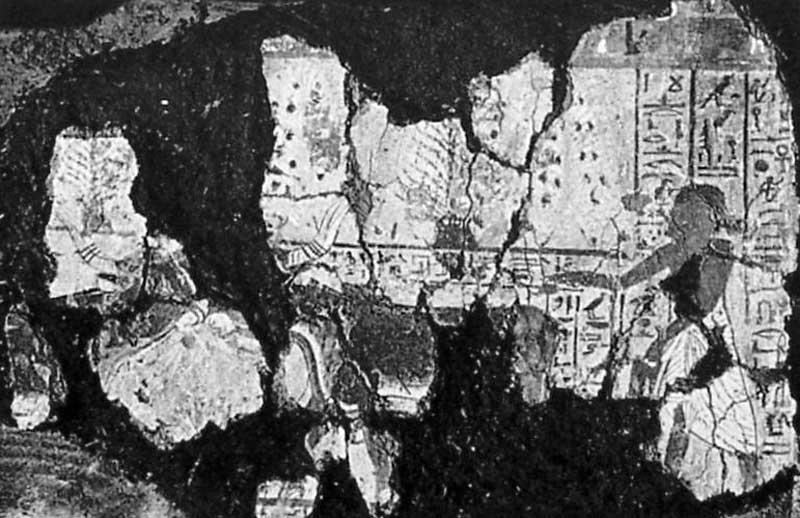
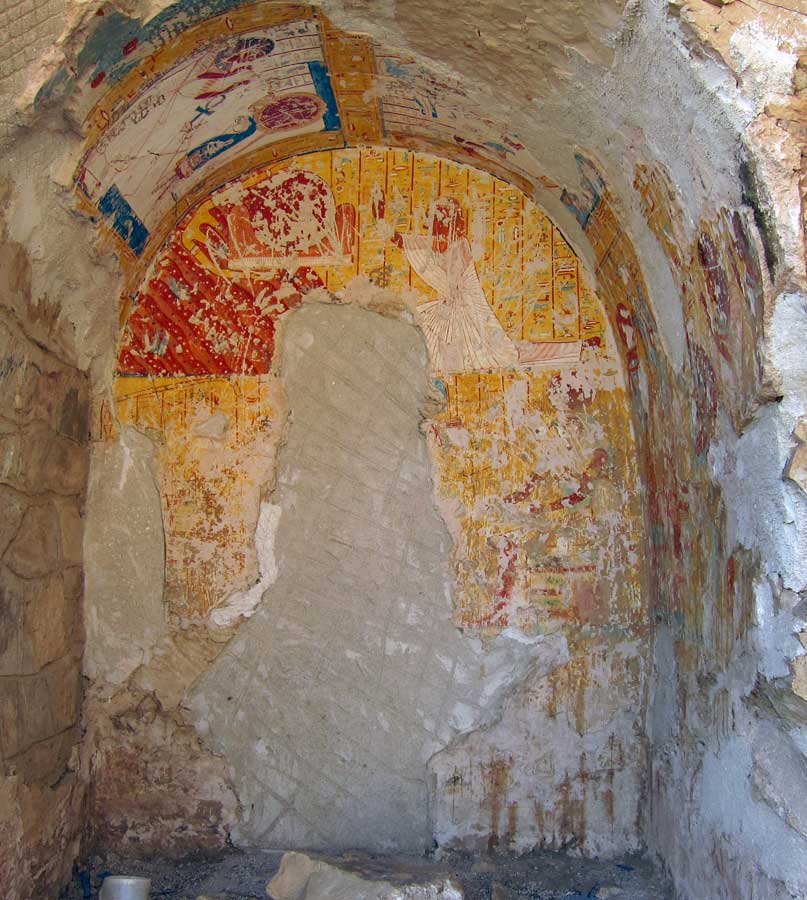
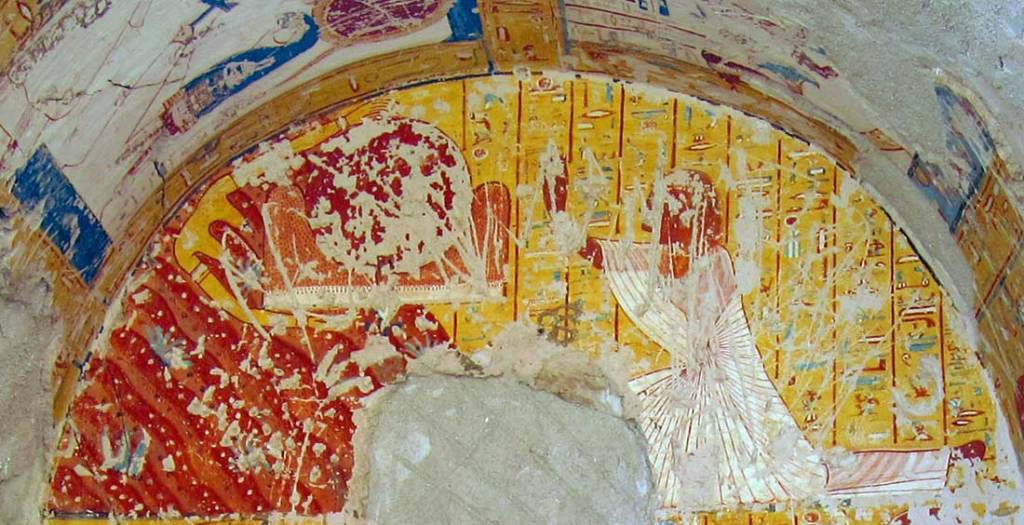
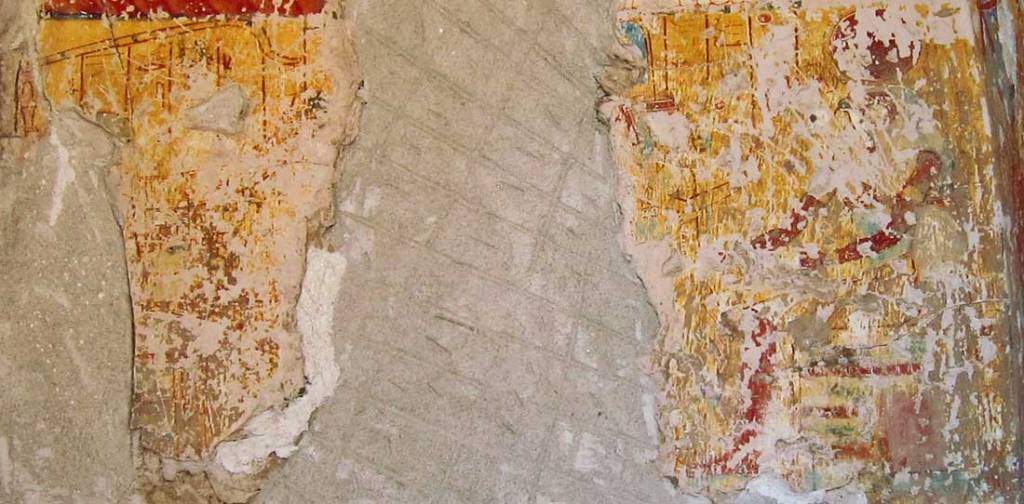
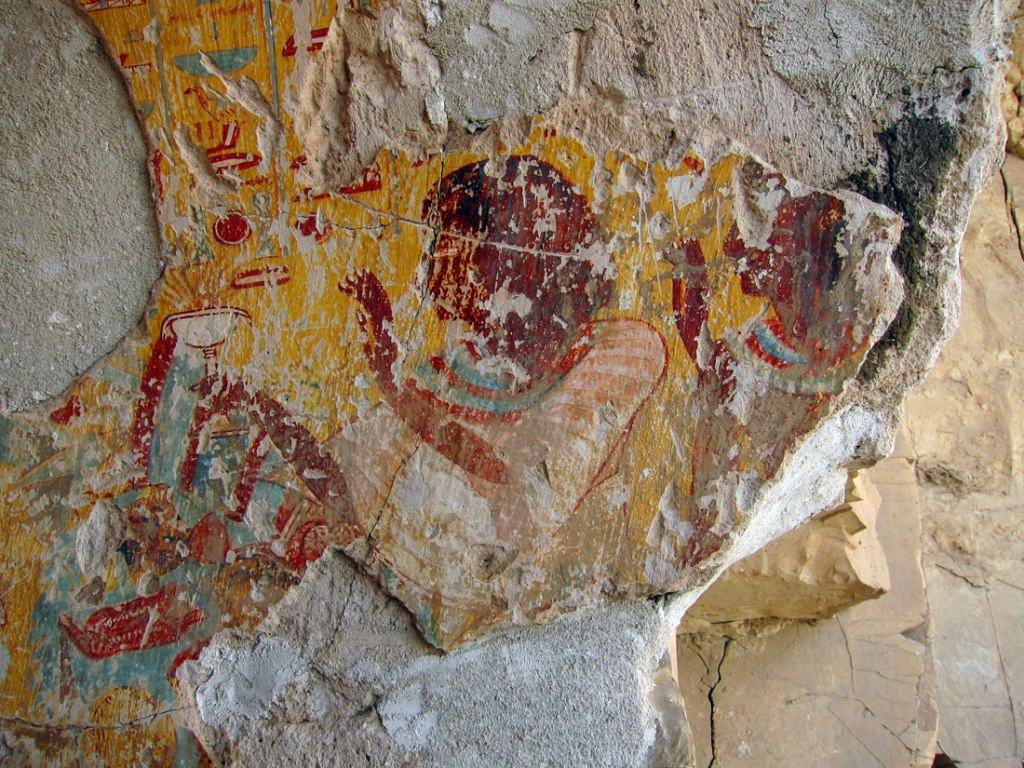
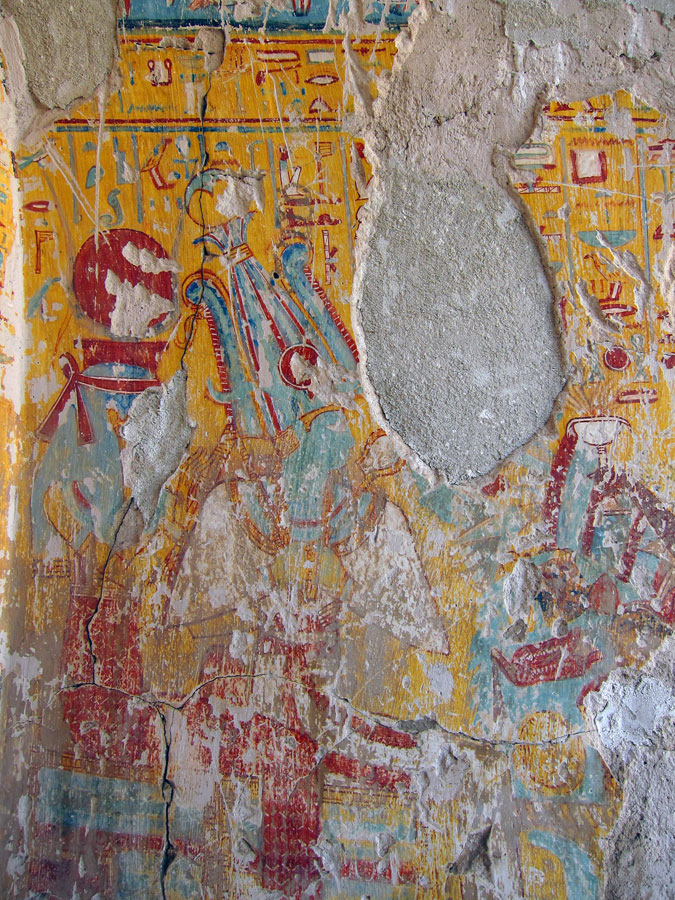
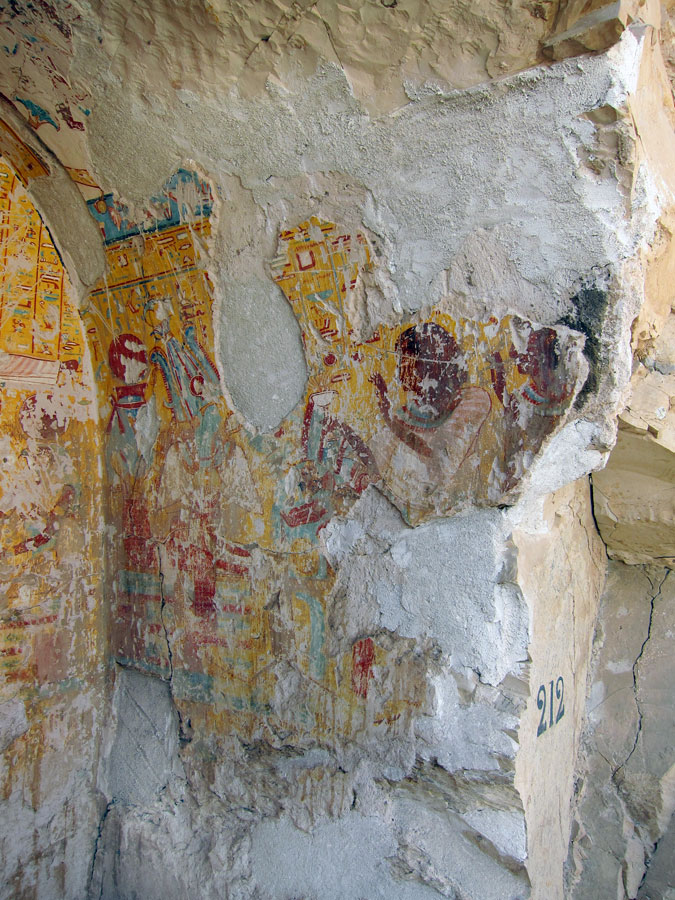
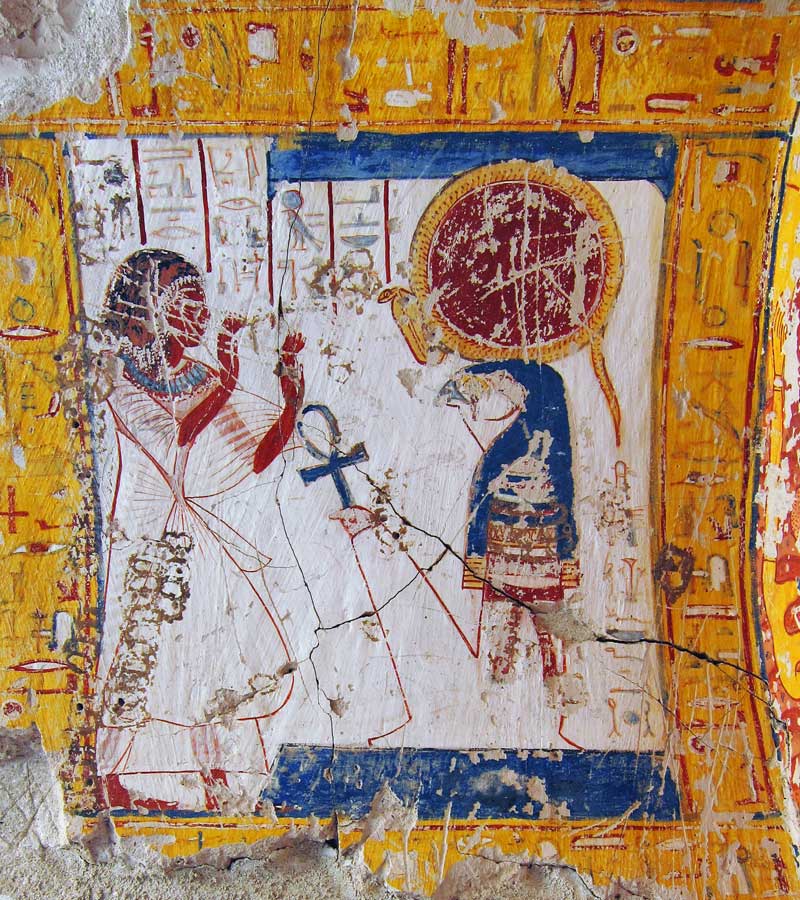
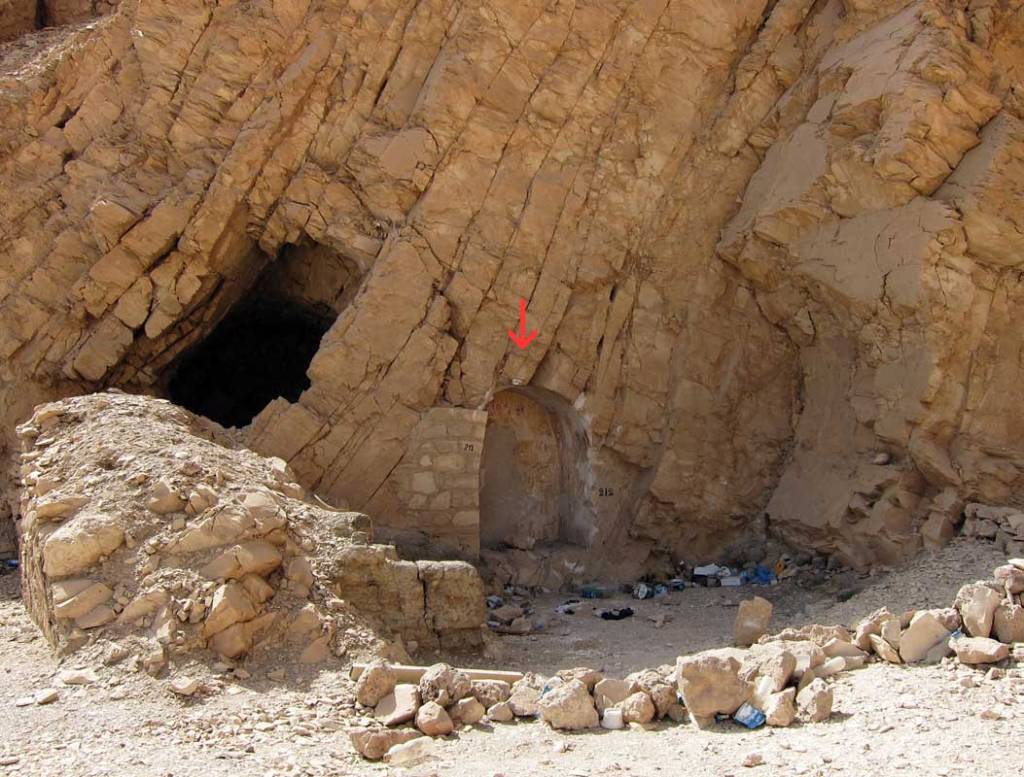
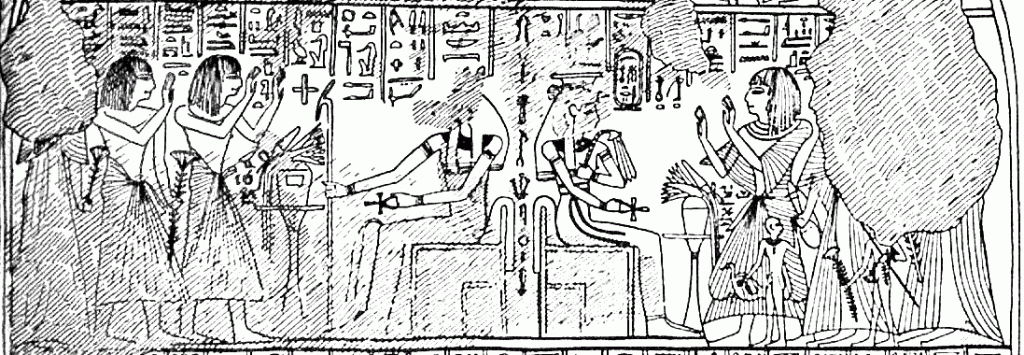
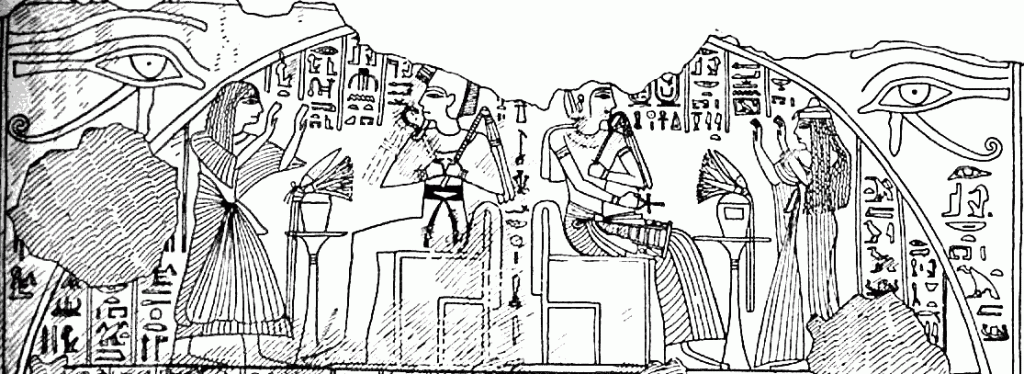
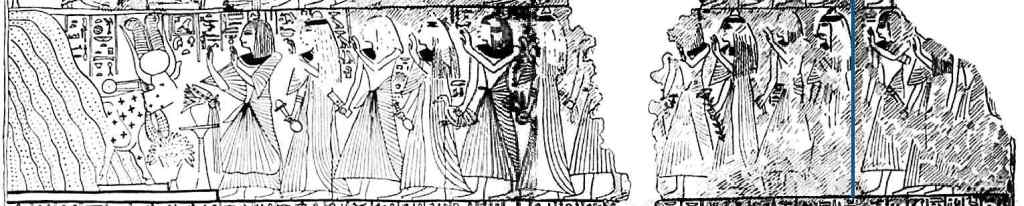
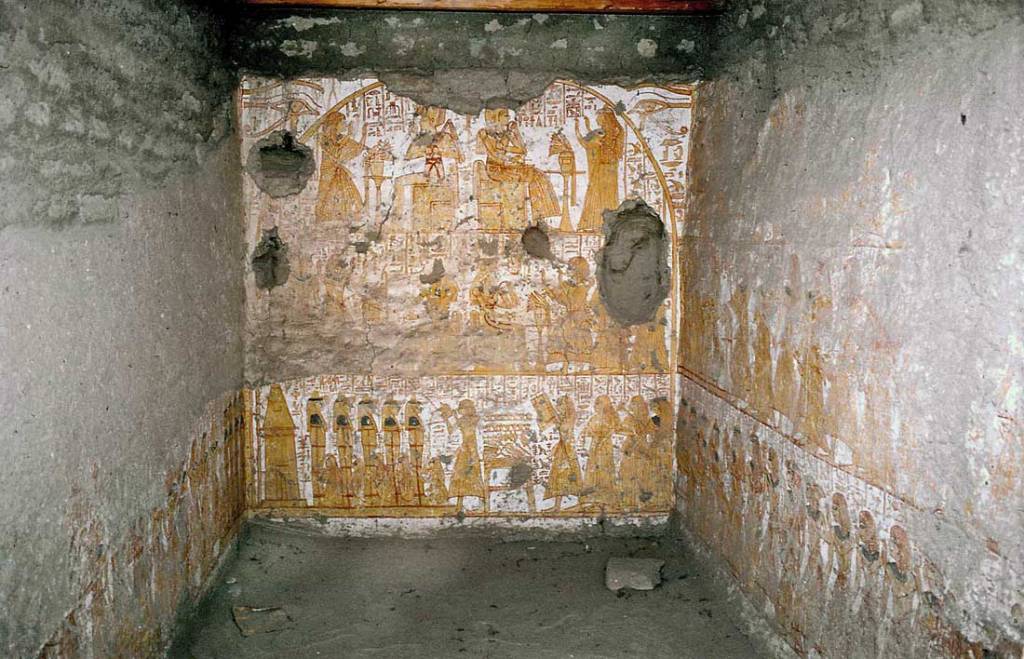
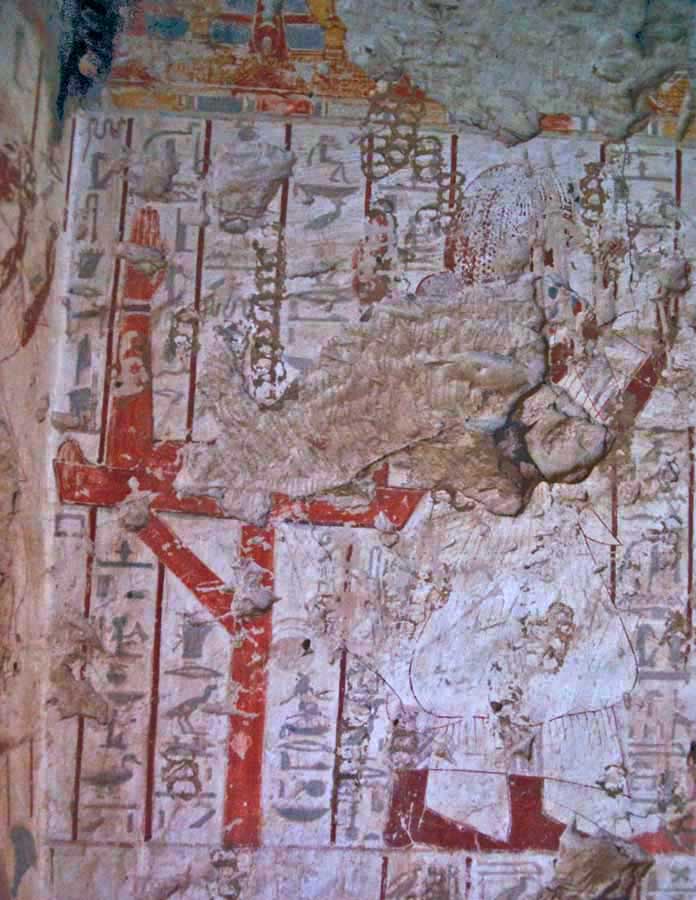
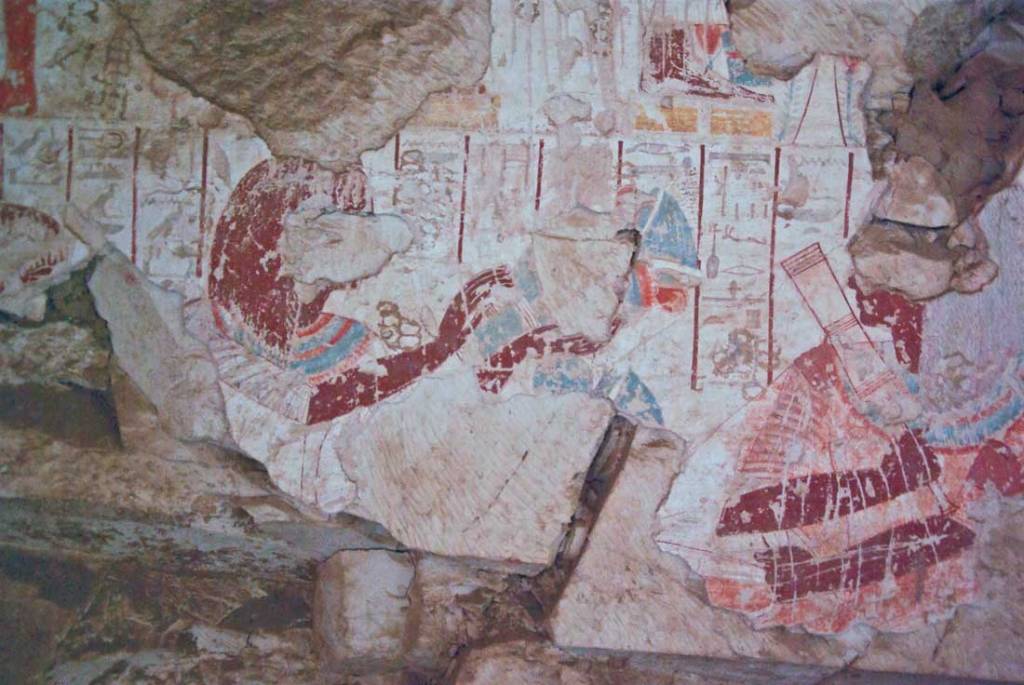
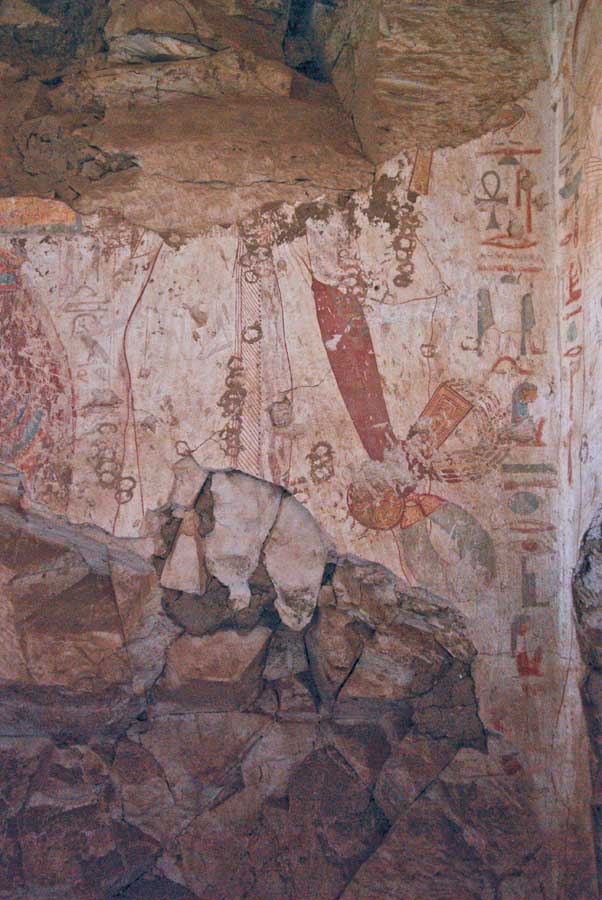
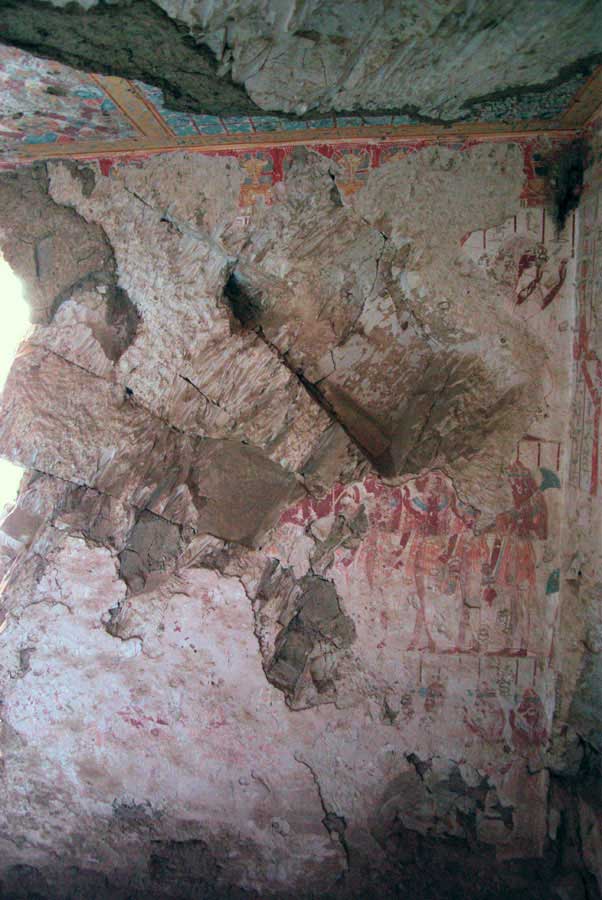
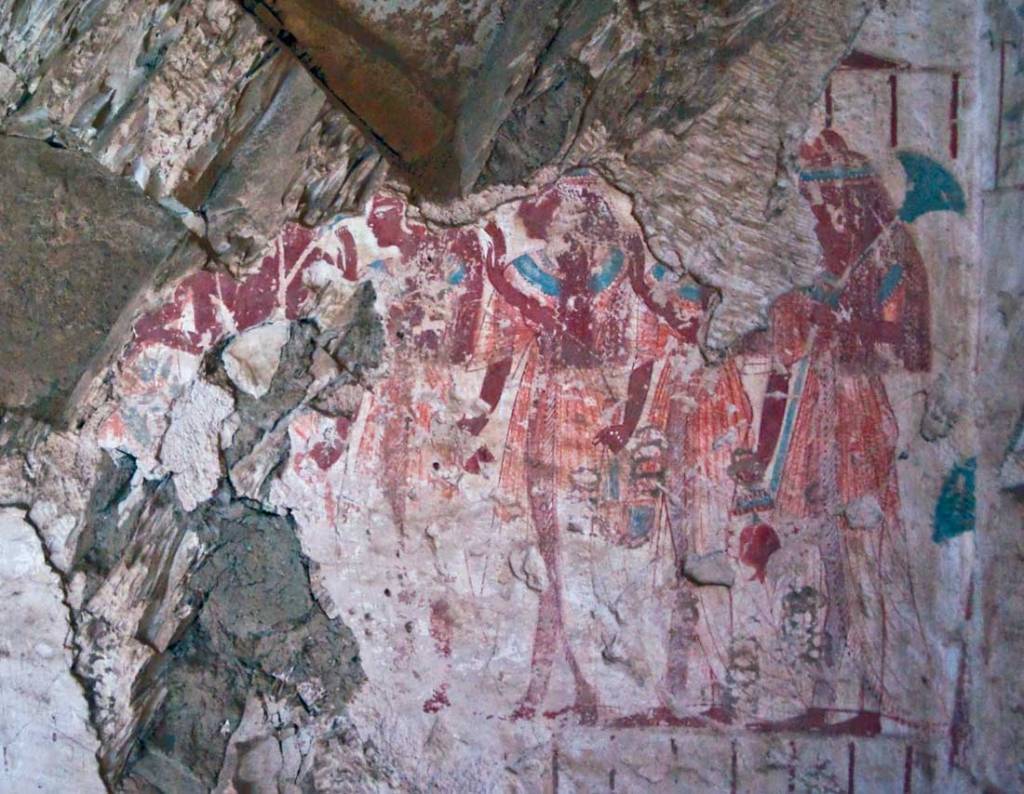
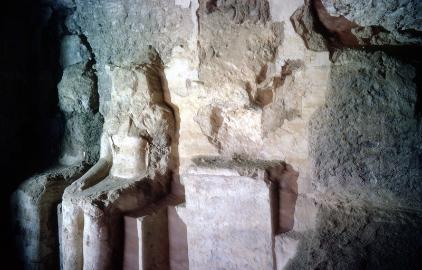
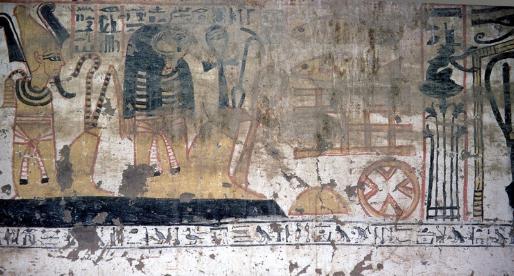
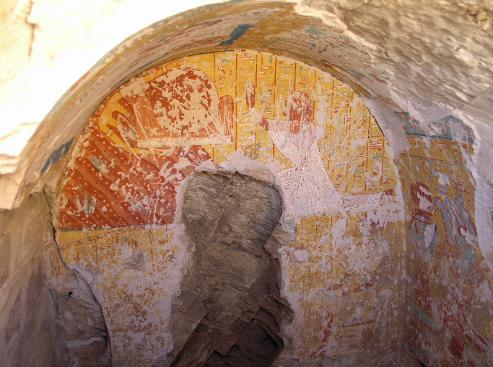
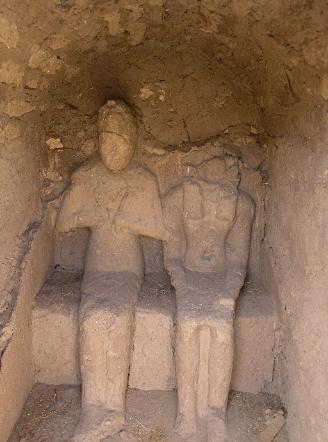
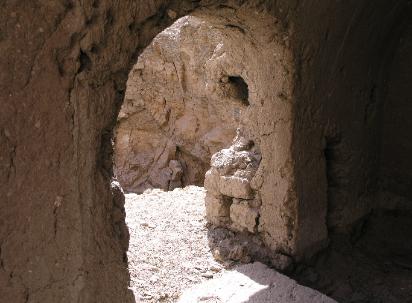
Ramose is one of the best documented officials from Deir el-Medina. Although he was not born in thevillage, he became one of the richest men who ever lived there. He was a son of lady Kakaia and aretainer Amenemhab (someone who delived messages to officials in the Theban area). Ramose was bornaround 1314 BC (Booth,2006,185). He must have attended scribal schools before he became a scribe at the temple of Tuthmosis IV. He then moved to Deir el-Medina, where he married Mutemwia, the “lady of the house, whom he loves”. He was appointed by vizier Paser as “scribe of the tomb” in year 5 of Ramesses II (O.CGC 25671). He served in the rank at least until year 38 of Ramesses II (O.CGC 25809) (Davies, 1996, 98).As Ramose and Mutemwia continuously failed to conceive a child they petitioned various deitiesassociated with childbirth and fertility. Stela 50066, now in Turin, is dedicated to Qudshu, the Asiatic goddess of love. There are many stelae and statues recording their plea, but the couple remained childless. In the end they adopted Kenherkhepshef, like Ramose, most probably a new arrival in the village, to be an apprentice who would take the role of the eldest son, take over Ramose’s profession and perform burial rites for them. Ramose’s family occupied a house in the northern part of the village. He also owned some land outside Deir el-Medina and there are 3 decorated tombs attributed to him – TT7, TT212 and TT250.The images below, captured by Andy during our visit to Deir el-Medina in 2005, show the survivingniche that was cut into the bedrock of the slopes of the western cemetery. It used to be situated at the back of the chapel of Ramose’s tomb complex, that was later assigned number TT212. The chapel and the courtyard did not survive, the niche is all that is left to see.A detailed account of the surviving niche with photos and descriptions of the western and northernwalls and the vaulted ceiling, as well as the partially reconstructed agricultural scene
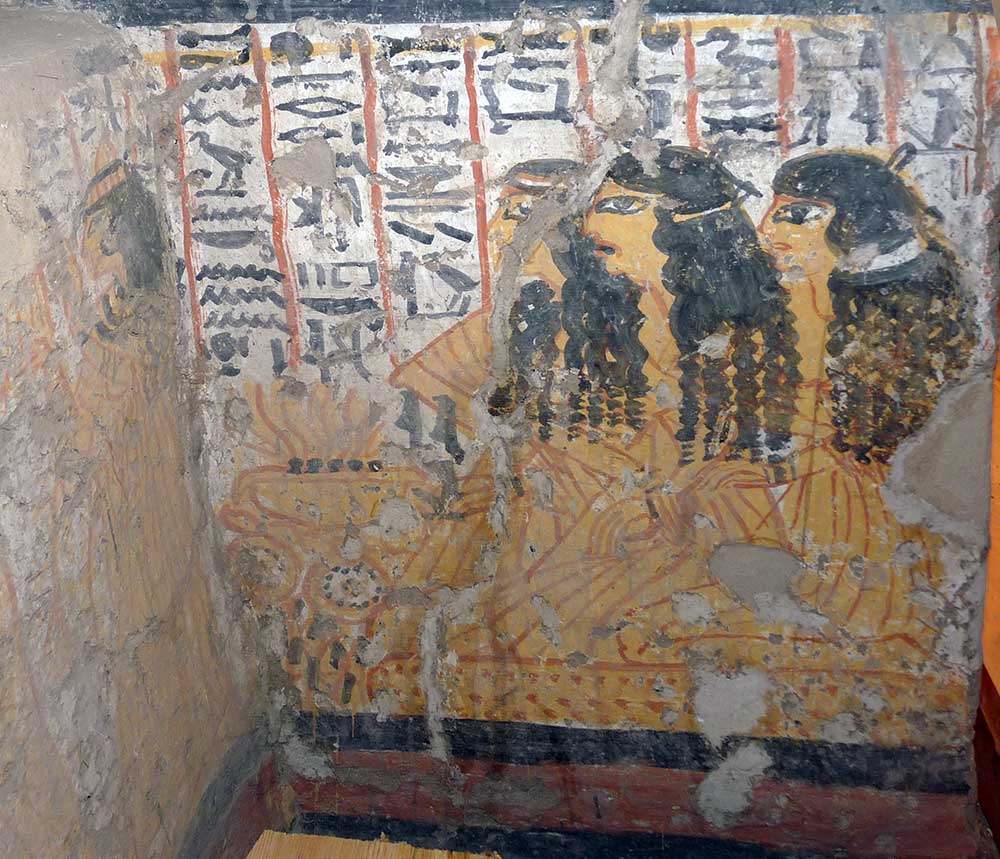
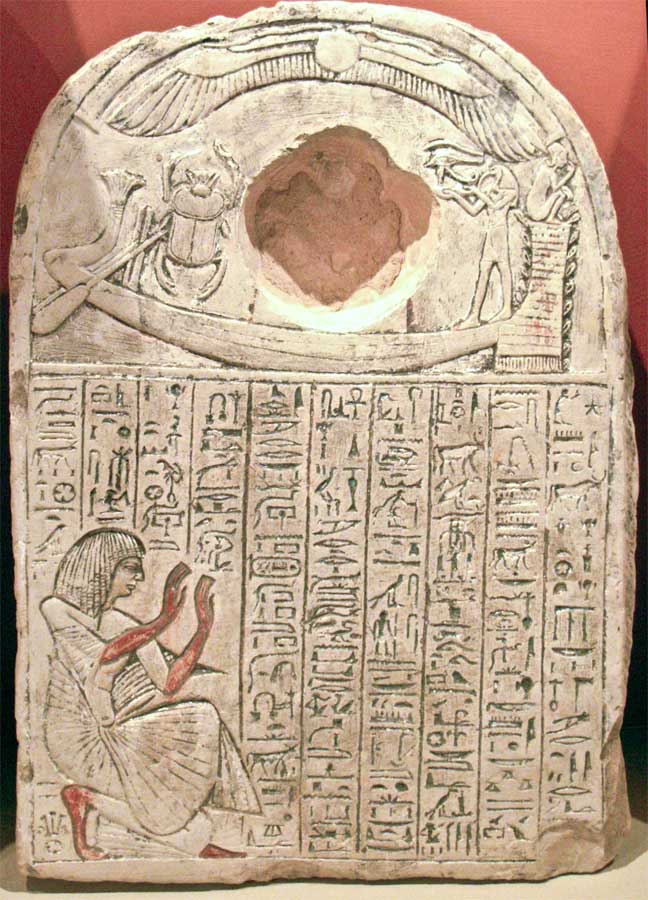
The west wall of the nicheshowing kneeling Ramoseworshipping the rising sun.Preserved scene from thevaulted ceiling, showingRamose standing with hisarms raised in the gesture ofworship, in front of theseated god Re-Harakhte.To view and browse the digitised version of The Topographical Bibliography of Ancient EgyptianHieroglyphic Texts, Statues, Reliefs and Paintings, (also known as Porter & Moss or TopBib) for this tomb,



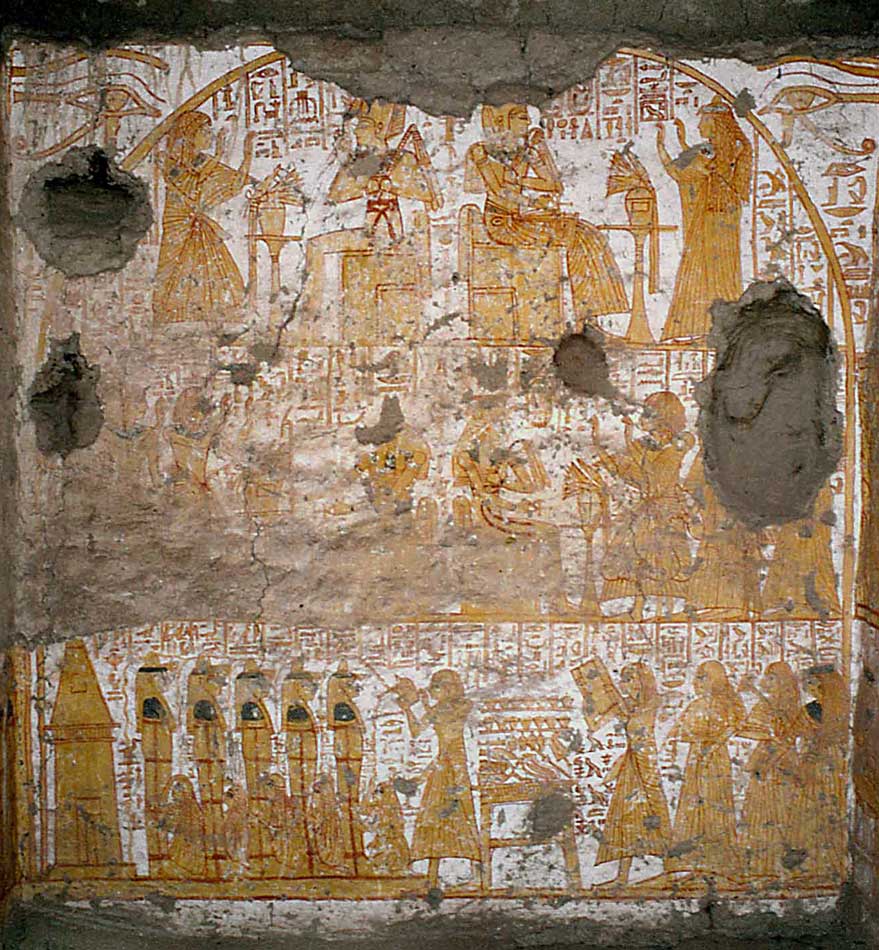
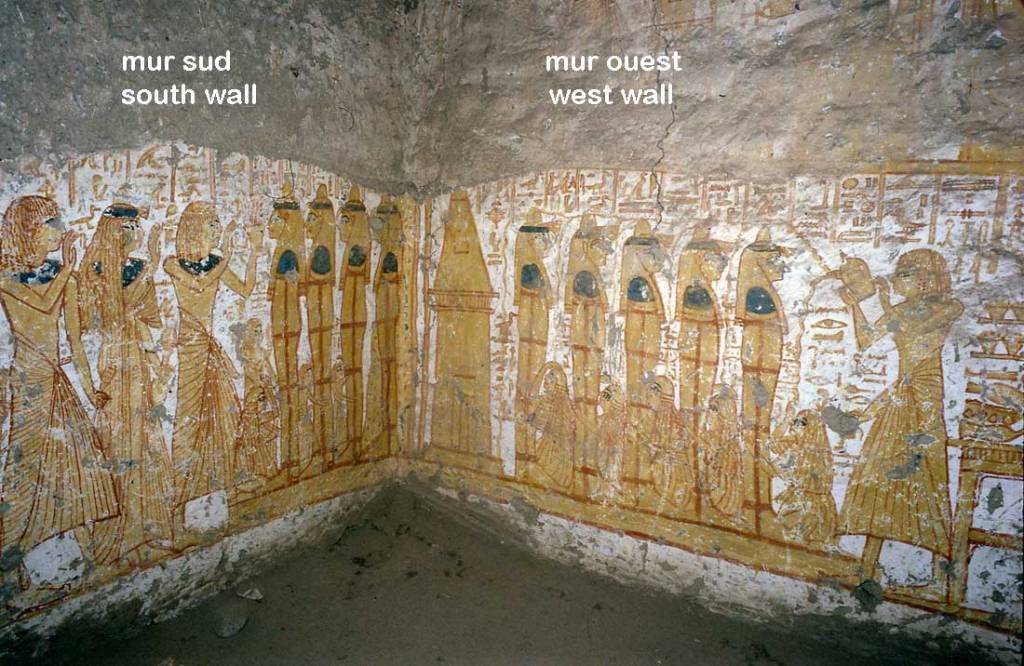
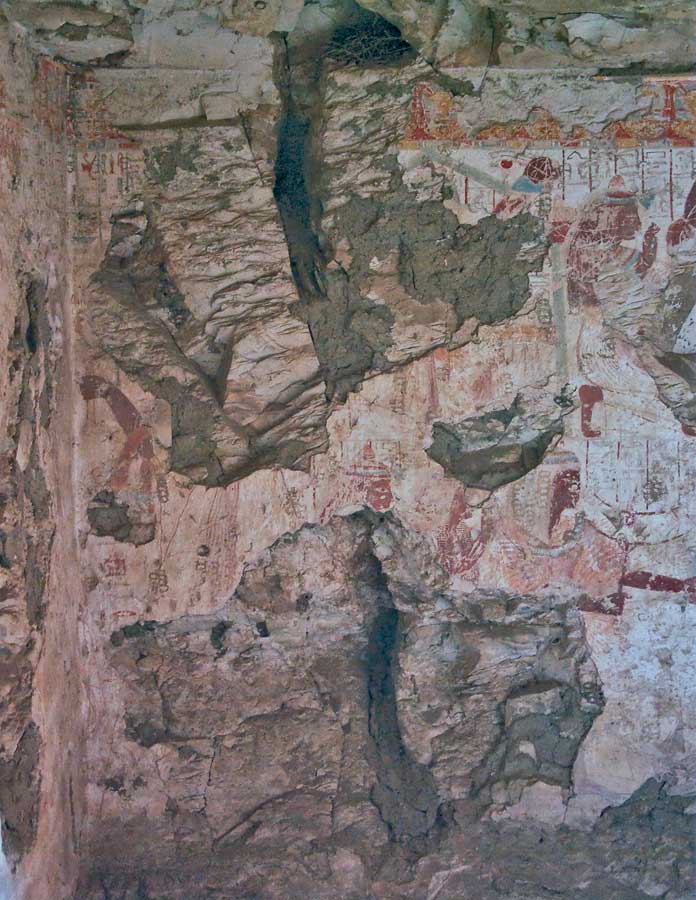
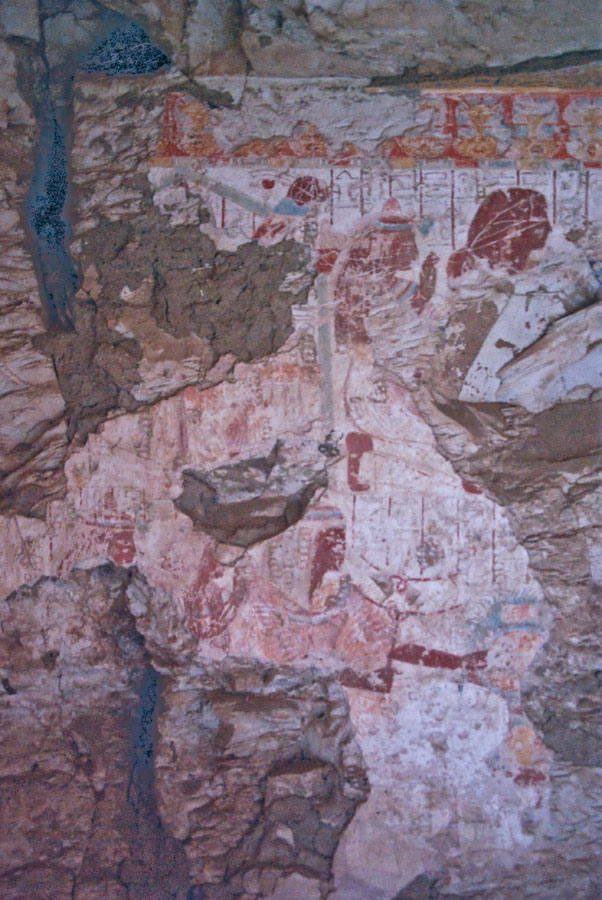
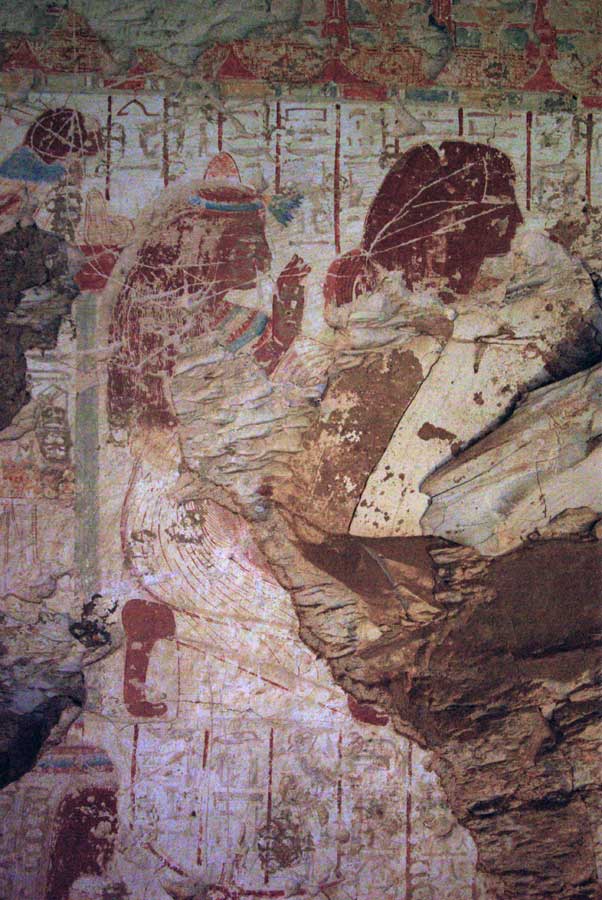
TT6, the tomb of Neferhotep (I) and his son, Nebnefer .
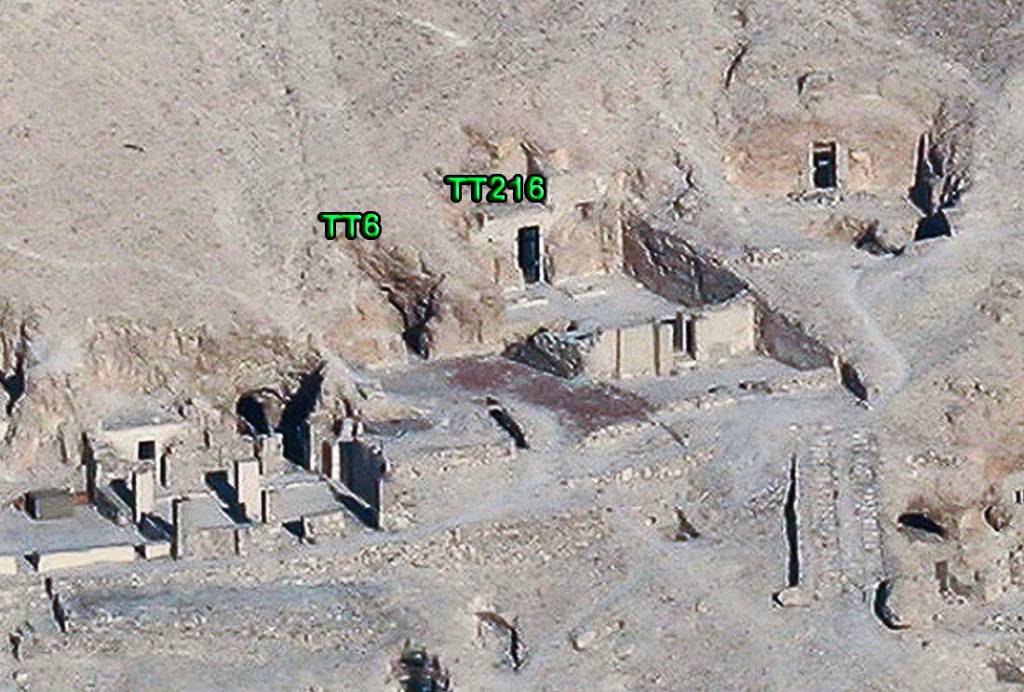


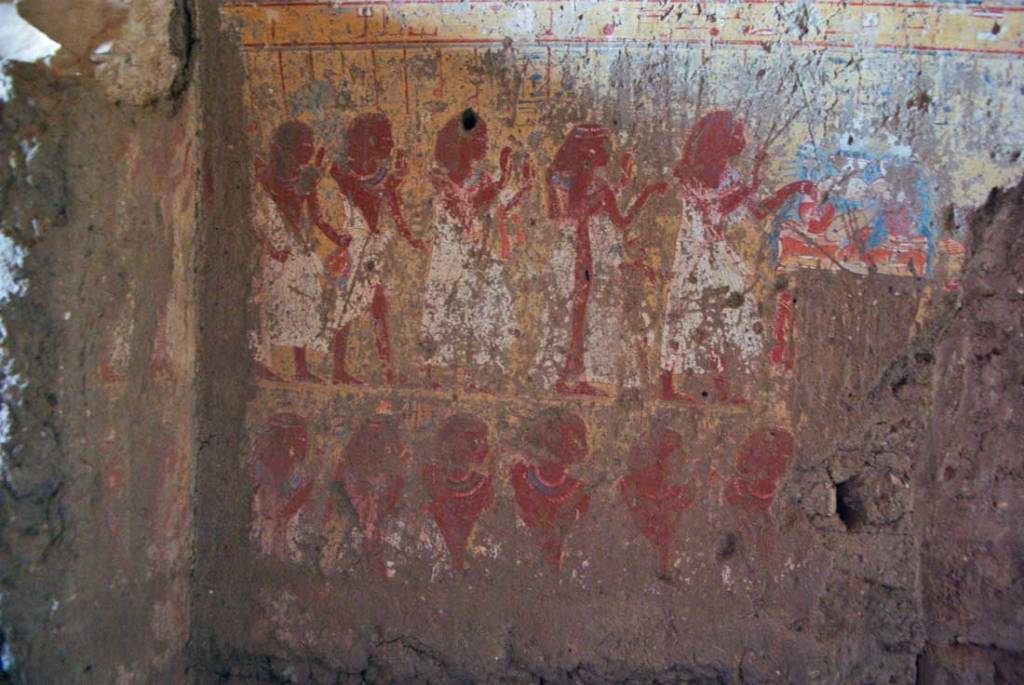
TT6, the tomb of Neferhotep (I) and his son, Nebnefer .
TT6 is a family tomb which clearly dates from the time of Ramesses II (according to Hofmann). Neferhotep and Nebnefer are father and son, and they succeeded one another in the post of foreman, in the “”Place of Truth””. Their descendants continued to belong to the right-side gang of the (royal) tomb during the greater part of the nineteenth dynasty, making this one of the most influential families of Deir el-Medina.
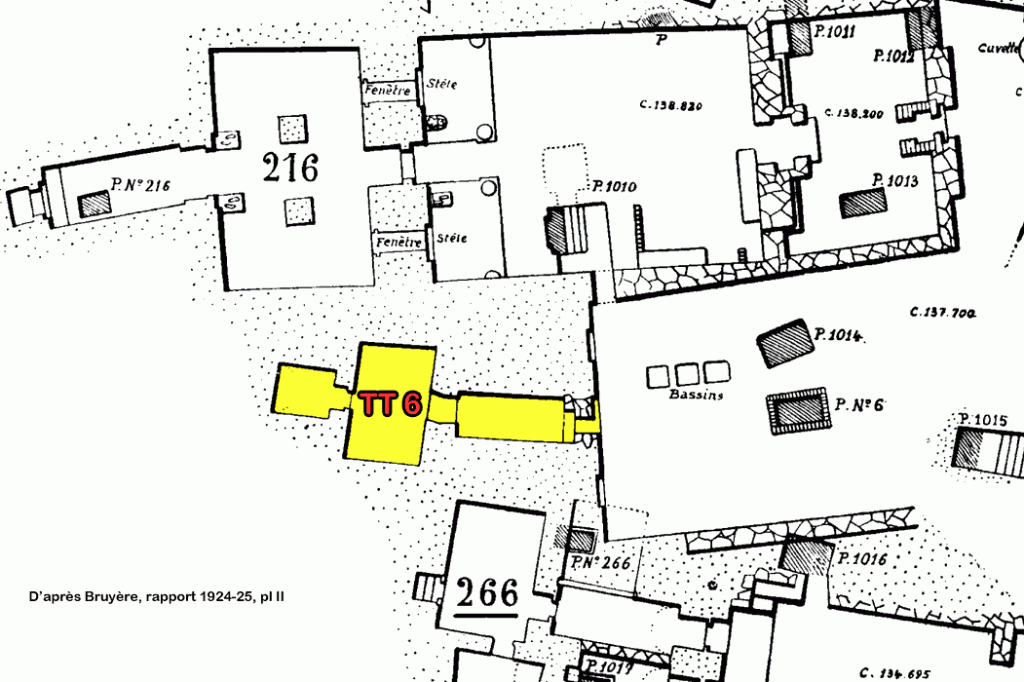
It should be noted that tomb TT216, adjoining that of TT6, is that of another Neferhotep, son of Nebnefer thus grandson of the TT6 Neferhotep, which is the largest and best located in the necropolis of Deir el-Medina. The Neferhotep of TT6 will be referred to as Neferhotep (I) and his grandson as Neferhotep (II).
It should be remembered that the work in the royal tombs was done in parallel by two teams, one for the right-hand side and one for the left, there were two foremen (and only two) who exercised authority at the same time, one for each side, Neferhotep was foreman of the right.
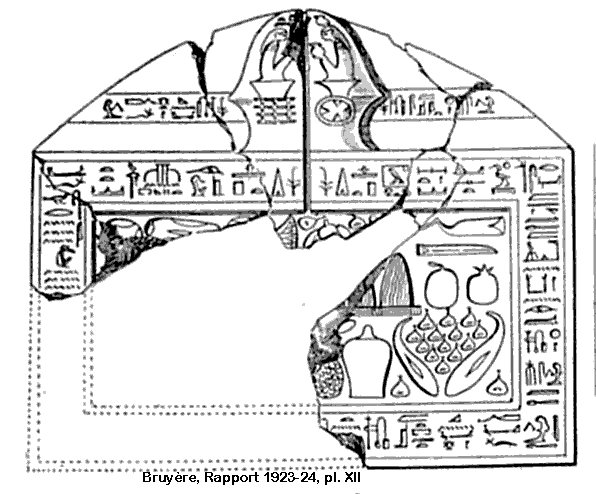
Inscribed monuments are very rare for Neferhotep (I), although an offering table in his name was found by Bruyère in the courtyard of tomb TT216. This table refers to “”[…] Neferhotep, foreman of the Lord of the Two Lands, Djeserkheperure-Setepenre “”. Neferhotep was thus in office under Horemheb, probably from year 7 of his reign and remained there at least until year 5 of Rameses II. He appears with his wife, Iyemuau, in the chapel of the scribe Ramose, TT250.
TOMB OWNERS
Neferhotep (I)
No tomb belonging exclusively to Neferhotep has been discovered, and it is thus necessary to follow Cerny when he suggested that he was buried in tomb TT6, with one of his sons and successor Nebnefer.
Only one wife of Neferhotep is known, Iyemuau, who gave him several other children besides Nebnefer. However, not all of the children stayed in the village: Nakhy (son) was “”an army scribe of the Lord of the Two Lands and chariot warrior of His Majesty””; Mose (son) was “”transport officer of His Majesty, horse groom and porter of the temple of Usermaatre Setepenre (Ramesses II)””. At least a fourth son is known, named Turo, and a daughter, named Tuya, existed.
The foremen (or team leaders) had a very important social standing, probably greater than that of the scribes. They were at same a time members of the team of the tomb and accepted it. They are supposed to supervise and co-ordinate the activities of workers, in the manner of a foreman on a current excavation site. They are the ones who represent the team in front of the upper authorities. They must also arbitrate the disputes and litigations and these are the main characters of the courthouse of the brotherhood, which they preside over; they act as witness for the vows and the transactions. They are present at the time of the divine processions. They are also the ones responsible for the tools and necessary supplies for work in the royal tombs. They are usually referred to as “”chief of the team”” or “”team leader”.”
Neferhotep, chief of the team on right of the tomb, had for colleagues the head of the team on the left, Baki then Pached. He was a contemporary of the worker Sennedjem, possessor of the famous tomb, TT1, recovered intact. Some of the similarities proves to be interesting as will be seen below.
Nebnefer
This was the son of Neferhotep and Iyemuau. His wife was called Iy, daughter of the lady Isis. Both are represented in tomb TT250 of Ramose, however only Nebnefer is present in the funeral procession of Kasa (and Penbui) in the TT10 chapel.
Nebnefer remained in office from year 5 until year 30/40 of the Ramesses II, whereas Paser and then Khay occupied the post as vizier. He then maybe became the foreman of the left-hand side of the Pached tomb (the same as his father), but especially Kaha and, maybe, Ankherkhauy.
The couple’s children included Neferhotep (II), Henutmehyt and Iyemuau. Neferhotep (II), who succeeded his father around year 40 of the reign of Ramesses II, accommodated the largest tomb at Deir el-Medina, TT216, which adjoins the tomb of his father and grandfather, TT6. The place is ideally located: at the top of the hill overlooking the village to the west, with a view of the entire site and to the north the Ramesseum, the Temple of a Million Years of Ramesses II (see tb-ramesseum aerial photo).
The inscriptions of the tomb have a dual distribution: those on the right half are of Nebnefer, who was the recipient of offerings (which did not prevent his father Neferhotep being mentioned several times). Entries, specifically of Neferhotep, occupy the walls of the left side. This division also exists for the inscriptions of the ceiling.
OUTSIDE AREA AND COLLAPSED ENTRANCE PASSAGE
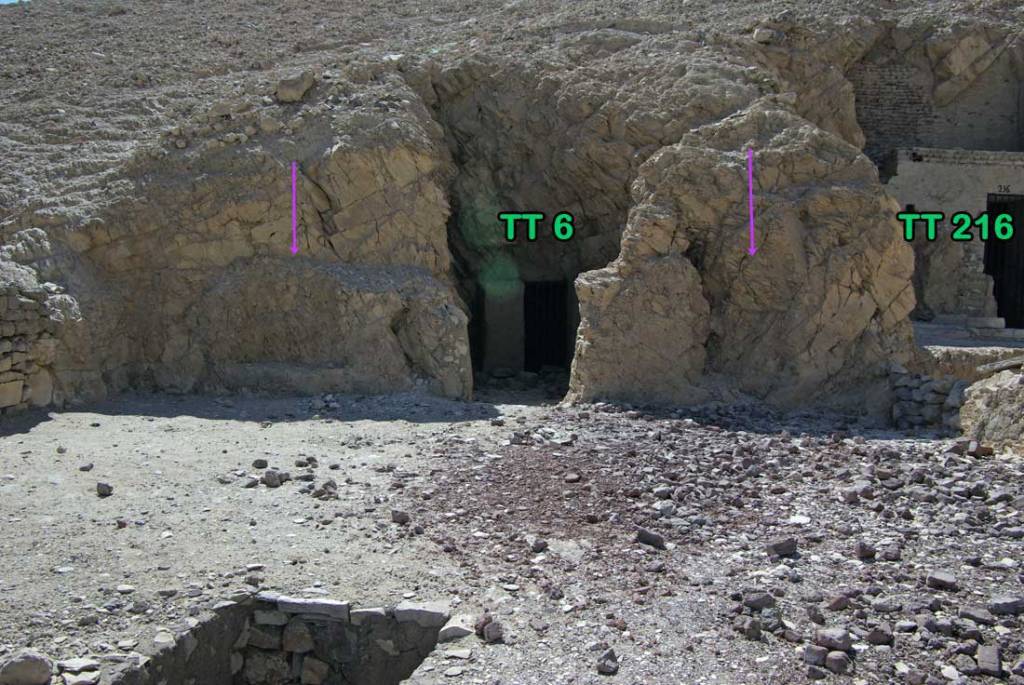
As seen in the image opposite, tomb TT6 is preceded by a terraced rectangular courtyard, adjoining the one of TT216, which is located to the right. Tomb TT216 belonged to Neferhotep (II), who was the grandson of Neferhotep (I) and son of Nebnefer.
In the middle of the courtyard is a shaft which descends to the burial chamber. The burial chamber is described at the end of page 2.
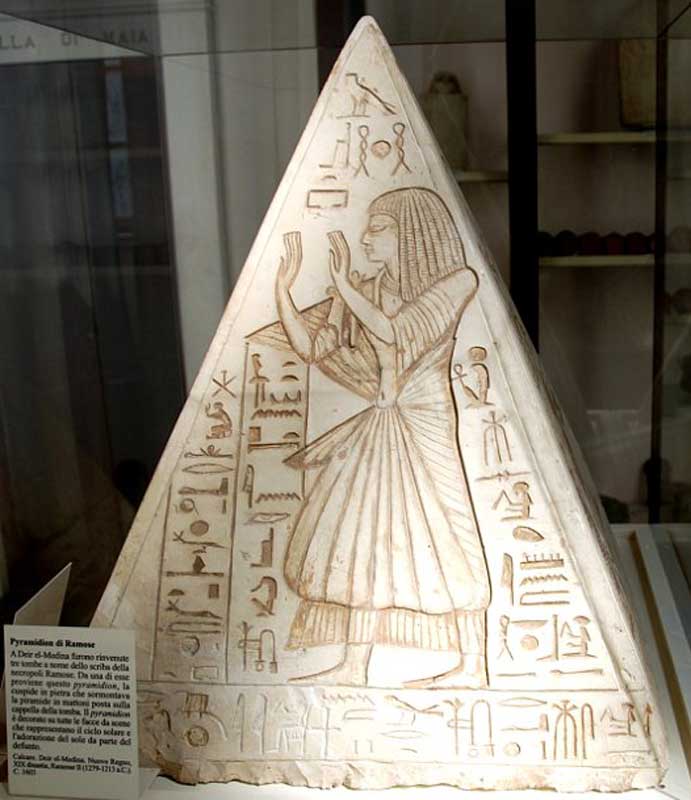
A pyramidion has been found, and it is known that a small pyramid overhung the entry to the chapel.
The original facade, carved into the rock of the hill, had two stelae, the locations which can still be seen (these are marked by arrowheads in the picture above).
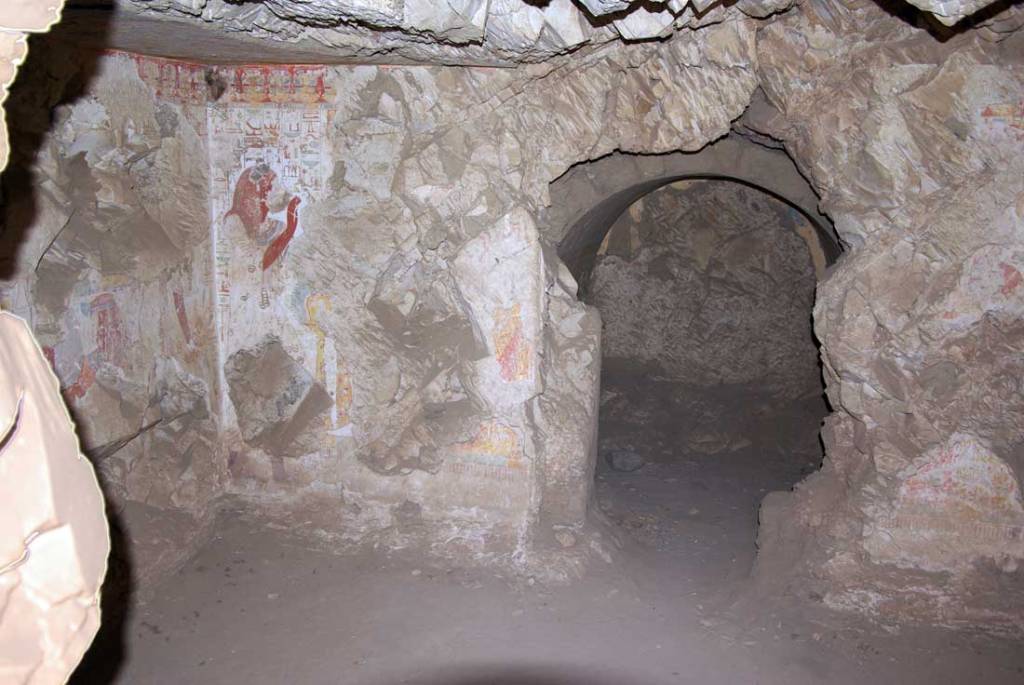
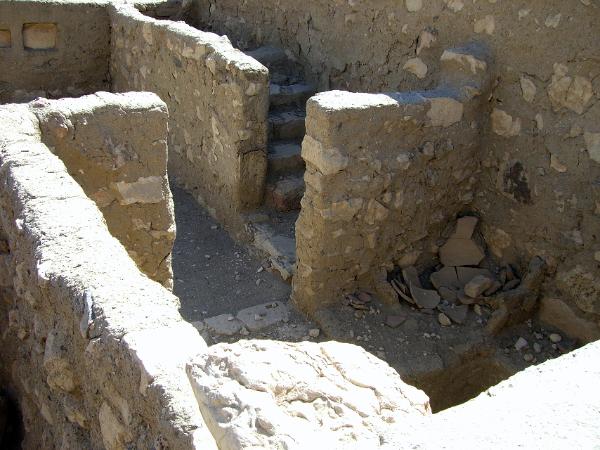
Today the tomb is entered by a collapsed corridor, of which only two small fragments still exist, one with a piece of the ceiling and some hieroglyphs forming the name Neferhotep (see tb-1708), the other with jars, amphorae and a shrine (see image to the right).
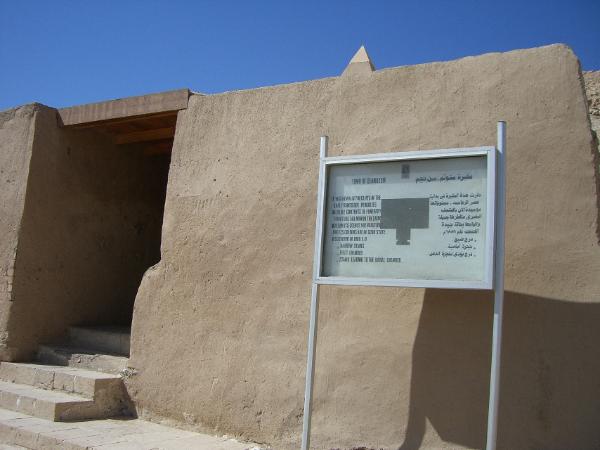
Today, the entrance to the tomb is into the main transverse chamber, through the passage which originally linked this chamber and a preceding corridor (see tb-1702).
TRANSVERSE CHAMBER
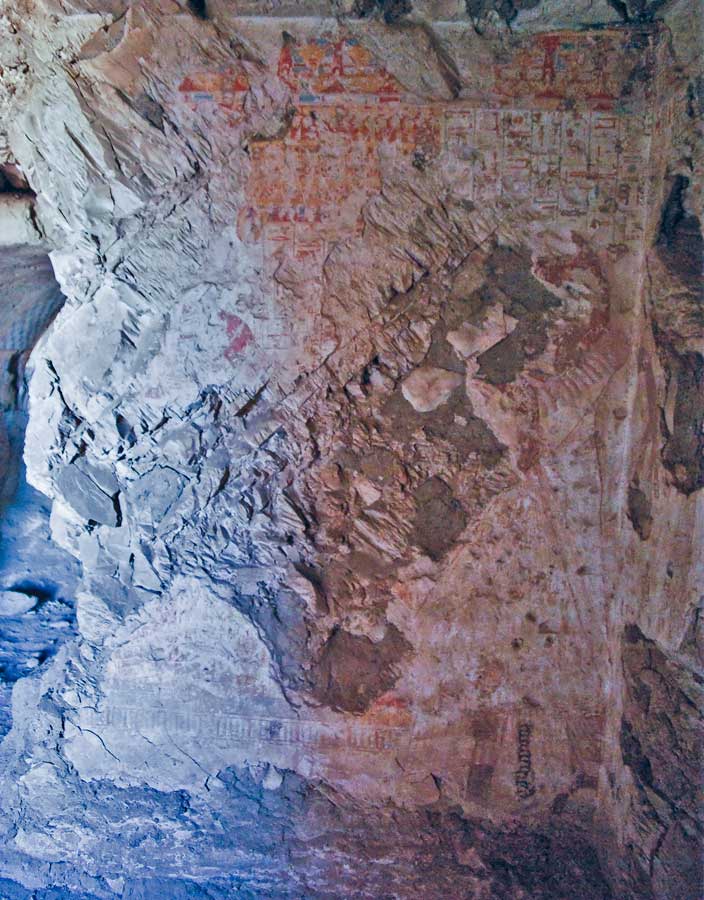
Upon entry it can be seen that the chamber is very damaged, but what has survived is of good quality.
CEILING AND UPPER FRIEZE
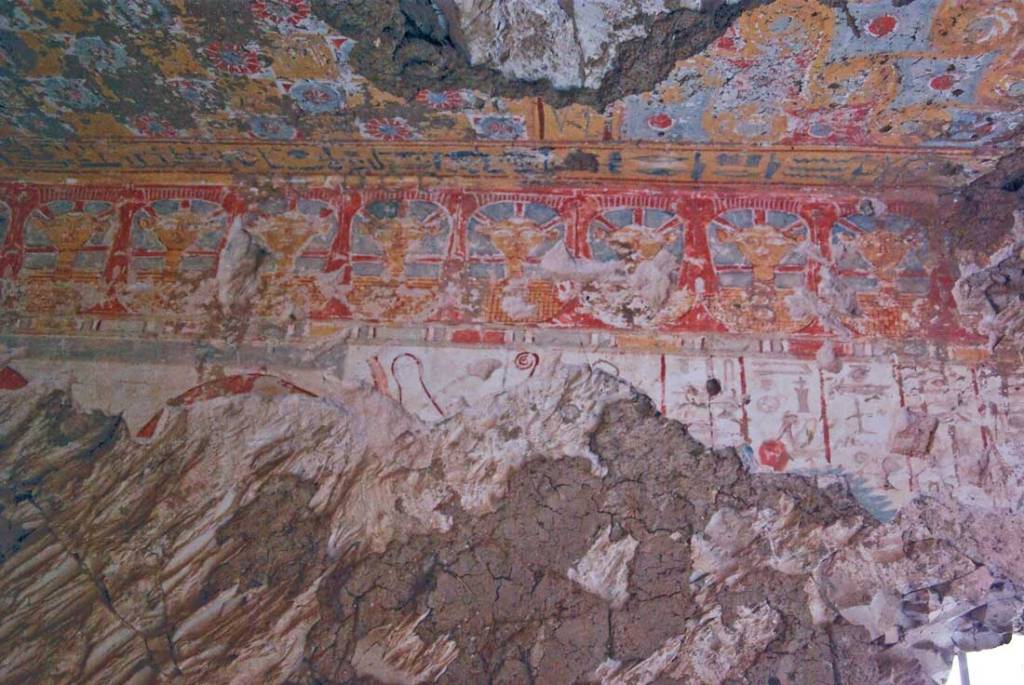
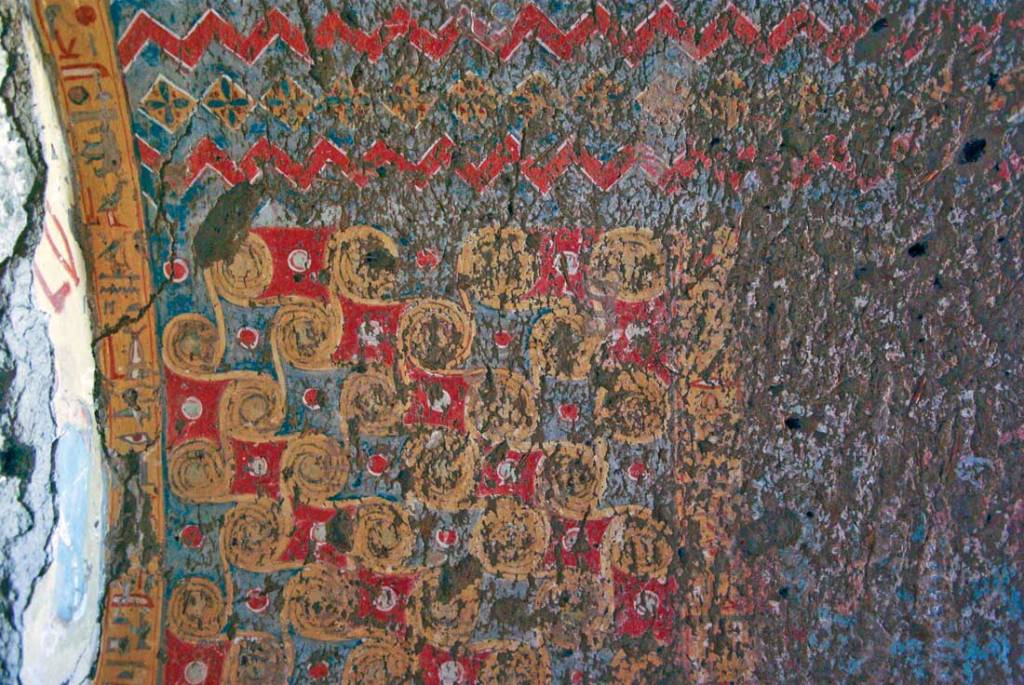
The ceiling is divided into rectangular areas by yellow bands edged with one or two red lines and having blue hieroglyphs. The patterns of the enclosed areas are varied, containing circles, rosettes, leaves, etc. (see tb-1728, tb-1727 and tb-1726).
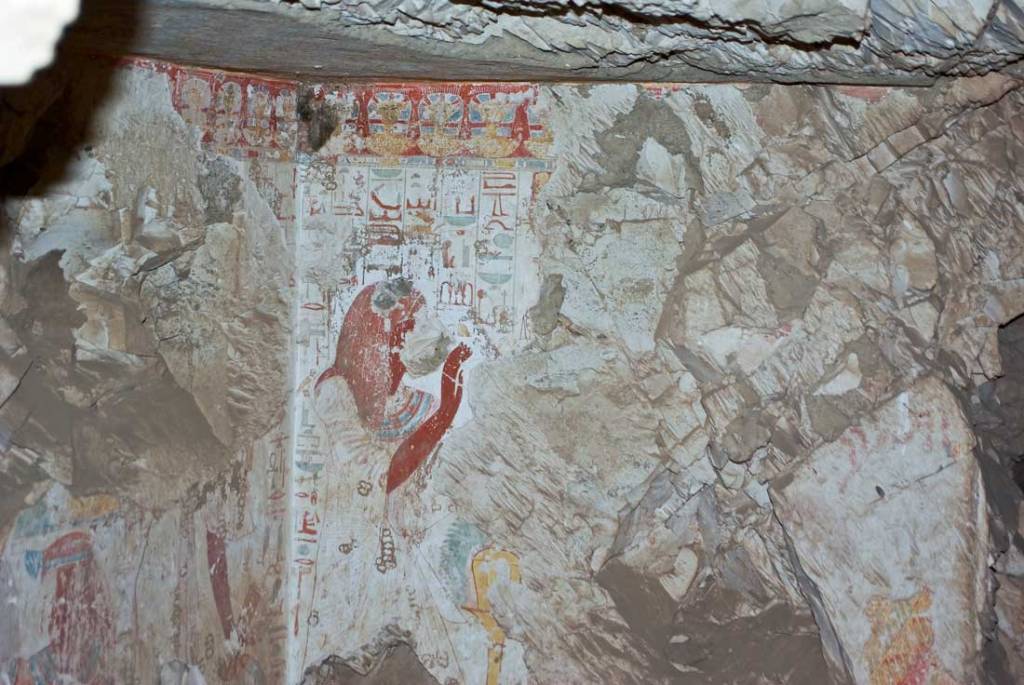
At top of all the walls runs a frieze. This consists of a red background on which are images of the goddess Hathor with the head of a cow with horns, surmounting a woven basket. The frieze is separated from the underlying scenes by classical band formed of alternating coloured rectangular patterns.
The walls were covered with a thick coating of mud which had been painted white. As is often the case in the Ramesside period, the same scene is no longer limited rigidly to a single wall, but may extend to the adjacent wall.
LEFT SIDE OF THE TRANSVERSE CHAMBER (SOUTH)
1)- East wall – south section
This includes three registers.
Upper register
(See Wild, pl.5.) This is almost completely destroyed, see the left side of the image opposite. At the extreme right, a man is seen in adoration before the ka sign, which is actually located on the adjoining south wall.
Middle register
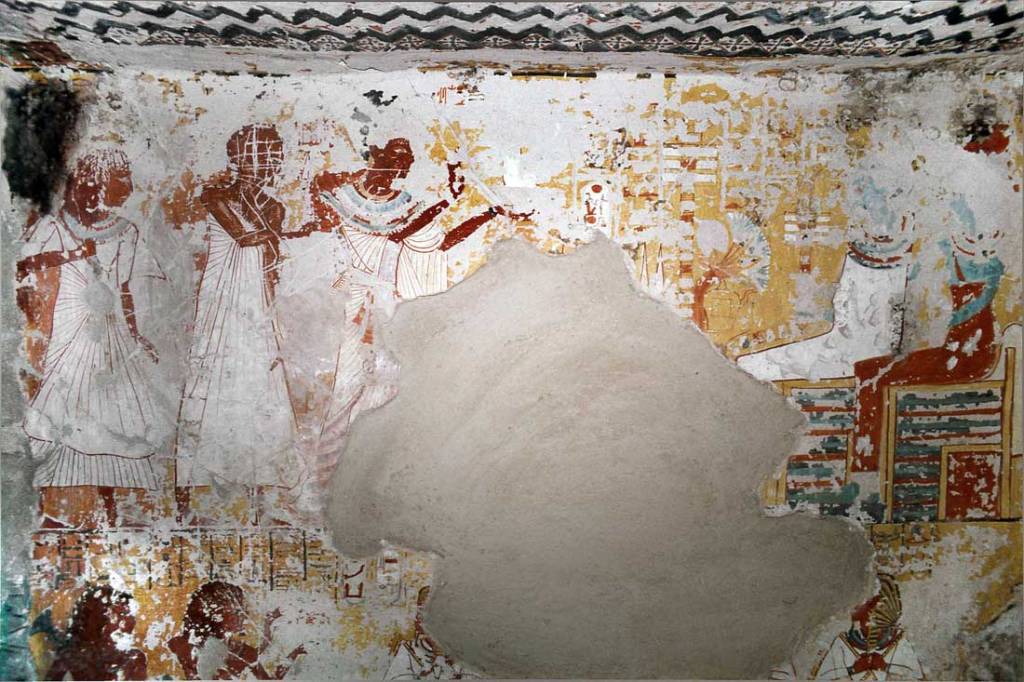
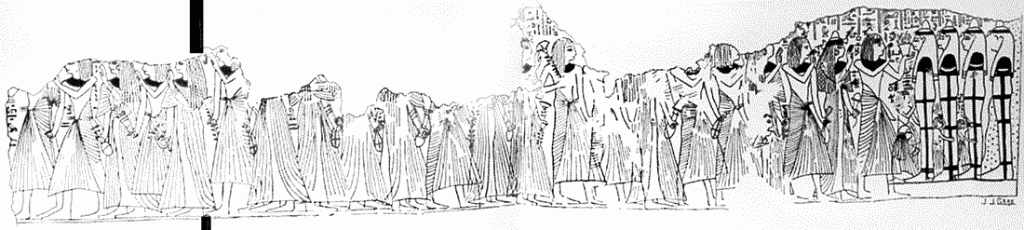
(See Wild, pl.7.) A seated couple receive the homage from four men followed by four women (the seated couple and the most of the image of the four men have disappeared). The women are dressed in a large fringed tunic with bouffant sleeves and wear a wide collar. The one which is furthest to the right is the best preserved, and she holds in one hand a large stem of blue papyrus and in the other a basket or bag. This basket is a little better seen with the woman who precedes her (see tb-1723-01). The basket appears to be divided into four parts, each containing round objects: this is a way of representing different fruits (?) for the dead, sometimes similar partitioning in baskets are found placed on tables.
Bottom register
(See Wild, pl.8 and tb-1724.) This scene is also very damaged. The left side is hardly recognisable, but what remains are of three seated couples and the two or three men who pay them homage, followed by better preserved three women.
2)- South wall
(See tb-1714)
This includes two registers on the left, but on the right the wall shares a full height image with one on the south end of the west wall.
Upper register
Adoration of the ka.
The ka, which represents the vital strength of the individual, is closely dependent of the food offerings. It is presented here on a pavois, as a symbol. As already mentioned, the image of a man on the adjoining east wall is also connected with this scene. One can see the close relationship between image and writing, since it is also about the hieroglyph , Gardiner D29. The ka remains in the tomb, unlike the ba it doesn’t have the possibility to pass from one world to the other. The representation refers to Chapter 105 of the Book of the Dead: “”Formula to make favourable to Neferhotep his ka”” or “”Formula to satisfy the ka””; sometimes the space between the two open arms contains victuals; sometimes a libation or incense are carried on the sign. The plural of the word ka, kau, designates the food offerings, showing the close relationship between one and the other.
If the individual succeeded in uniting his person’s different components (mummy, ka, ba, name and shadow) it becomes an efficient mind, an Akhu. The text of Chapter 105 goes farther, it offers to wash his ka of blemish: “”I have brought you natron and incense so that I may purify you (…) These evil things which I could hold, these evil sins which I could have committed, which are not returned to me (…) I am quite flourishing and my ka (is quite flourishing) as are those (the inhabitants of the horizon), the food of my ka is like theirs”.”
Worship of the serpent Sa-to (or Sa-ta, sata).
The name literally means “”Son of the Land””. Many snakes inhabit the Egyptian imagination, sometimes lending their protective functions – like the snake Mehen which surrounds and protects the sun on its nightly journey, sometimes destructive – as Apophis trying to capsize and destroy the solar boat every night. They are beings of the earth, particularly wetlands, which live in burrows, from where they emerge in the light of day. In addition, during the moulting period, they seem to revive themselves, the illusion of a perpetually renewed life and and undergoing transformations, during the sun’s nightly journey.
The inhabitants of the village of Deir el-Medina show some commitment to the serpent deities, as shown by the numerous stelae and the devotion to the worship of the goddess Meretseger (“”she who loves silence””) represented as a cobra.
Among the many avatars of these ophidians, the one who adores Neferhotep takes the form, rarther strangely, of the head and the inflated hood of a cobra raised on human legs, an uraeus which walks, associating the idea of mobility to that of transformation. The explanation of this figure is available in Chapter 87 of the Book of the Dead: “”Formula for taking the form of a serpent – sata:” (followed by the words spoken by Neferhotep, the deceased) “‘I am a snake, sata, rich in years, and I spent the night be in the world, every day I’m a snake – sata, who is in the bosom of the earth. I spend the night to come into the world, to be renewed, to be rejuvenated, daily'” “. Barguet made the following commented: “”The text strongly suggests that the snake, sata, is a form of the sun, the one which takes it into the underworld during its nightly journey during which it is again formed, and formed the new sun every day, the creation of the sun (and the world) recurring every morning.”.”
Chapter 87 is found in only five tombs, all Ramesside: TT290, TT183, TT214, TT359 and this TT6.
On the wall to the right, today much destroyed, showed a seated couple.
Bottom register
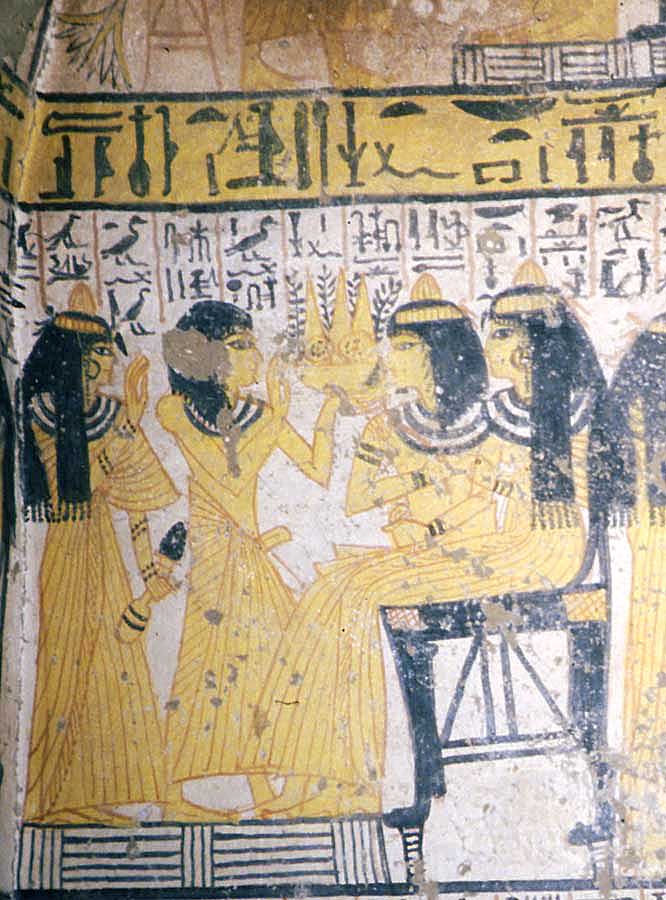
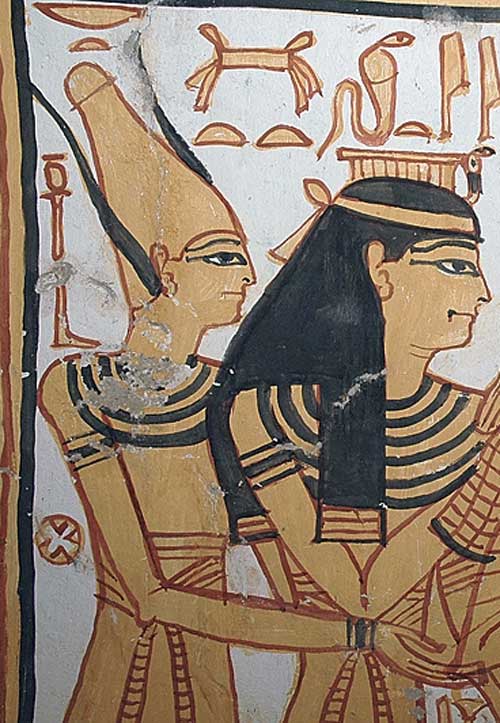
Three sons and two females, standing on the left, pay homage to Neferhotep and his wife. Neferhotep holds in his left hand a folded piece of cloth whilst in his right hand he grasps a Sekhem sceptre. He wears a large necklace of multicoloured beads. His wig is white, streaked with black (see tb-1720) which doesn’t necessarily indicate an advanced age, but rather his status as ancestor of a vast family (a similar representation is in the tomb TT290 of Irynefer (see is-19). Iyemuau, his wife, surrounds his shoulders with her arms. She also wears a broad necklace; her black wig is decorated with a headband and a stem of lotus, but without a festive cone. The first son holds out a bouquet to his parents.
Extreme right
(See Wild, pl.4 and tb-1715.) Only part of the the image of the lady Iy, the wife of Nebnefer, remains and she is standing behind her husband who is actually portrayed on the south end of the west wall. “”His daughter, who makes his name live, Iy, ‘True of Voice’ by Osiris […]””. It is also on the west wall that the explanatory text, painted in beautiful coloured hieroglyphs, which ends in front of Iy, begins: “”To bring all good and pure things for your ka, the Osiris, master of the west, Un-nefer, master of the Sacred Land, the foreman of the team of the Place of Truth, Neferhotep. His son, who makes live his name, the foreman of the team of the Place of Truth, Nebnefer, ‘True of Voice’ by the great god. His sister, the chantress of Khnum, Satet and Anuket.”.”
Iy holds in her hands two instruments with Hathoric connotations: a sistrum in her right hand, a Menat necklace and its counterweight in her left hand. According to the custom of the Ramesside period, her dress is full, occupying a significant space in the composition.
3)- West wall – south section
(to the left of the entrance to the shrine)
(Also see tb-1707)
The right-hand side is occupied by the beginning of the scene which has just described, with Neferhotep carrying a brazier, in worship of the kiosk of a seated a divinity – or rarther, where one sat, because Osiris has disappeared completely. Behind Osiris stood the goddess of the west, who protected him with her winged arms. In front of the kiosk are still the remnants of a pedestal on which was placed a golden ewer surrounded by a plant crown.
RIGHT SIDE OF THE TRANSVERSE CHAMBER 5NORTH)
West wall – north side
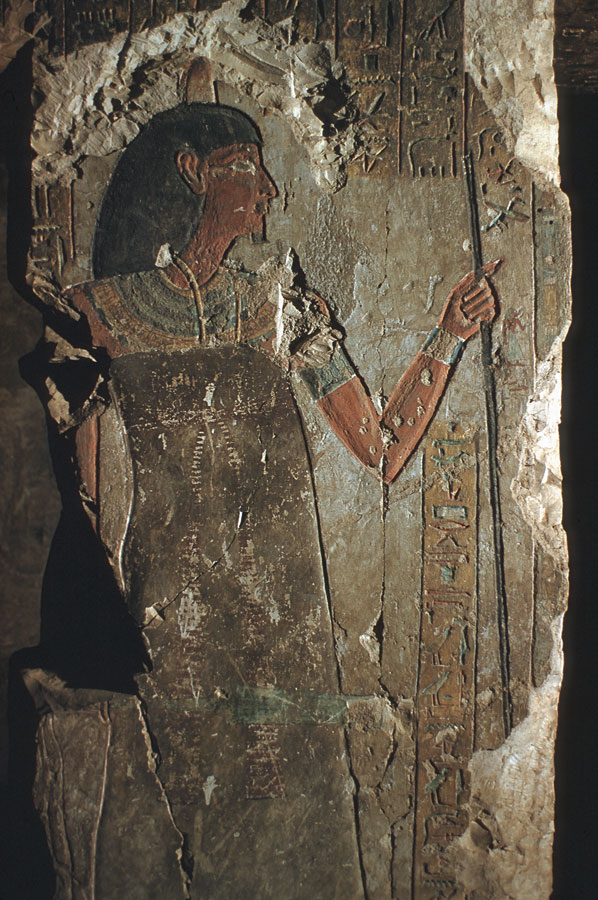
This is almost completely destroyed. Henry Wild recognised however, that immediately to the right of the opening leading towards the shrine (see tb-15) was the image of Re-Horakhty sitting under a kiosk, as Osiris does on the other side of the opening. The kiosk is surmounted with a complicated motif including, at the summit, a row of solar cobras (see tb-45). Toward him advances Nebnefer with a brazier in his hand, followed by his wife, Iy, who is actually on the north wall. In the text above him is mentioned Neferhotep (II), their son: “”making live his name”” (probably meant to be ‘their names’).
North wall
(See tb-1733)
1)- The lady Iy
This lady has already been mentioned, in the fact that she follows her husband, who is on the connecting west wall. Her image is almost the full height of the wall, with text above her, but after her the wall is divided into two registers. Very little remains of her image, but part of her dress can be seen and her right forearm waving a Hathor sistrum, whilst lotus stems hang from her elbow. Above her, the columns of text state: “”For his sister, his beloved, the hostess, Iy, the highly praised by Hathor, mistress […]””. Before her, there was also the text “”Her son, who makes live the name of his father, Neferhotep.””. As already mentioned, rest of the wall, to the right of Iy, is divided into two registers.
2)- Upper register
(See Wild, pl.11-01)
A couple sit in front of a table, playing the board-game senet
(See tb-1730-01.) This is connection with Chapter 17 of the Book of the Dead: “”Formulae for transfigurations and glorifications, for going out of the empire of the dead and return to him; to be a blessed in the good West; going out by the day, taking any form desired to be taken, to play the board-game senet sitting in the pavilion; to leave in the living ba, the Osiris, Neferhotep, after his death.”” (Barguet). In the Ramesside period, the game of senet had only one player, the deceased, without a visible opponent in front of him. But the opponent exists, it is death, forgetfulness, failure in the course in the hereafter, and finally it is a summary of the path which the deceased follows in the underworld, he must emerge victorious. This is illustrated, for example, in the commentary accompanying the identical scene in the tomb of Inerkhau, TT359: “” (…) May I move the pieces by placing them where I want (…) May I fight like a god against the opponent and see Neith (…) let my heart be insightful without being negligent, may my heart be clever to guess the game (the opponent) against me and his pawns turn around (against him), can his fingers become disturbed, and his heart leave the place so that he doesn’t know (how) to respond.”” (Cherpion). This idea to play his destiny against death will be taken by Ingmar Bergman in the movie “The Seventh Seal” (see screen capture) : here also death is invisible for all the characters, except for the knight who seems to play alone.
As often in this type of representation, two ba-birds are found: they are perched in front of the right-hand part of the roof of the structure, in front of the small bowl containing bread; a Wedjat eye was added to fill the space (see tb-1730-02).
Adoration of Nebnefer and his wife at sunrise
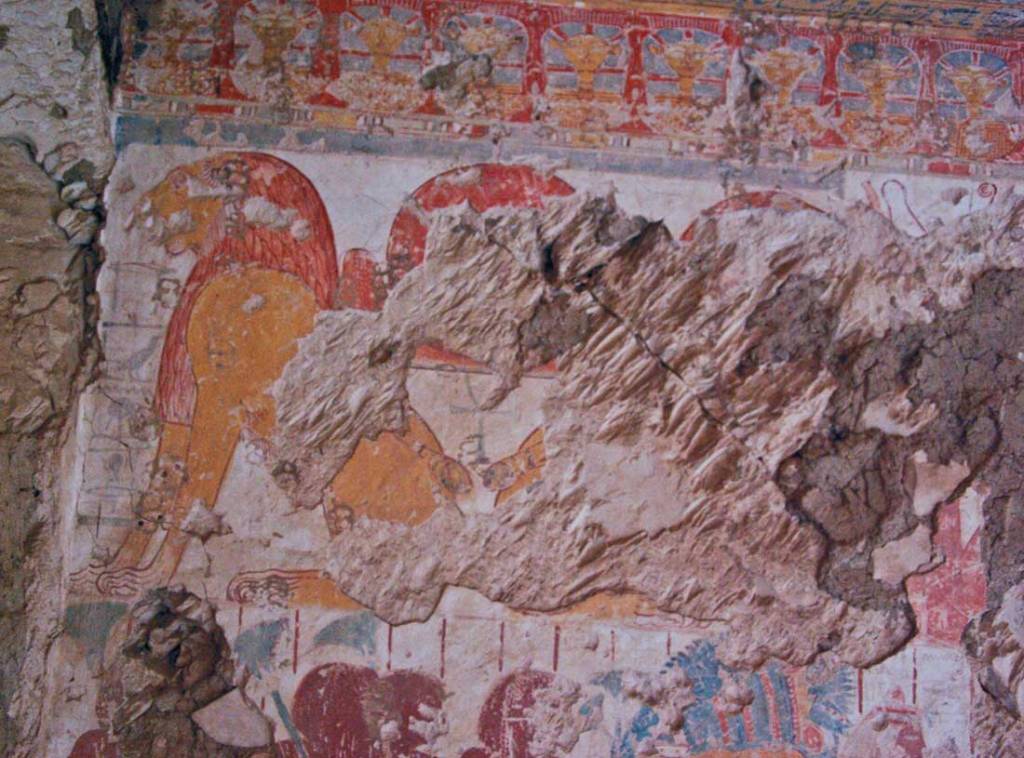
Nebnefer and Iy are kneeling in adoration, and recite a solar hymn which begins: “”Worship Ra at sunrise on the horizon in the form of a disk…””. A large area of damage has removed the rest of the imagary of the wall except a few traces which allowed Henry Wild to reconstruct the presence of the goddess Nut welcoming the deceased into it, one of the three vignettes from Chapter 17 (see Wild, pl.11-02).
3)- Bottom register
(See Wild, pl.12 and tb-1731-01.) All of the right-hand side is destroyed, it still shows Nebnefer sitting alongside his wife, Iy, and her mother, Isis. He holds in his right hand a small billowing sail, symbolising the air which the deceased hopes to breathe again, the breath of life, but also the gentle north wind, which he enjoyed during his lifetime, it is also the hieroglyphic sign (Gardiner P5). His left hand is stretched toward offerings. In the destroyed area must have been a couple of people standing in adoration, three other couples are on the lower register of the east wall.
East wall – north side
(See tb-1736)
1)- Upper register
The two lions
(See Wild, pl.13-01)
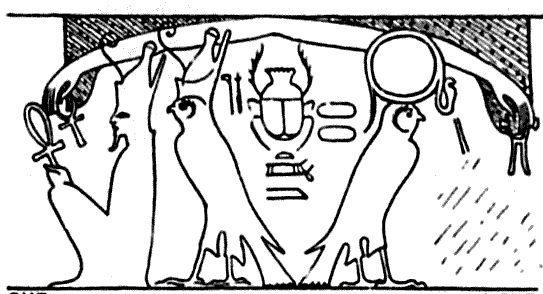
The two lions, positioned back to back, seem to support the image of the sun rising between two hills, forming the akhet hieroglyphic sign (Gardiner N27), which designates the horizon. It is also a vignette of Chapter 17 of the Book of the Dead. They are called “yesterday” and “tomorrow”; the naming indicates the ageing sun, which sets in the western horizon, so that the young sun can rise in the eastern horizon, symbolising death and rebirth of the star, and thus, by assimilation, life of the deceased being constantly renewed, which is reflected in the ankh sign of life hanging from under the image of the horizon.
The Benu bird
Further to the right, the wall is destroyed, but it is certain that it contained the image of a seated god of high authority, wearing the double crown (see tb-1739) and a wading bird, a grey heron, with a fragmentary text which refers to the transformation of the deceased benu bird (later the Phoenix of the Greeks) in Heliopolis. It is a theme which can be found in Chapter 83 and secondarily in Chapter 17 of the Book of the Dead, this transformation is one of those which the ba (soul) of the deceased hopes to accomplish. The deceased is often seen adoring the bird (as in the tomb of Inerkhau for example, tomb TT359), but not here.
The ba of Ra, the sun, is a benu bird, whose principal place of worship is Heliopolis and it is known that the sun always evokes the eternal return, it is also the ba of Osiris, referring to the victory over death and rejuvenation; finally, it is a being which comes from itself into existence.
2)- Middle register
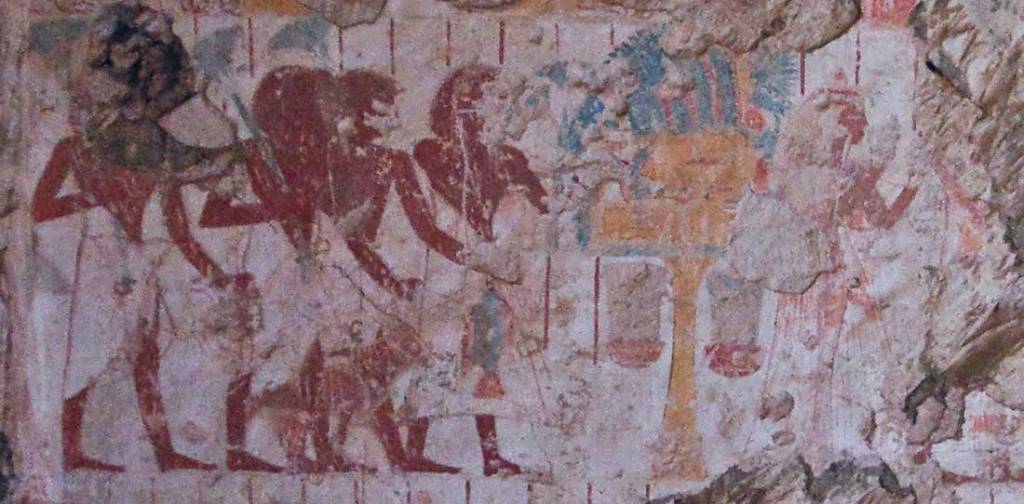
Nebnefer and Iy worship a female deity, they are followed by four men (including the military) who bring offerings (one of them even holds a calf on a lead), which will be added to those already placed on a monopodal table. The table is flanked on each side by a pedestal supporting a large vase. The columns intended for the descriptive text are empty.
3)- Bottom register
(See tb-1736-02)
This is the extension of its counterpart on the north wall. Three couples, heading towards the left, are bringing offerings. Again, the columns to the text remained empty.
THE SHRINE
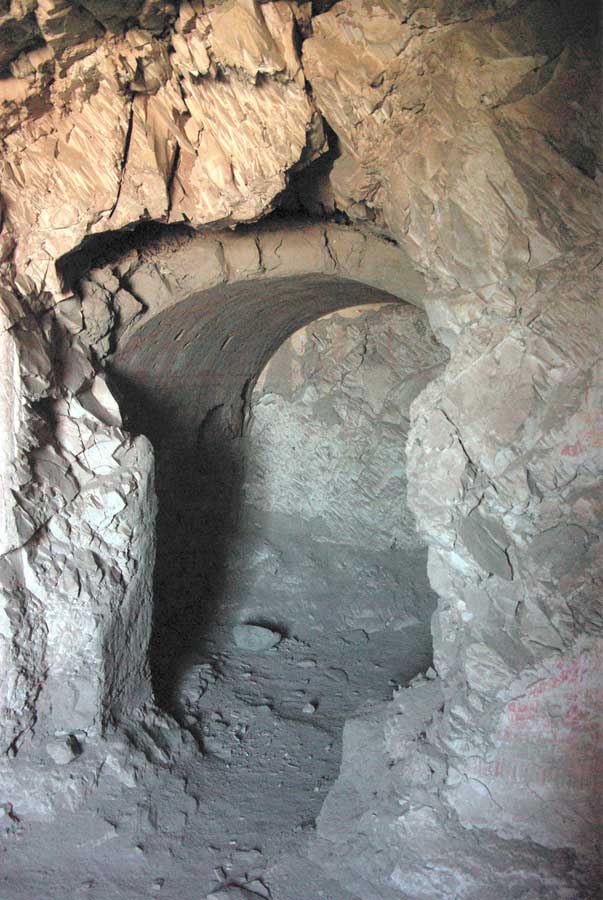
The entry to this is in the middle of the west wall (see tb-04). It is fully lined with mud bricks, with a vaulted ceiling. The whole shrine has suffered damage. Thus there is nothing left on the rear west wall of the four statues which occupied it, which were, from left to right, Satet, Osiris, Ra-Atum-Horakhty and the goddess of the West.
THE CEILING
This has a vaulted surface, extending down to the two side walls to about a quarter of the full height of the chamber. Even the upper surface of the side walls are slightly curved at the top (see the image to the right). The ceiling is centred, from the entry to the rear wall, by two side-by-side text columns of hieroglyphic text on a yellow background; each column being edged with a red line and a blue one. At each side of the two texts is a motif formed of zigzag lines of different colours (see tb-1746 and tb-1747). On either side, north and south, are four rectangular areas. The two outer rectangles are decorated with geometric patterns.The middle two, although difficult to examine, actually contain scenes. All the four sections are edged with a column of text on a yellow background. At the junction of the ceiling and the side walls there is another row of coloured text, again on the usual yellow background (see the bottom of tb-1747).
On the southern half of the ceiling
(See Wild, pl.21-01 and tb-1745)
In the two scenic areas: to the left is found the deceased with a tree goddess who provides his subsistance and to the right are represented four baboons sitting around with food, surrounded by date palms.
Move mouse pointer over image
On the northern half of the ceiling
(See Wild, pl.23-01, tb-1741 and tb-1743)
The two central areas show, on the left side, the deceased crouching under palm trees in the process of quenching his thirst (as in the tomb of Pashed, TT3) and on the right side, the deceased is fed and watered by the goddess of the sycamore who is kneeling beside the tree.
SOUTH WALL
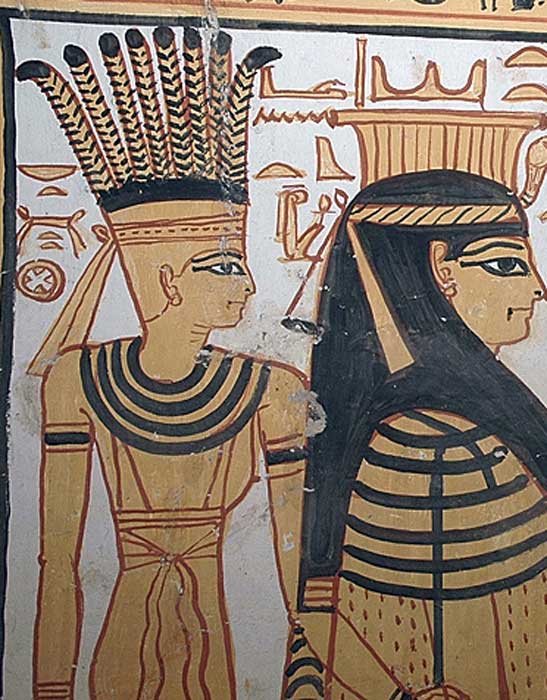
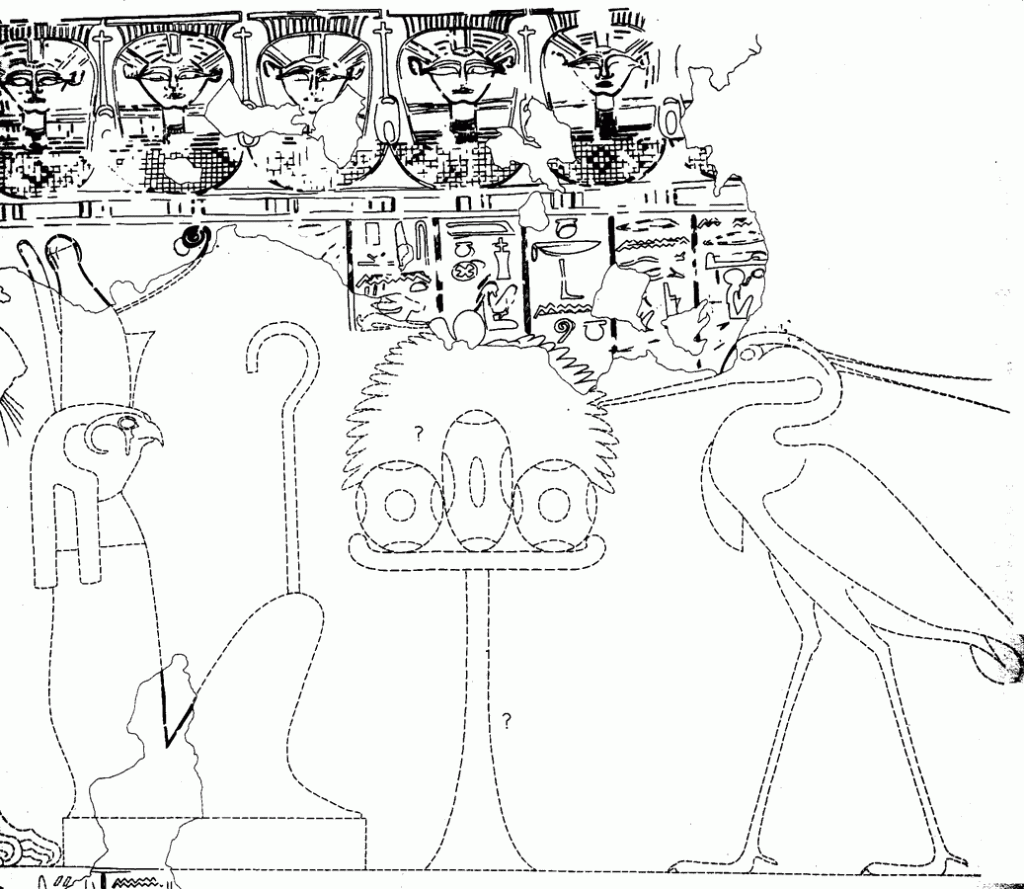
This wall is divided into two registers, but possibly containing similar scenes, the lower one is almost lost. In the upper one Neferhotep and his wife, Iyemuau, are offering to the goddess Anuket and Horus son-of-Isis, they are accompanied by their children and grandchildren (see tb-1744 in which an arrow points to the feathered headdress, characteristic of the goddess Anuket; also see Wild, p.20-01 for detail). Horus is in the form of a falcon wearing the Double Crown, with a flagellum stuck in his back, whilst at his feet rises a cobra wearing the white crown. Behind Horus, two wings spread around the solar disk which are appropriate to Horus Behedet (also known as Behedety), who was a god of the midday sun in the Delta, but would be quickly assimilated with Horus of Edfu.
NORTH WALL
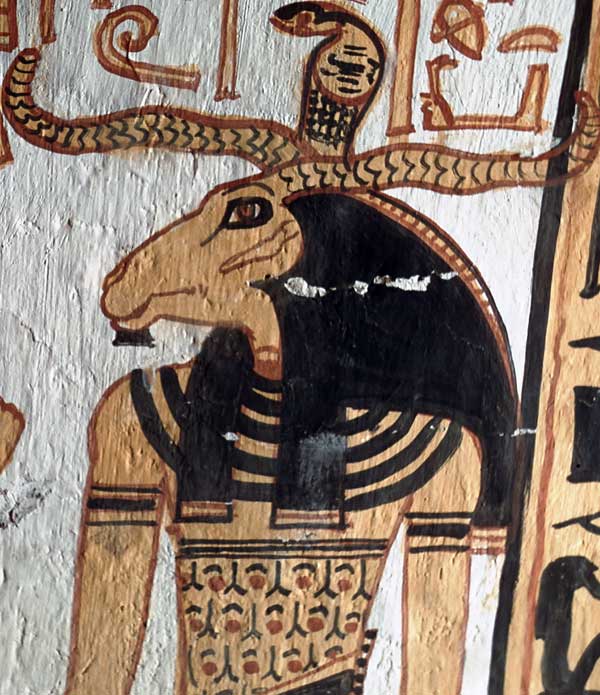
This wall was constructed in a similar fashion to the facing one, also having two registers, which here constitute a single theme. This time it is consists of Nebnefer and his wife, Iy, who dedicate some offerings, followed by members of their family (see tb-1749, tb-1752 and tb-1755). Recipients are, this time, Harseisis and Anuket, who are associated here with the two other members of the triad of the cataract, Satet and the ram god Khnum.
The triad of Elephantine: Satet (Satis), Anuket (Anukis) and Khnum
These three divine entities protect the region of Aswan, south border of Egypt and are the guards of the first cataract. All three are associated with the Nile and its nutrient and fertilising flood, specifically the rise, but also with the withdrawal of the water after the flood.
Satet was the lady of Sehel, the warrior goddess, the goddess of the inundation and guardian of the borders of the south. As mistress of Elephantine, which was the principal place of her worship, she became the consort goddess of Khnum and the mother of Anuket. When Khnum was associated with Re (Khnum-Re), she became the eye of Re. The goddess was also associated with Sothis (the Sirius star) whose heliacal rising announces the flood. She was almost always depicted as a woman wearing a tight dress and head on the white crown of Upper Egypt, associated with two antelope horns and a uraeus.
Anuket was also a goddess of the cataract at the level of Aswan, protective of the southern border. In the Middle Kingdom, this former divinity was incorporated into the triad of Elephantine as the daughter of Khnum and Satet. She was considered as the Goddess Mother of the sovereign. She was more often represented in a very recognisable way, in the form of a woman wearing on her head a low and flat crown surmounted with high ostrich feathers (reminiscent of its African origin) and holding a papyrus sceptre. Her sacred animal was the gazelle. Her cult, centred on Elephantine and Aswan, also concerns the whole of Lower Nubia.
Khnum was one of the main ram gods of Egypt. Creator God, he shaped living things on his potter’s wheel. He was associated with the flood he held under his sandal and was considered as lord of the cataract, a mythical place where the flood was supposed to come from the caves of Hapi, the fertilising stream. Demiurge, lord of crocodiles, the ba of Ra when he appears as Khnum-Ra, the god is most often represented as a man with a ram’s head, wearing a short kilt and wearing a tripartite wig, sometimes topped with the Atef crown – which is readily associated with a pair of horizontal horns – or the white crown. Besides Elephantine, one of the important places of worship was Esna.
This triad of the south is found in the tombs of some of the craftsmen of Deir el-Medineh, but it is especially Anuket who is venerated, because she was associated with Hathor, the main divinity of the village.
How did this cult become installed in Thebes? It is only one of the multiple cults imported which one finds in the village and that testify to the mobility of the craftsmen. When a newcomer was admitted into the community, he brought with him his beliefs and his gods and goddesses. On the other hand, it is known that the workers of the village were mobile. This is how one finds their traces in some tombs of Bubastion of Saqqara. Nothing prevents one thinking that some could also go to their work in the region of Aswan and discover the divinities from there, which they then integrated in their personal pantheon.
THE BURIAL CHAMBER
This was originally entered by a shaft in the courtyard. This may have been modified into a ramp (see the area photo), but can anyone confirm this? The entry to the chamber is on the east side (see tomb plan). The chamber is decorated with sketches on a white background. No photos are currently available.
Turning to the left on entering the chamber, on the south part of the east wall and the south wall, the tomb owner and his wife pay homage to squatting gods.
Now, turning to the right on entry, on the north side of the east wall is the text from the “Book of the Dead” and images of the deceased, his wife and more squating divinities.
Proceding to the next wall, the north one, this is divided into five registers. Even though, as stated, no photographs of this chamber are currently available, comparison between the two photographs in the Eva Hofmann publication (p.80) shows that this wall is almost identical with the famous wall of the tomb of Sennedjem, TT1. It includes the painting of the harvest in the fields of “Iaru”, the land of the hereafter (see ogdb-75). In it, the deceased ploughs, harvests, eats, drinks and can live on, in the circle of his family.
Finally, the west wall, the one facing the entry, is divided into two registers. It includes pictures of the Book of Gates which are guarded by five fire-breathing snakes with knives. The upper register has the deceased and the lower one has his wife. There appears to be a niche at the south end of this wall.
Neferabu’s tomb no. 5 at Deir el-Medina
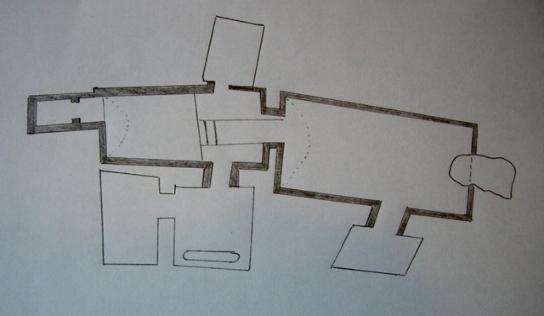

Neferabu’s tomb no. 5 at Deir el-Medina
Neferabu was a worker from Deir el-Medina, whose title was “The servant in the Place of Truth”. He
was active in the necropolis during the first half of the 19th dynasty. Thanks to the surviving textual
evidence from the village the dates can be narrowed down to years 36 (O.Gardiner 133) and 40 (O.BM
5634) of Ramesses II. (Davis,1999,158)
The tomb of Neferabu (which is numbered TT5) is an excellent source from which his family tree can
be constructed. Neferabu was the son of “The servant in the Place of Truth” Neferrenpet and his wife
Mahy. In the tomb’s inscriptions Amenmose is referred to as the “father” of Neferabu, but it has
been proven that Amenmose was in fact the father of Neferabu’s wife Ta-Isis (or Isis or Taiset).
(Davis,1999,158)
The names of his numerous children are recorded on the tomb’s walls. He had sons Nodjemger,
Neferronpet, Ramose and Meriunu and the daughters Henuttu, Mahi, Tenthaynu, Hotepy, Mutemopet,
Istnofret, Henut-iunet and Roruti.
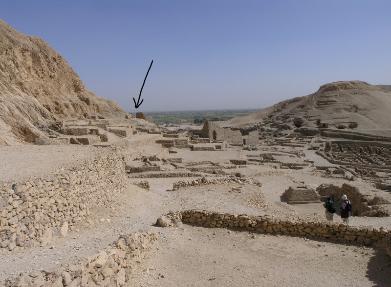
The tomb of Neferabu is nestled
against the Theban hills in the
northern part of the western
necropolis of Deir el-Medina.
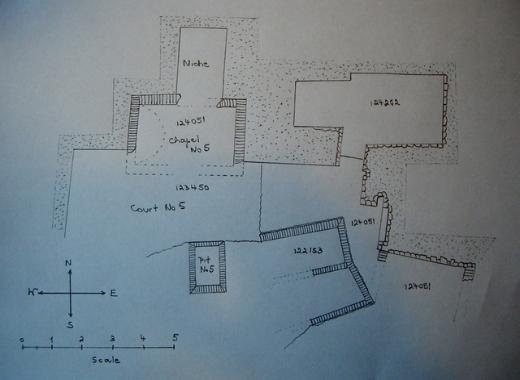
A plan of the tomb of Neferabu, no. 5. Drawn by Lenka Peacock, after a
drawing in Vandier, Jacques : Tombes de Deir el-Médineh, 1935.
History of the discovery
We know almost nothing about the discovery of the tomb of Neferabu. Most probably it goes back more
than two centuries. Maspero suggested 1818 as the year of discovery on the basis of Neferabu’s stele
now in the British Museum (EA 589, more details below). The stele came from a collection of Count
Belmore and is said to have been found in a tomb at Thebes in 1818. Although this votive stele may have
come from his tomb, it is more likely that it originated in one of the shrines at Deir el-Medina, or possibly
from the rock shrine between the village and the Valley of the Queens.
Further evidence disinclines us to accept Maspero’s claims.
- From a papyrus kept in the Louvre, we know that the tomb was violated during the Ptolemaic times
when it served as the catacombs:
“Appointed Horus leaves to each of his sons a quarter that belongs to him in Neferabu’s catacombs, and a
quarter of the dead.” - The tomb was most probably inhabited by Copts. In the first hall and in the two connecting rooms,
there were numerous burn marks on the ceiling and walls. This does not prove with certainty that the tomb
was inhabited by Copts (some markings are modern and were caused by the Arabs) but they can often be
seen as a sign of the presence of Copts, and it is very likely that the tomb of Neferabu, after serving as
the catacombs, was used as dwellings by Copts. - After his visit to Deir el-Medina in 1880s Alfred Wiedemann describes 19th dynasty tombs but does
not mention the tomb of Neferabu in his article published in 1908. - In 1929 Bernard Bruyère discovered another stele in the shaft of pit No. 1195. That again proves the
stele from Belmore’s collection, found in a tomb in Thebes, does not have to come from the tomb of
Neferabu.
However it is not impossible that the tomb of Neferabu was known already in 1818 and as forgotten
rapidly thereafter. The fact is not without precedent in Deir el-Medina – wall scenes in tomb No. 3 were
copied by Hay between 1825 and 1838 and then the tomb was again discovered by Howard Carter in - This hypothesis might be likely. The tomb known in 1818 could have filled with sand shortly
afterwards. There is another example of this happening at Deir el-Medina: the tomb of Inherkau was
partly drawn by Lepsius in the middle of 19th century, consequently lost and rediscovered by Bruyère in
1930.
A conclusion cannot be drawn on whether the tomb was known in the early 19th century, and we cannot
answer the question about who discovered the tomb of Neferabu and when. (Vandier,1935,1-4)
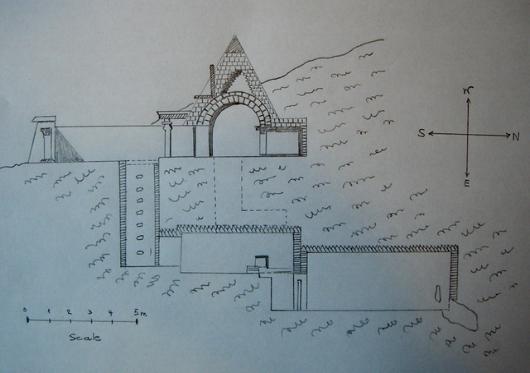
Drawn by Lenka Peacock, after a drawing in Vandier, Jacques : Tombes de Deir el-Médineh, 1935.
Architecture
The tomb belongs to the category of chapel tombs. It had the following plan: at ground level a small
open courtyard, the vaulted chapel of one room surmounted by a brick pyramid topped with a stone
pyramidion and with a large funerary stele beyond. The vaulted chapel was very brightly decorated. The
shaft near the courtyard leads into the underground passage and into two burial chambers.
This type of tomb was widely used during the 19th and 20th dynasties.
The tomb consists of two distinct parts: the underground part for the deceased, and the outer side
visited by family and friends and functioning as a place for worshipping the dead. This part was almost
completely destroyed, but the preserved remains and other data gathered from other tombs can help in
reconstruction of its shape.
The courtyard was a square measuring 6.5 meters on each side, surmounted by walls of stone and mud
brick. The entrance, which was on the southern side, undoubtedly consisted of two brick pillars, and was
approached via a ramp or stairs. At the end of the courtyard a pyramid shaped building was located.
A small chapel, the layout of which, as noticed by Bruyère, is the same as the hieroglyphic sign for the
house, was built of mud brick and stone, and measured 2 x 3.10 meters. The door, located on the
longer side opened towards the south. At the end of the chapel – opposite the front door – was a niche
where the floor was elevated to the height of one step. The niche measured 2 meters by 1.5 meters.
This was where the funerary stele and a table of offerings were usually placed.
In his report of 1926 (p. 86) Bruyère says of the chapel that “the fact the slope collapsed, the
remains were all but demolished. We can just about assume a room that had to be arched, constructed
of brick, with a west-east axis parallel to the front.”
Multicoloured figures were painted on the chapel walls against a yellow background.
Pyramid. The walls of the chapel were the basis on which stood a brick pyramid, topped by a
pyramidion. The pyramidion was made of painted limestone and had inscriptions honoring the sun engraved
on it. Each of the four sides represented one stage the sun went through during the day.
On the south side of the pyramid, a niche containing the round topped stele, found by Bruyère 1929 in a
neighboring pit No. 1195, was placed.
The inside of the pyramid was hollow to avoid putting too much weight onto the walls of the chapel. The
outer walls of the pyramids were lime washed. (Vandier,1935,5-6)
A plan of the tomb of Neferabu, no. 5. Drawn by Lenka Peacock, after a
drawing in Vandier, Jacques : Tombes de Deir el-Médineh, 1935.
Shaft. In the courtyard, two meters in front of the chapel, there was a tomb shaft. It was dug into
the ground vertically. It measures 0.75 x 1.40 meters and is 4 meters deep. Its walls were clad in
mud brick covered with white paint. There are slots in the walls of the shaft at intervals of about 0.60
metres so that descent is possible.
Four steps leading into the first chamber are modern, the 5th one is original. The door within the east
wall opened towards the west.
The first hall. It is a long hall oriented north to south, measuring 2 meters by 5.08 meters. The ceiling
is vaulted and consists of mud bricks placed in oblique lines. The walls are completely covered with paint
applied onto plaster. A large part of the vault and the north wall are blackened and burned, so it is very
hard to read the text of inscriptions and to study the wall paintings.
Around the middle of the hall the vaulted ceiling is cracked. Traces of old brick structure, no doubt the
old shaft, can be seen. This suggests that Neferabu reused an earlier tomb as his resting place. It is
likely that the earlier tomb dates from the 18th dynasty.
The original shaft is located about 2 feet from the later shaft. In the chapel courtyard remains of the
southern wall of the old shaft can be traced. It was also built from mud brick, as was the later shaft
of Neferabu’s.
A small longitudinal room leads from the first hall towards the west side and two other small
interconnected rooms are placed on the east side. It is hard to say whether the little rooms belonged to
the original tomb, or whether they were added by Neferabu. These areas may have served as
storerooms and were filled with funerary goods. The walls of these rooms are blackened by smoke
either from the Ptolemaic or the Coptic times. The first room of the eastern group displays a cavity in
the ground along its eastern wall, representing a kind of oblong tank, in which the sarcophagus could have
been placed at some stage.
At the end of the northern side of the tomb’s first hall we observe a kind of a stage or mastaba,
elevated by 47cms and 2m wide. O this altar, which occupies the entire far end of the hall, the family
of the deceased probably placed their offerings during the funeral ceremony. This mastaba is an element
occurring in the tombs of this area quite often, but is usually located at the bottom of the burial
chamber. The Mastaba in this tomb masks the shaft, which leads into the burial room. The shaft was
filled with hard-packed soil, which also formed the mastaba itself. The entrance to the second room
was no doubt closed by a large vertical stone, that slid into two vertical grooves. The grooves are still
visible at the entrance to the tomb, although they are covered with white plaster.
The entrance to the burial chamber has 4 steps, which are modern. Farina’s photographs from the time
when the tomb was excavated by Bruyère shows us the original state: there was a shaft with three of
it’s walls being whitewashed with lime. The fourth wall formed by the sealing plug. At the bottom of
the southern wall the last three layers of mud bricks were left unplastered. Either there could have
been a step, or – and it is more likely – that it is simply a sign of damage.
Burial chamber. The second room, which is the burial chamber, is larger than the first hall. It
measures 6.25 by 3 meters. Its hight reaches 2.6 metres but is also reduced by its arched ceiling. Its
floor is about 1.5 meters below the level of the first hall. Quite a large crack in the ceiling, which
damaged the front wall scenes and areas in the southeast and southwest corners, allows a glimpse of
remains of the original brickwork, as in the first hall.
The eastern wall is damaged by a large rift, about a meter wide, probably caused during probing at the
time of the discovery. It leads to a small lower cavity with dimensions 2.0 by 1.4 meters. The texts
and scenes on the walls are intact here.
The text on this page was written by Lenka & Andy Peacock
Photography © Lenka Peacock, The Trustees of the British Museum
With many thanks and gratitude to Jaroslav Bican, my brother, for the translations of the French
text into the Czech language.
Objects connected to Neferabu housed in the British Museum
Drawn by Lenka Peacock, after a drawing in Vandier, Jacques : Tombes de Deir el-Médineh, 1935.
Drawn by Lenka Peacock, after a drawing in Vandier, Jacques : Tombes de Deir el-Médineh, 1935.
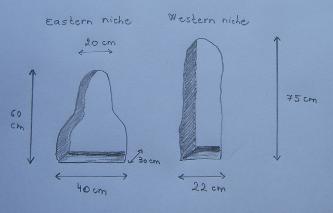
At the end of the burial chamber there is a special
and interesting detail: there are small oblong vertical
niches, located on the east and west walls about half
a meter from the northern corner. Bruyère thought
they were intended to hold a wooden beam that would
take the weight of the sarcophagus while lowering it
into a room underneath. In 1929 he made a probe
into the floor at the foot of the north wall, but
found nothing apart from a small empty cavity at 1.5
meters. The purpose of these niches thus remains
enigmatic.
The niches were drawn by Lenka Peacock, after a drawing in Vandier,
Jacques : Tombes de Deir el-Médineh, 1935.
When the tomb was being decorated, the niches were bricked up and lime washed, but the
artist left them blank without decoration. It is difficult to explain these elements as nothing
similar has been discovered in other tombs. (Vandier,1935,6-9)
Objects connected to Neferabu housed in the British Museum
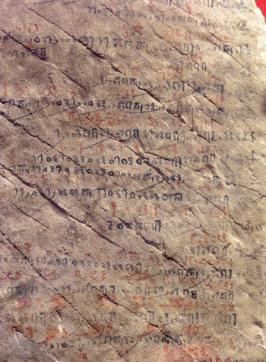
Fragment of a stele of Neferabu
19th dynasty
Limestone
From Deir el-Medina
British Museum EA 1754
Location: Gallery 63/11
Height: 17.5 centimetres
Length: 52 centimetres
Acquired in Luxor
The stele above may have come from his tomb TT5 or perhaps from one of the shrines at Deir el-Medina.
The relief shows the sons and relations of the deceased and the draftsman Pabaki, the draftsman Pashedu
and the scribe Ipu(y), carrying assorted funerary goods to place in his tomb. These include various boxes
and stools. Merysekhmet is referred to as a sn (brother) of Neferabu on the stele, but Jac Janssen
identifies Merysekhmet as Neferabu’s nephew. He argues that Merysekhmet is not his true brother, but
a member of the same generation, which, according to Janssen sn refers to. (Gleanings,1982,128). The
argument is supported by identification of at least 11 so-called brothers (sn) from several monuments
attributed to Neferabu. The filiations recorded in Egyptian funerary reliefs do not always reliably reflect
a particular blood relationship and closer investigation in certain cases enables Egyptologists to ascertain
the true relationship with the persons involved (Davies,1999,158).
It is in good but incomplete condition. In literature it is always cited together with
stela 150 (as BM 150+1754). It has been published by Kitchen in his Rammesside Inscriptions, Vol 3, p.
774, Part of 154. It has also been published in The British Museum hieroglyphic texts from Egyptian
stelae etc., edited by T. G. H. James, Part 9: Plate XXX
Registration number: 1931,0613.11
Ostrakon bearing an attendance record of
workmen
EA 5634
Neferabu’s name appears on line 3 of the
ostrakon:
Neferabu: month 4 of Spring, day 15 (his
daughet was bleeding), day 17 (burying the god),
month 2 of Summer, day 7 (embalming his
brother), day 8 (libating for him), month 4 of
Summer, day 26 (his wife was bleeding).
Pashedu’s tomb no. 3 at Deir el-Medina

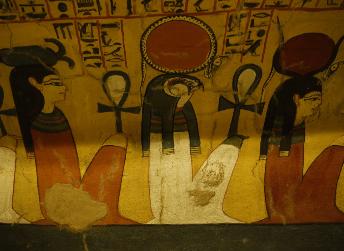
The first deity is the
falcon-headed Ra-Harakhty,
followed by a human-headed Atum.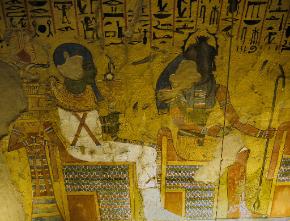
Atum is followed by the scarab-headed Khepri (the
morning form of the sun god), and the god Ptah.
Djed-pillar stands behin Ptah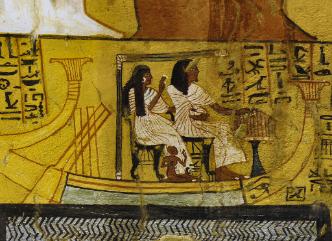
On the right side, there are:
Hathor, Ra-Harakhty, Neith…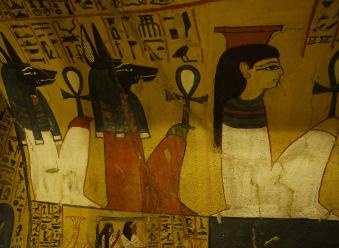
.Geb, Anubis and Wepwawet. 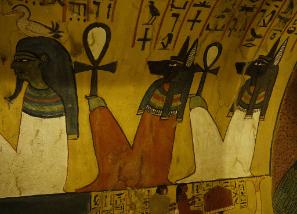
…Serqet, Anubis and Wepwawet. 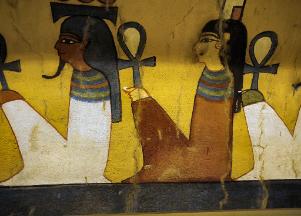
…Nun and Nepthys… 
There are sixteen deities on the
vaulted ceiling of the innermost
burial chamber, eight on each side.
On the right side, there are:
Osiris, Isis and Nut…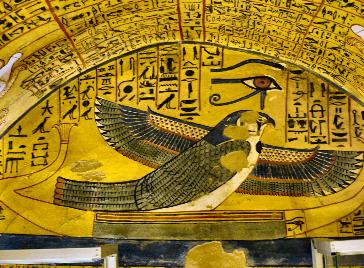
Pashedu’s tomb no. 3 at Deir el-Medina
The owner of the tomb 3 at Deir el-Medina was Pashedu, who lived in the settlement during thereigns of Sety I and Ramesses II. He had the title “Servant in the Place of Truth on the West ofThebes”. He might have also been a “foreman”, if he is to be identified with the person named in aninscription translated by Kitchen (Kitchen, 1993, p. 270). He was a stone mason, responsible forcutting the corridors, chambers and pillared halls of the royal tombs in the Valley of the Kings.Pashedu was a son of Menna and the lady Huy. He had five sons and daughters with his wife, calledNedjem-Behdet. Pashedu’s son Menna, was without any doubt named after his grandfather. Frominscriptional evidence in the tombs it seems that Kaha also was Pashedu’s son (Davies, 1999, p. 166).TT3 was discovered in 1834 by Egyptian army draftees. Scottish artist Robert Hay visited the tombshorty afterwards and recorded its decorated walls (Weeks, 2005, p. 464).
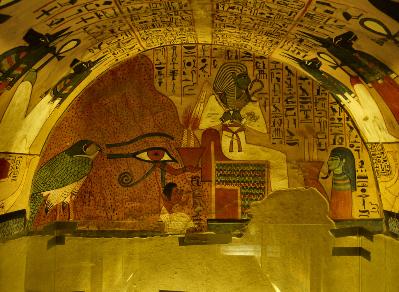
At the bottom of the entrance stairs there isan entrance into the first burial chamber,behind which the second burial chamber lies.A short vaulted passage leads into the third,innermost burial chamber. Anubis jackals thatlie on top large white shrines with cavettocornices are painted on both sides of thepassage walls. There is the godPtah-Sokar-Osiris in the form of a falcondepicted within the vaulted area above thedoorway. His elaborately painted wingsstretch out below a wedjat-eye. The falconsits in a boat. There are 15 lines of ahieroglyphic inscription. Pashedu’s sons Mennaand Kaha both kneel beside the boatworshipping gods depicted (out of the picture).
The rear wall of the innermost burialchamber shows the godOsiris-Onnophris, the ruler of thekingdom of the dead, on his throne withthe mountain of the West behind him.Osiris wears a nemes-crown and holds aflail and scepter. A seated god beforehim presents a bowl with burningtapers. The inscription written incolumns of black hieroglyphs containsspell for “lighting a lamp for Osiris”(Málek,2003,222). Behind the throneof Osiris a small figure of Pashedu isdepicted kneeling
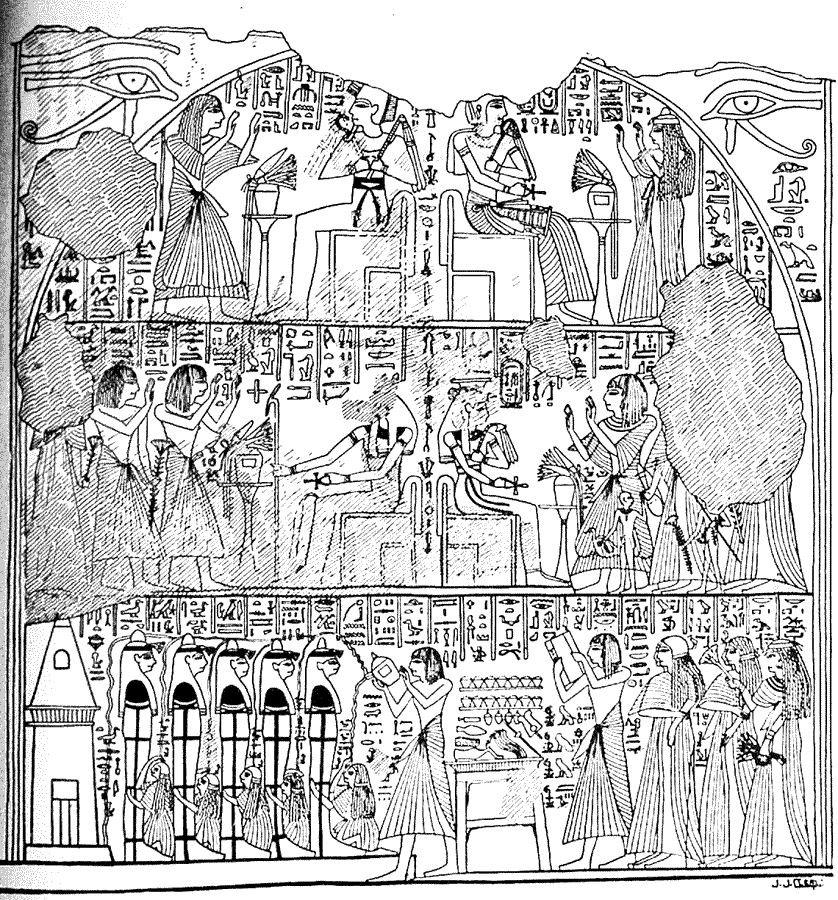
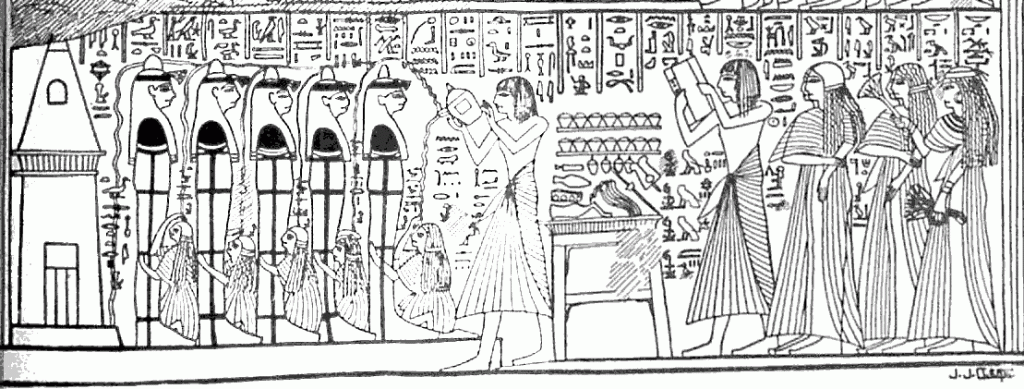
Pashedu and his wife sit before an offeringtable in a small boat of the Abydospilgrimage. One of their daughters sits atNedjem-Behdet’s feet. They both wearelegant pleated costumes made of fine linenand have long and elaborately coiffed hair.
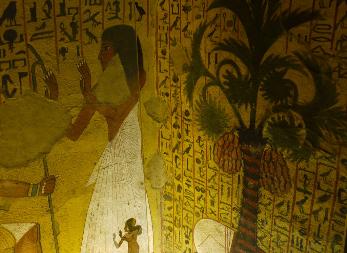
The image on the left records two cornerscenes. The scene on the right comes fromthe left front wall of the burial chamber. Itis one of the best known scenes in Thebes.Pashedu kneels and bows down beneath adom-palm at the edge of a pond. There are21 columns of text around him. 17 come fromchapter 62 of the Book of the Dead, theChapter for Drinking Water in God’s Domain.The left scene comes from the right wall ofthe burial chamber. Pashedu and his daughterNebnefret stand before four male deities anda djed-pillar. The first deity is thefalcon-headed Ra-Harakhty,followed by a human-headed Atum.Atum is followed by the scarab-headed Khepri (themorning form of the sun god), and the god Ptah.Djed-pillar stands behin Ptah.
There are sixteen deities on thevaulted ceiling of the innermostburial chamber, eight on each side.On the right side, there are:Osiris, Isis and Nut…
TT2 of Khabekhnet at Deir el-Medina
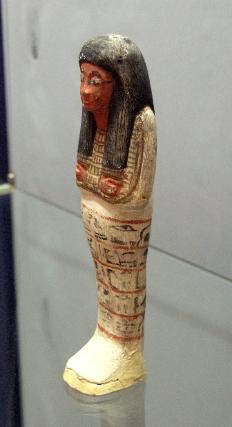
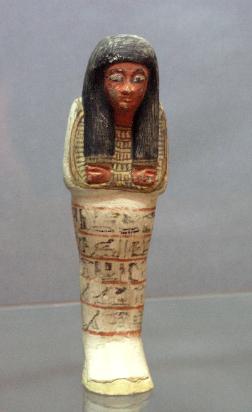
TT2 of Khabekhnet at Deir el-Medina
Khabekhnet was buried along with his wife,Sahte, and their family in a tomb in theabove and slightly to the south of hisfather’s tomb.Khabekhnet’s family was as extensive asSennedjem’s family. A stela found in thecourtyard of the tomb contains the namesof Khabekhnet, his brother Khons andseveral children: Mose, Anhotep,Amenemheb, Isis and Henutweret.Benedict Davies suggests they all wereKhabekhnet’s offspring (Davis,1999,45).Shabti for KhabekhnetFrom TT2, the Western cemetery at Deir el-MedinaLimestone, painted19th dynasty, reign of Ramesses IIHeight: 20.8 cmThe Náprstek Museum collection, Prague, Czech Republic, P6125Khabekhnet was the eldest son of Sennedjem (TT1).He lived during the 19th dynasty when Ramesses II(1279-1212 BC) was on the throne. His title was”Servant in the Place of Truth”. He lived in Deirel-Medina and worked in the royal tombs at theValley of the Kings.Khabekhnet’s house was located in the southwesternpart of the village. It stood next to the house ofhis father Sennedjem (Théby,2007,276).
Khabekhnet was buried along with his wife,Sahte, and their family in a tomb in theabove and slightly to the south of hisfather’s tomb.Khabekhnet’s family was as extensive asSennedjem’s family. A stela found in thecourtyard of the tomb contains the namesof Khabekhnet, his brother Khons andseveral children: Mose, Anhotep,Amenemheb, Isis and Henutweret.Benedict Davies suggests they all wereKhabekhnet’s offspring (Davis,1999,45)
Another group of children of Khabeknet is listed in a register on the north wall of the hall of his tomb:sons Sennedjem (ii), Piay, Bakenanuy and Kha and the daughters Webkhet, Mutemopet and Nofretkhau(Davis,1999,45).Inscriptions on a statue of Khabekhnet and Sahte preserved the names of their three more daughters:Roy, Nodjemmut and Wabet as well as the names of the grandchildren Mose, Khaemseba and Mutkhati(Davies,1999,46).The substructure of the tomb contains decorations and scenes of the gods Ra, Osiris, Hathor and theking, also of Hapi and offerings and scenes of various other deities.
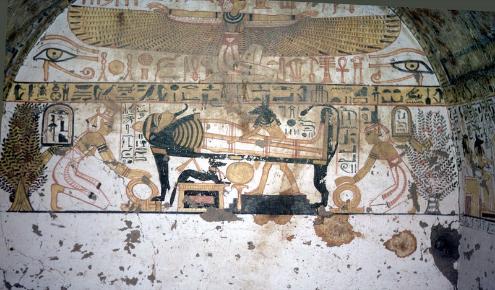
The goddess Isis spreads her protective wings above the bed, where the mummy of the deceased is laidout on the bed and the priest with the mask of Anubis cares for it. It represents Chapter 151 fromthe Book of the Dead. The goddess Isis and goddess Nepthys both kneel beside the bed.
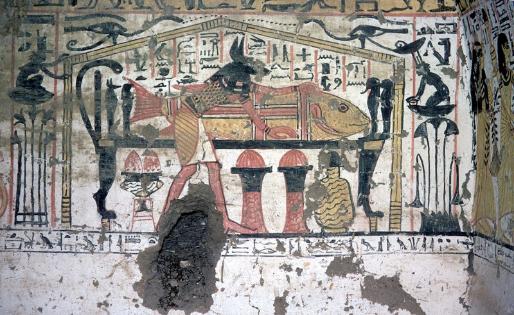
Another wall shows a similar scene in slightly modified form: Anubis, the jackal-headed embalmer, isattending to the dead Khabekhnet, who is depicted here as a mighty fish, rather than the usual humanmummy, lying on a lion-legged couch. The following words accompany the scene: “Anubis, the imy-wt,says: I come and I am your protector of eternity, oh abdw-fish from true lapis lazuli”. The four sonsof Horus (Imset, a human headed deity responsible for the liver, Hapi, a baboon headed deityresponsible for the lungs, Duamutef, a jackal headed deity responsible for the stomach and Kebechsenefwith a head of a falcon responsible for the viscera of the lower body) flank the fish at the head andfoot of the bed. The whole scene is framed by a tent, by the sides of which Isis and Nepthys kneel onclumps of lilies and papyrus plants. This large “abdw” fish is unidentifiable. The painting remains so farunparalleled.
The fish has been identified as the Nile perch (Lates niloticus) and was explained as a symbol of thedeceased awaiting rebirth (Germond,2001,143).Patrick Houlihan admits that the precise meaning of this fish mummy is uncertain, but he thinks that itprobably represents the deceased, who associates himself with the god Osiris (Houlihan,1996,132).Ingrid Gamer-Wallert (Gamer-Wallert,1970,131-132) suggests that the abdw-fish is related totilapia, a fish that in ancient Egyptian art symbolises rebirth. She argues that in this painting, the fishrepresents the followers of Re and his boat or is even a manifestation of the sun god himself. Could itbe that the dead man, regarding his continued existence to be secured by the presence of the solarbark and the tilapia and abdw-fish, might also have felt the desire to transform himself into one ofthese fish, and thus into one of the manifestations of Re? Why Khabekhnet chose the abdw-fish in thiscase and not the usual tilapia, we will probably never know.
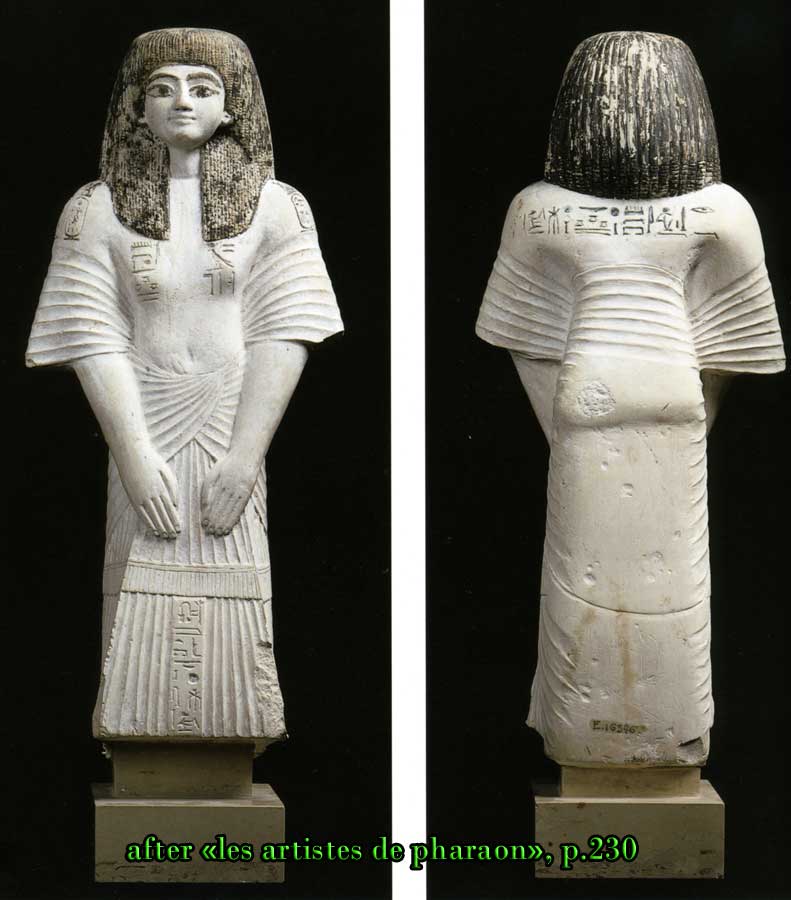
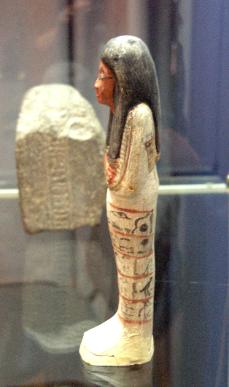
Shabti for KhabekhnetFrom TT2, the Western cemetery at Deir el-MedinaLimestone, painted19th dynasty, reign of Ramesses IIHeight: 20.8 cmThe Náprstek Museum collection, Prague, Czech Republic, P6125
The shabti has a blacktripartite wig and a widecollar around his neck.
There are five lines of hieroglyphicinscription from a chapter of theBook of the Dead.
“Sehedj, Osiris, servant in thePlace of Truth, Khabekhnet, iscounted, when people are called toall works that should be done inthe necropolis…”(Théby,2007,273)
Sennedjem’s tomb no 1 at Deir el-Medina
Sennedjem’s tomb no 1
at Deir el-Medina
The tomb lies within the Western cemetery. It was discovered intact in 1886. The opening and
clearing of this intact burial place was overseen by Gaston Maspero, the head of the Antiquities
Service at the time. Twenty mummies, nine of which were in coffins and eleven only wrapped in linen,
were found inside the vaulted burial chamber which measures 5.12 m by 2.61 m, and 2.40 m high.
The tombs owner was Sennedjem, a “servant in the place of truth”, who lived in the village at the
beginning of the 19th dynasty and then shared this “house of eternity” with his wife Iyinofreti, their
son Khons and daughter in-law Tamakhet and the lady Isis, wife of their second son Khabekhnet,
together with their grandchildren. Both Sennedjem and his wife lived well into an old age. Iyinofreti’s
mummy, now in the Metropolitan Museum in New York, is that of a woman of approximately 75.
Sennedjem’s house lies in the south-western corner of the settlement. It neighbours a house of his son Khabekhnet.
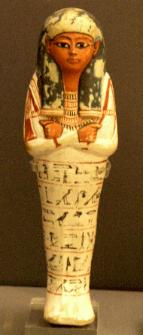
Shabti of Sennedjem
Fitzwilliam Museum, Cambridge E.9.1887. Limestone with
pigment
Height 21.5 cm.
From Deir el-Medina, Tomb 1 of Sennedjem
New Kingdom, 19th dynasty, reign of Seti I, 1294-1279 BC
The shabti holds a broad bladed hoe against his right shoulder
and a hoe with pointed blade against his left shoulder. A basket
for seeds is depicted on his back, slung by a rope over his right
shoulder. The text invokes the shabti as a servant, literally
“hearer of the call”, to act on behalf of Sennedjem if required
at any of the works which are done in the necropolis.
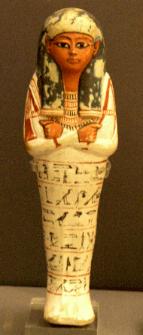
Shabti of Sennedjem
Kunsthistorisches Museum Vienna, Egyptian –
Oriental Collection, Inv AE_INV_6614
New Kingdom
19th dynasty, around 1300 BC
From Deir el-Medina, Tomb 1 of Sennedjem
Limestone, painted
Height: 28.3 cm
Width: 9.95 cm
Depth: 8.8 cm
For the translation of the hieroglyphic inscription
The tombs of Deir el-Medina

The tombs of
Deir el-Medina
The ancient Egyptians regarded the human life as cyclical, an experience which, like the
endless re-emergence of the sun each dawn, could be expected to repeat itself
throughout eternity. Death was regarded not as an end, but a further change, leading
forward to another type of existence. They recognised death was inevitable but believed
that by passing through it could the afterlife be attained (Taylor,2001,12). This
conception was the product of many centuries of thought. Various means could ensure
their eternal life : piety to the gods, the preservations of the body through
mummification, and the provision of statuary and other funerary equipment. The body and
the funerary equipment of various kinds were usually placed within a tomb. The tombs
were almost always subterranean, usually comprising a simple pit, a rock-cut room or a
chamber of mud-brick or stone.
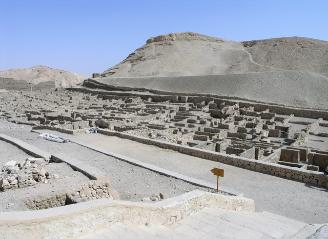
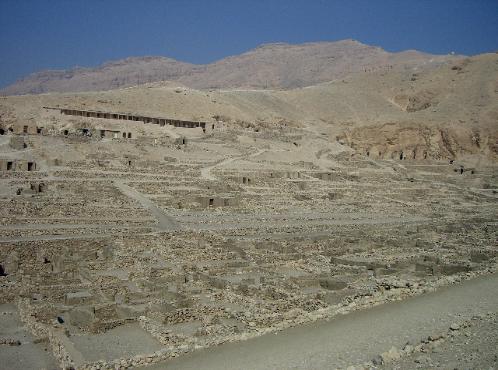
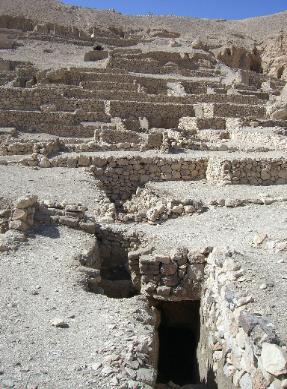
The main cemetery of the royal workmen at Deir el-Medina is situated to the west of the village, on
the slope of the Theban hills. Most of the tombs were built during the 19th dynasty. Some of them
are impressive in their decoration and size. By the time of the 20th dynasty the tombs had been
turned into family tombs in which the descendants of the original owners were buried. Little
alterations were made apart from the addition of another subterranean burial chamber. The lower
courses of the eastern hill of Qurnet Mura’i were the site of burials of babies and children. More than a hundred children were buried in common domestic pottery jars or amphorae, in baskets, even fish baskets, in chests, boxes or in proper coffins there. The poorest burials were those of still-born babies. They contained no jewellery or amulets, only small vessels filled with food for the afterlife. The adults’ graves were situated higher up. Many of these graves date from the 18th dynasty.
– View of the cemetery at the northern side
of the settlement looking towards west
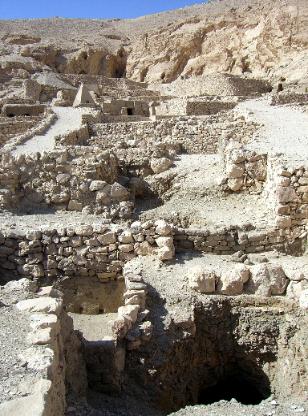
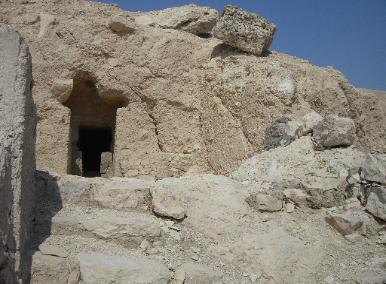
– A tomb at the southern part of the settlement
The settlement’s tombs had a basic plan:
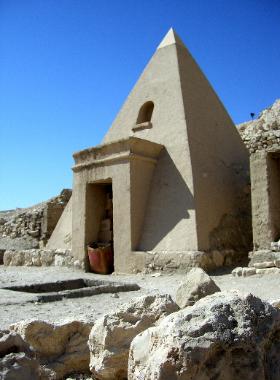
at ground level a small open courtyard, a vaulted chapel
of one or more rooms surmounted by a brick pyramid topped with a stone pyramidion. A shaft in the
courtyard led into an underground passage and a decorated burial chamber or chambers, depending
on the individual’s means and status. The main subterranean chamber usually had a vaulted roof and
was very brightly decorated. Stelae were set into the mud-brick walls and a large stela
commemorating the deceased and depicting his funeral, was placed in the courtyard.
A number of the tombs are still in an excellent
state of preservation. Their decoration boast
vivid colours against a rich yellow background
possibly suggesting the colour of papyrus. The
themes of the decorated walls are not scenes
of daily life or funerary ceremonies but instead
are devoted almost exclusively to texts and
scenes from the Book of the Dead, borrowing
from the same repertoire of religious scenes
that appear on the walls of royal tombs in the
Valley of the Kings.
As the Harpist’s Song in the tomb of King Intef puts it:
“Increase your happiness!
Be not weary-hearted! Follow your heart and happiness!
Make your things on earth! Do not destroy your heart,
until that day of lamentation comes for you!
The Weary-hearted does not hear their lamentation;
mourning cannot save a man from the tomb-pit.
Make holiday! Do not weary of it!
Look, no one can take his things with him.
Look, no one who has gone there returns again.”
(translation from Parkinson,1991,146)
1 – Sennedjem, Servant in the Place of Truth under Seti I and Ramesses II
2 – Khabekhnet, Servant in the Place of Truth
3 – Pashedu, Servant in the Place of Truth on the west of Thebes (Also owner of tomb 326)
4 – Qen (link to the Griffith Institute Archive), Chiseller of Amūn in the Place of Truth. (Perhaps
also owner of tomb 337.) Ramesses II.
5 – Neferabu, Servant in the Place of Truth on the west of Thebes. Ramesside
6 – Neferhotep and son Nebnefer (link to osirisnet.net)
7 – Ramose (link to osirisnet.net) (also tombs 212 and 250)
8 – Kha, architect of Amenhotep II
9 – Amenmose
10 – Kasa and Penbuy (link to the Griffith Institute Archive)
206 – Inpumheb, scribe of the Place of Truth
210 – Raweben
211 – Paneb
212 – Ramose, scribe of the Place of Truth (also tombs 7 and 250)
213 – Penamun
214 – Khawi, guard in the Place of Truth
215 – Amenemopet, scribe of the king in the Place of Truth (link to the Griffith Institute Archive)
(also tomb 265)
216 – Neferhotep, the foreman (link to osirisnet.net)
217 – Ipuy, sculptor under Ramesses II (link to the Griffith Institute Archive)
218 – Amenakhte and Iymway. Excavated by Bruyère in 1928
219 – Nebenmaat. Excavated by Bruyère in 1928
220 – Khaemteri. Excavated by Bruyère in 1928
250 – Ramose, scribe of the Place of Truth (link to osirisnet.net) (also tombs 7 and 212)
265 – Amenemopet, scribe of the king in the Place of Truth (also tomb 215)
266 – Amennakht, chief craftsman of the Lord of the Two Lands in the Place of Truth
267 – Hay, officer of workmen in the Place of Truth
268 – Nebnakhte (family tomb)
290 – Irynefer
291 – Nakhtmin or Nu
292 – Pashedu
298 – Baki or Wennefer
299 – Inherkau (also tomb 359)
321 – Khaemopet
322 – Penshenabu
323 – Pashedu, draughtsman in the Place of Truth
325 – Simen
326 – Pashedu, foreman (also tomb 3)
327 – Turobay
328 – Hay
329 – Mose and Ipy
330 – Karo
335 – Nakhtamun (link to osirisnet.net)
336 – Neferrenpet
337 – Eskhons and Qen, chiseller in the Place of Truth
338 – May
339 – Huy or Pashedu (Ramesside Period)
340 – Amenemhat (link to osirisnet.net) (also tomb 354)
354 – Amenemhat (also tomb 340)
355 – Amenpahapy
356 – Amonemuia. Excavated by Bruyère in 1928
357 – Tutihermaktuf. Excavated by Bruyère in 1929
359 – Inherkau, foreman in the Place of Truth under Ramesses III and IV (also tomb 299)
360 – Qeh, foreman in the Place of Truth
361 – Huy, main carpenter in the Place of Truth
Tombs and pits excavated by Bruyère in 1928
1102 – 19th dynasty
1119 – Ramesside tomb –
1129 – 18th dynasty
1130 – situated 9 m north of the court of TT337
1131 – situated 4 m at 6 degrees north of TT337. 18th dynasty objects found
1132 – situated 10 m north of No 1130
1133 – situated 9 m from TT3. 5 steps staircase, simple chamber, amphorae fragments found
1134 – situated east of TT1133
1135 – situated 10 m east of TT325 chapel
1136 – situated 8.20 m south-west of TT325 chapel
1137 – situated 5.35 m north-east of TT337 court. 18th dynasty brick and 18th dynasty hieratic
inscription found found
1138 – Nakhy and Amenwahsu. Situated south of TT325 chapel. 18th dynasty. 64 funerary cones
found
1139 – situated 14 m north of TT337
1140 – 18th dynasty
1141 – situated 8 m east of 1139
1142 – situated 5 m east of TT337
1143 – situated 8.7 m east of 1140. Pit 2.9 m deep. Pottery fragments found
1144 – situated 5 m nort-east of 1139. Pit 3.45 m deep. 18th dynasty. Pottery fragments found
1145 – situated 13 m east of TT 340. Pit 3.65 m deep. 18th dynasty. Pottery
1146 – rectangular, 3.2 m long
1147 –
1148 – style of the 18th dynasty
1149 – situated 8.7 m north of TT329 court and 8.2 m west of TT250 chapel
1150 – north of TT250. Brick with cartouche of Tuthmosis IV (1419-1386 BC) found. 18th dynasty
1151 – fragments of pottery found
1152
1153
1154
1155
1156
1157
1158
1159 – pit 1. Hermes, pit 2. Sennefer
1160 – situated south of TT250. 18th dynasty
1162 – 18th dynasty
1163 – 18th and 19th dynasty. Brick with cartouche of Tuthmosis I (1524-1518 BC)
1161 – 18th dynasty, pit 3.90 m, 1 vertical chamber
1164 – 18th, 19th dynasty. Pottery found. The owner identified as Aamek
1165 – 18th dynasty
1166 – name of the owner lost, 18th dynasty
1168 – 18th dynasty
1169 – 18th dynasty
1170 – 18th dynasty.
1171
1172
1173
1174
1176 – 18th dynasty
1180 – 18th dynasty
1181 – 18th dynasty
1182 – 18th dynasty
1183
1184
1206 – anonymous
Archaeologists document 12,000 year old inscription in South Sinai
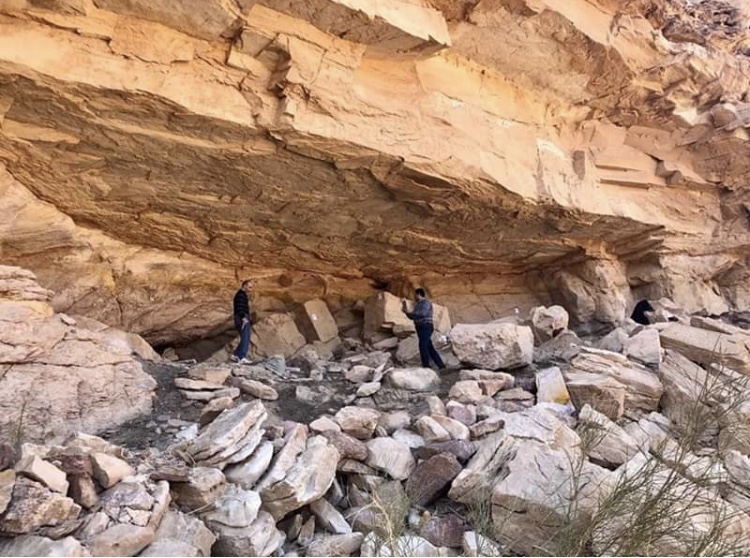
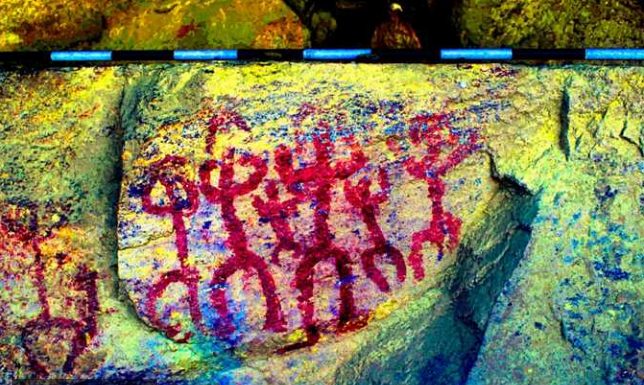
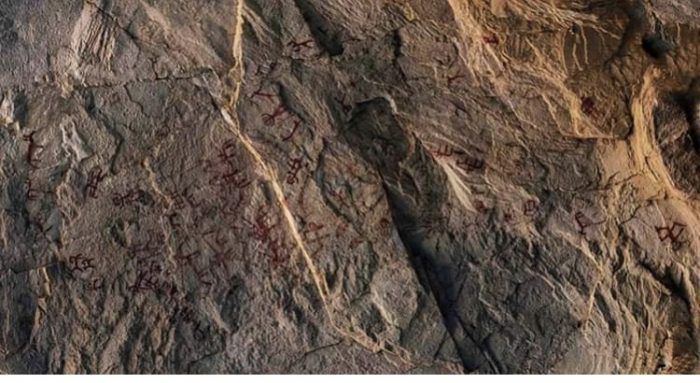
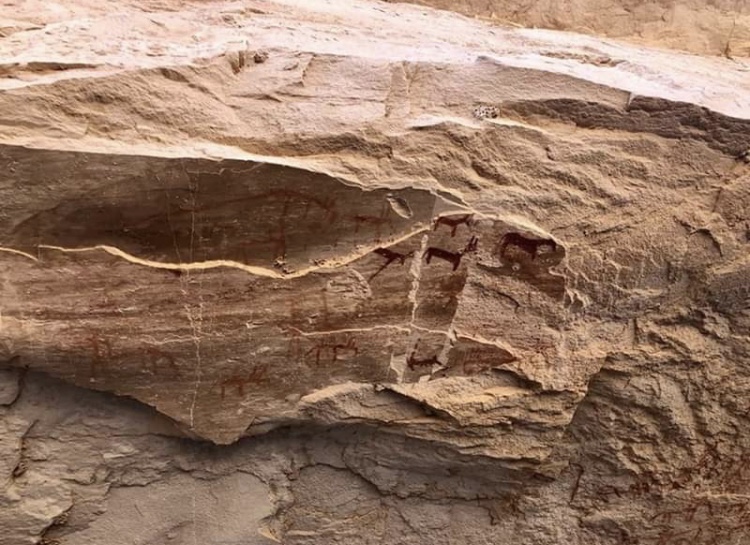
Archaeologists document 12,000 year old inscription in South Sinai
January 22, 20201:56 pm
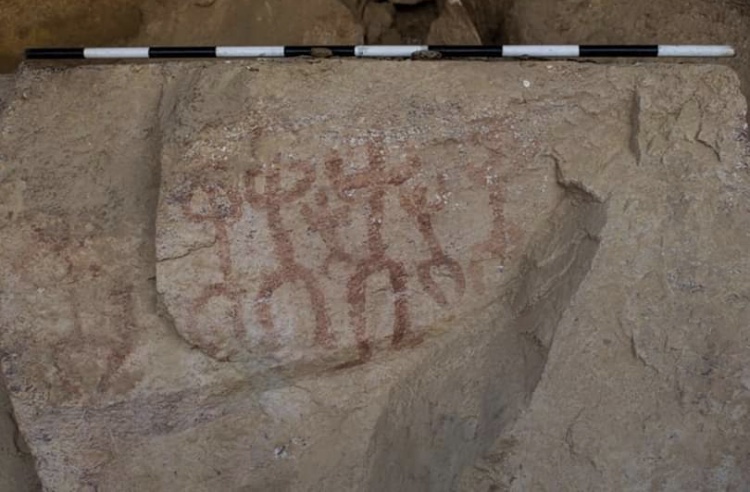
The archaeological mission of the Ministry of Tourism and Antiquities has finished documenting a colorful antique inscription dating back to about 10,000 years BC found in an archaeological cave located roughly 60km southeast of Serabit al-Khadem, and 30km north of Saint Catherine, as part of a project documenting rock inscriptions in South Sinai. the cave was located in a difficult region called al-Zaranij. The sandstone cave is at a depth of about three meters, 3.5 meters tall, and 22 meters wide, and is the first of its kind to be discovered in South Sinai.It was found by chance, upon notification from a desert adventurer in South Sinai.The discovered cave contains many colorful inscriptions, some on the ceiling of the cave and others on the stone blocks falling on the floor of the cavethat the mission also found large quantities of animal remains in the cave, indicating its use as a shelter for the Bedouins and animals from poor weather in the past.The discovered inscriptions depict many different scenes dating back to various eras, The inscriptions were divided into a number of groups.The first group was drawn on the oldest layer of the ceiling of the cave. It dates back to a period estimated between 5,500 and 10,000 years BC, and is characterized by a dark red color.Animals depicted include a donkey and mule, characterized by more realistic proportions unlike the rest of the scenes. Five animals and hand prints are depicted on the ceiling at the entrance of the cave dating back to the same eraThe second group likely dates back to the Copper Age and is characterized by scenes of women, , in addition to animal scenes while the third and final group dates to the AD era and depicts people with “Howdah” (a bed carried by camels).
Two exclusive pieces displayed at Egyptian Museum
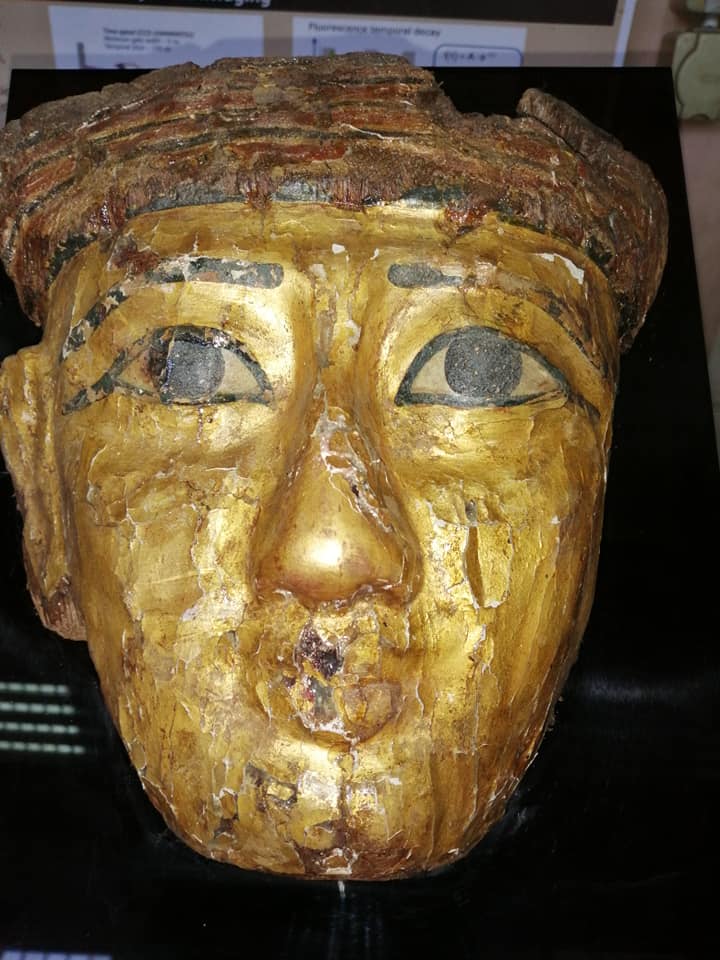
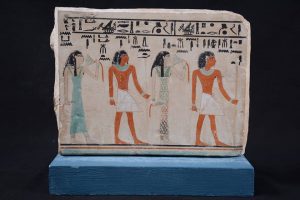
Two exclusive pieces displayed at Egyptian Museum
A gilded mummy mask and painted stele following restoration
Going on display for the first time
the gilded mask was offered to Egypt by the Egyptian owner who lives in France.
The second display is the funerary stele of Nit-Ptah
which was discovered in 1915 by the Metropolitan Museum mission at the Assasif necropolis on Luxor’s western bank.
The stele dates back to the Middle Kingdom and portrays four members of one family consisting of two females alongside males. Bringing up a good-looking contrast, men were painted in ochre and women in light cream wash.
The inscriptions over the figures are decorated in black depicting the god Ptah-Sokaris to provide offerings for the Ka of each member of the family.
Anfushi Cemetery
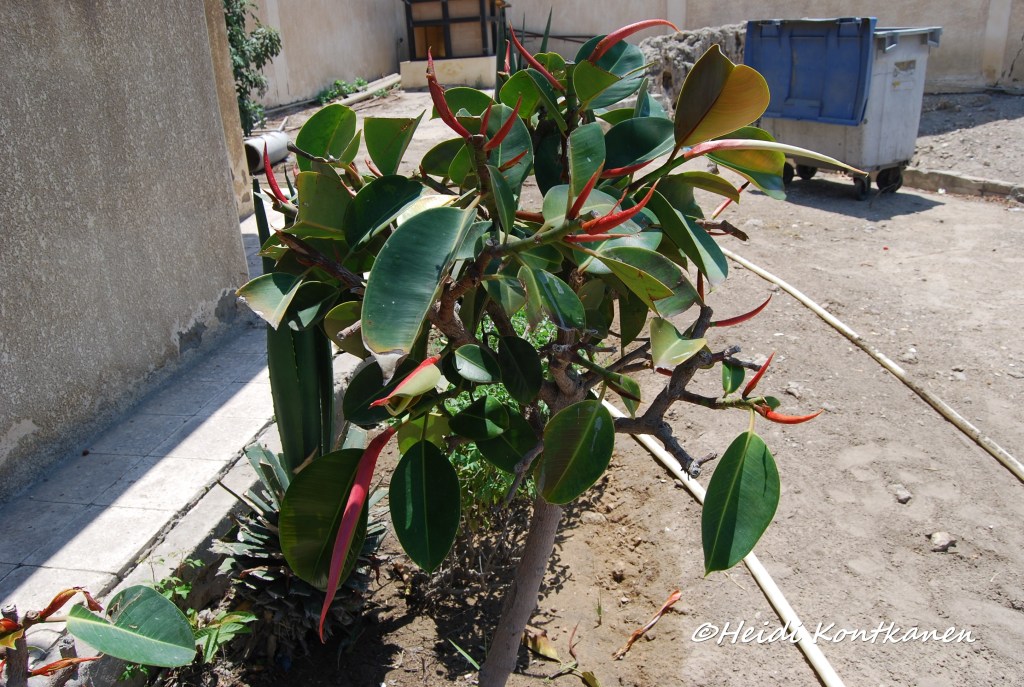
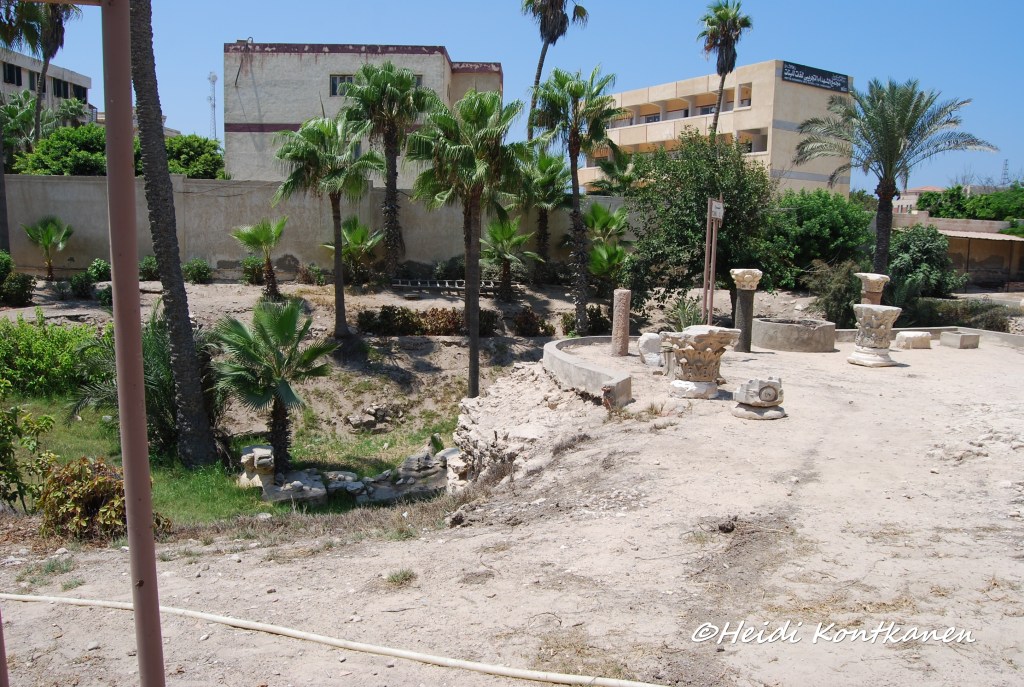
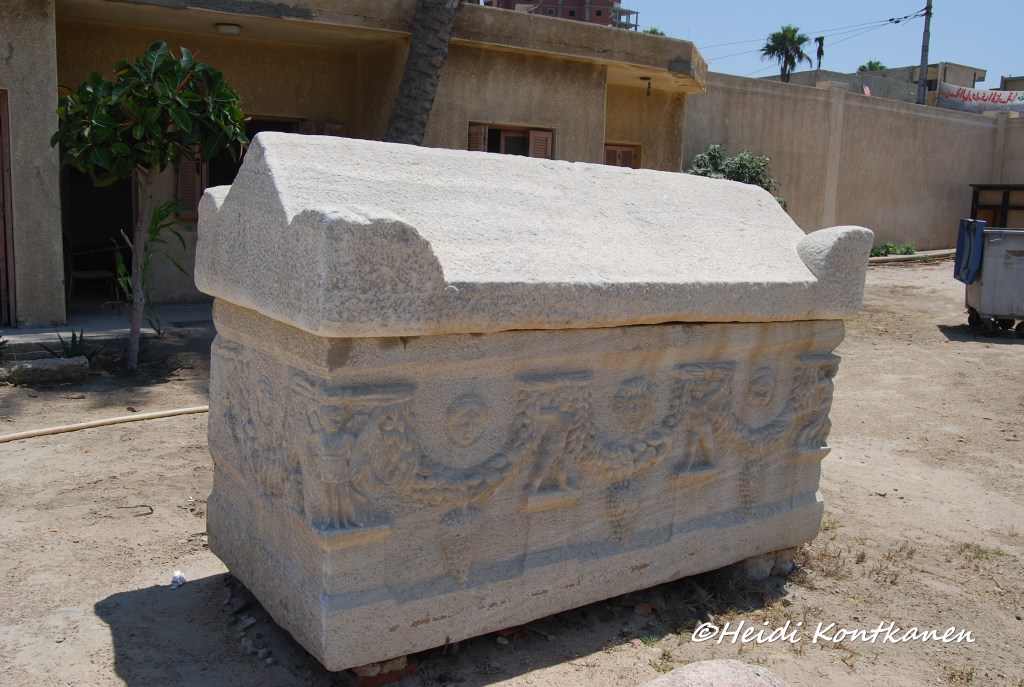
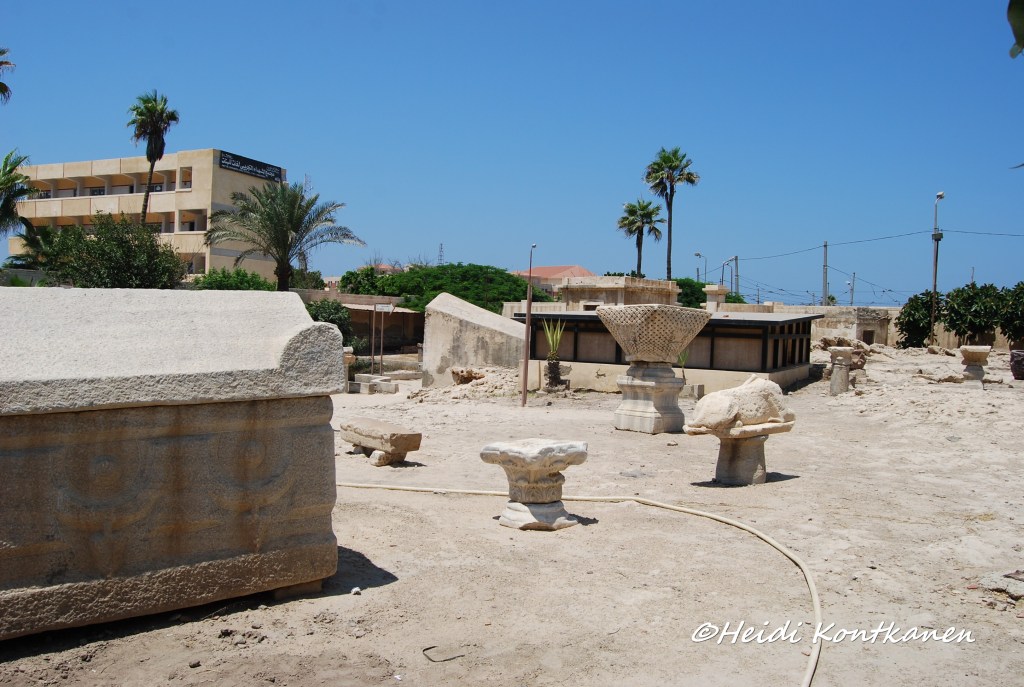

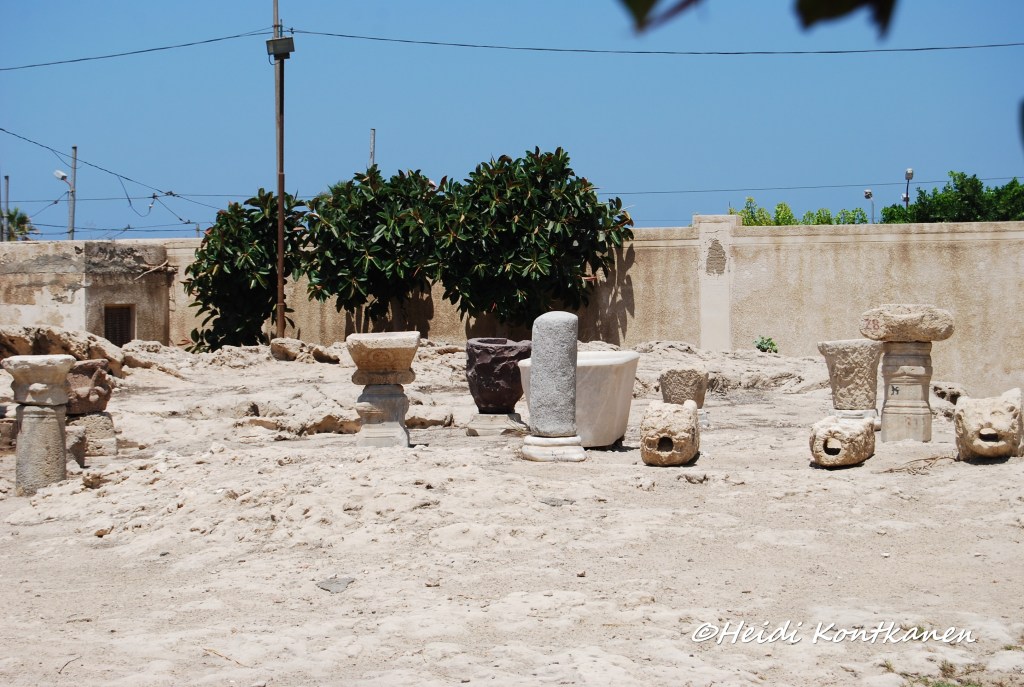
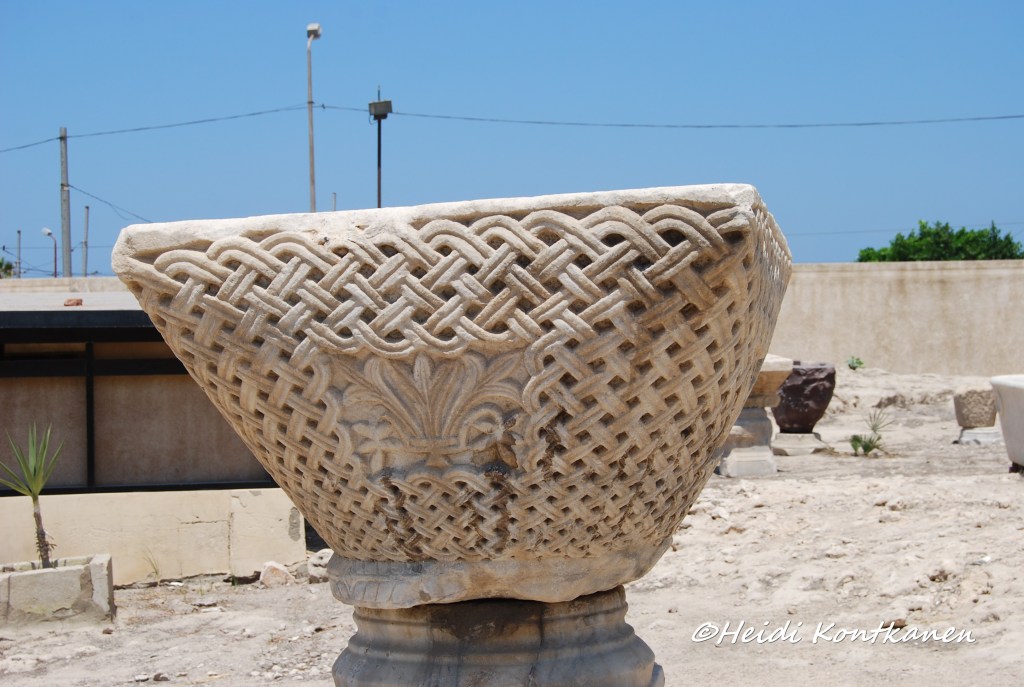
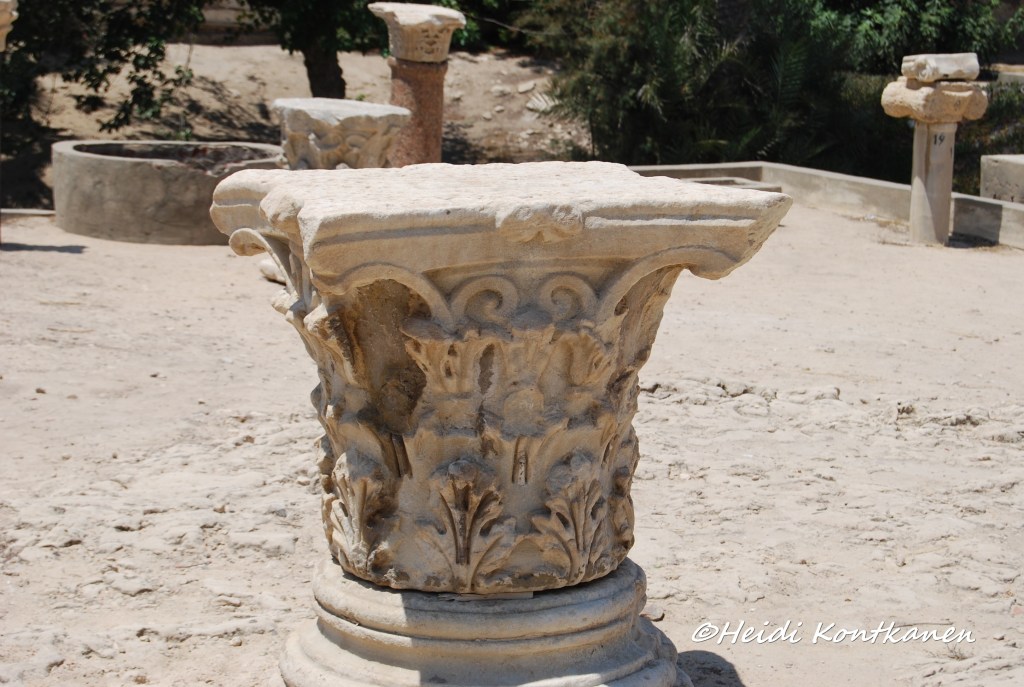
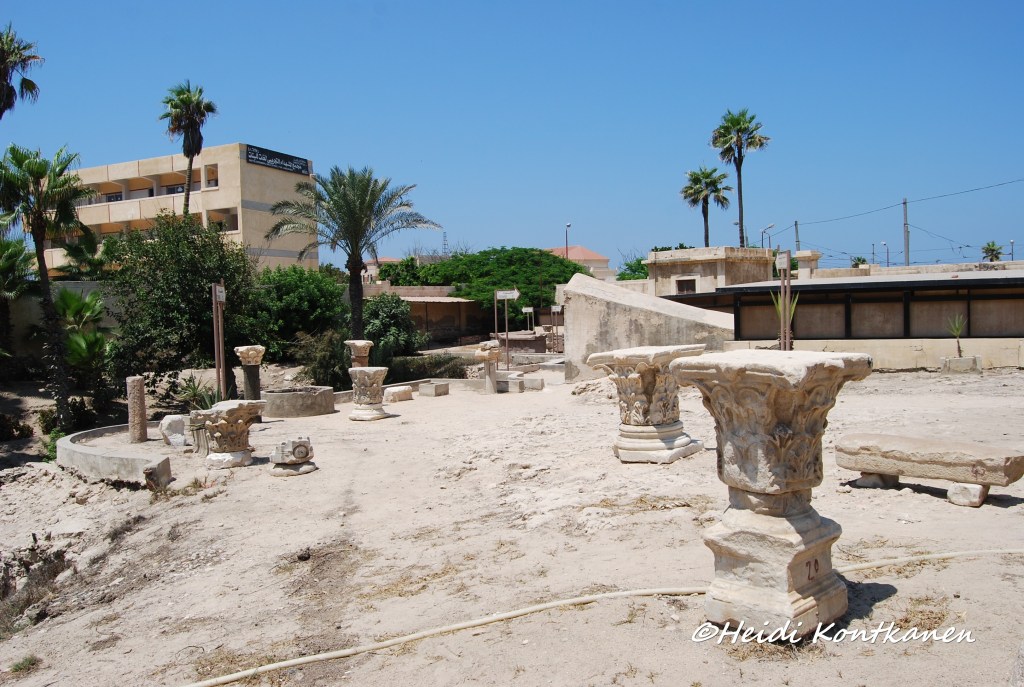
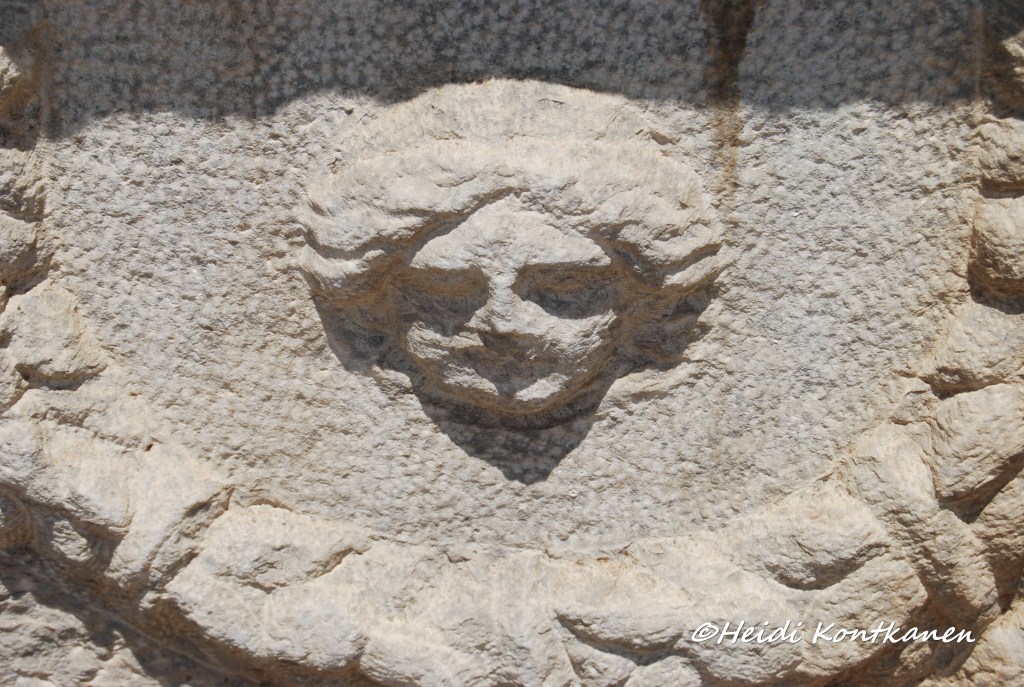
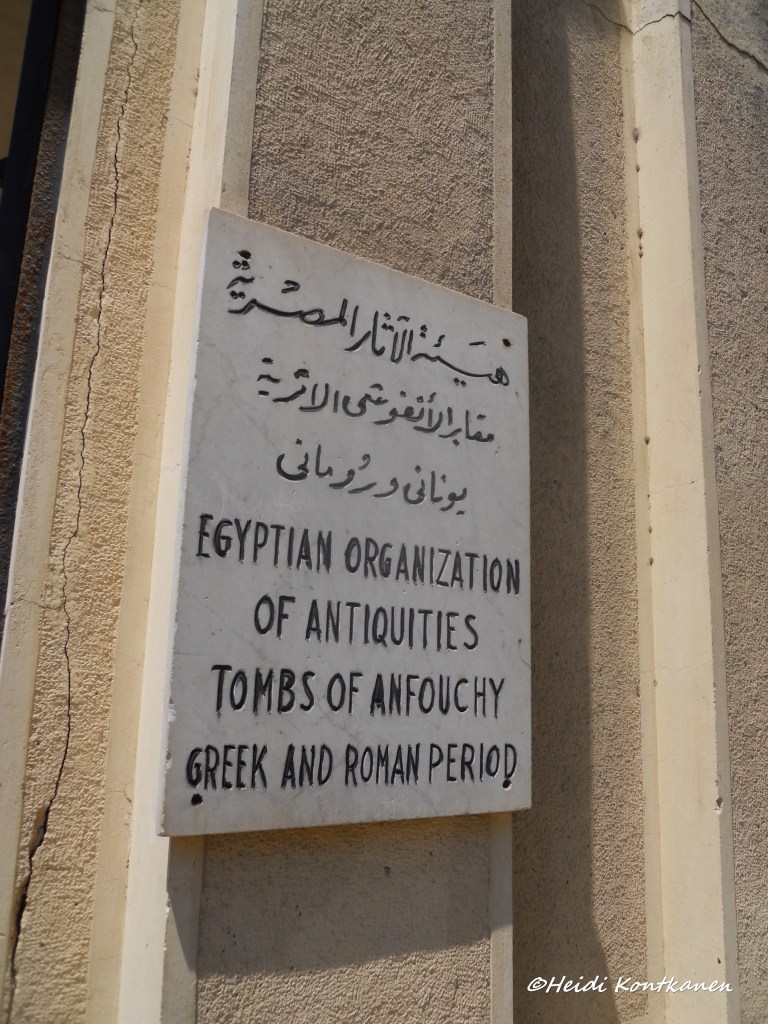
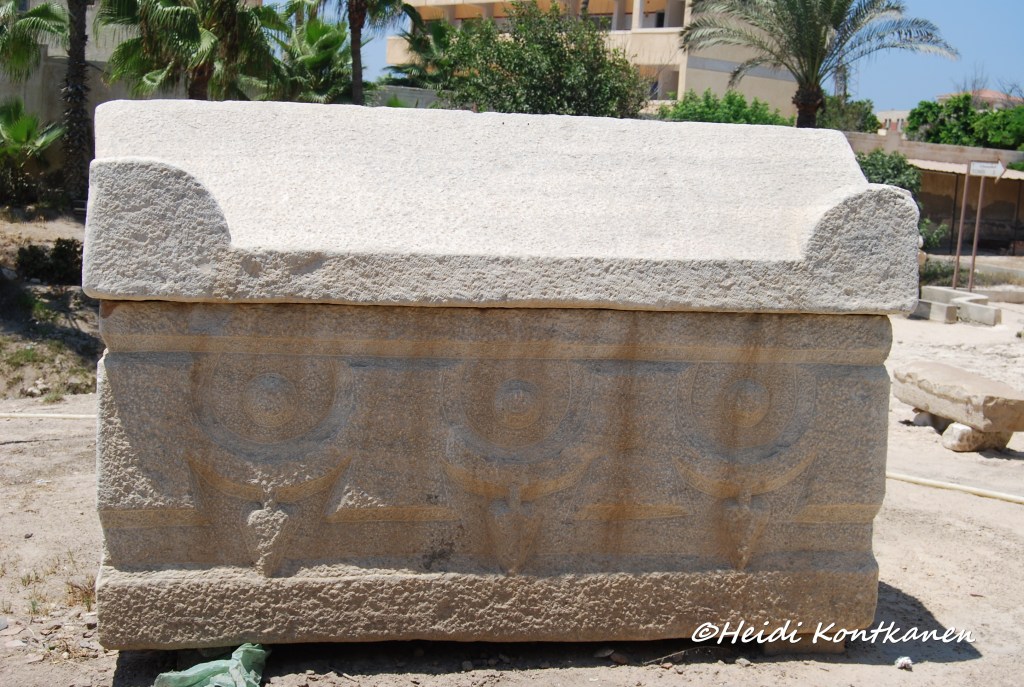
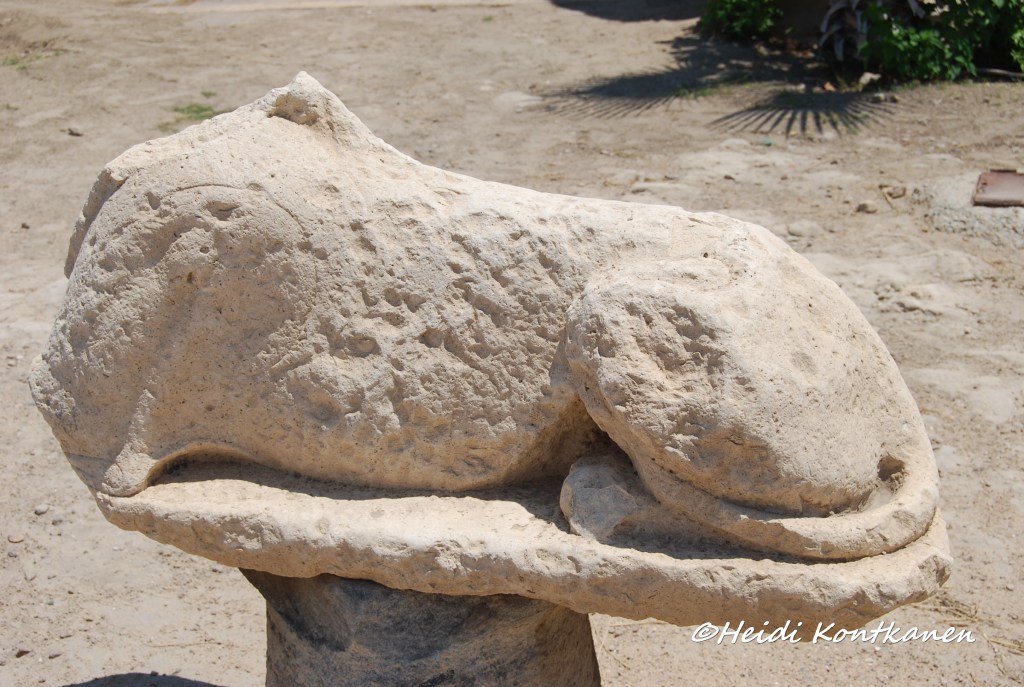
Anfushi Cemetery
Located on Pharos island
In the old Turkish neighborhood in Alexandria.
These are tombs from the Greco-Roman period.
 khaled gamelyanl blogger