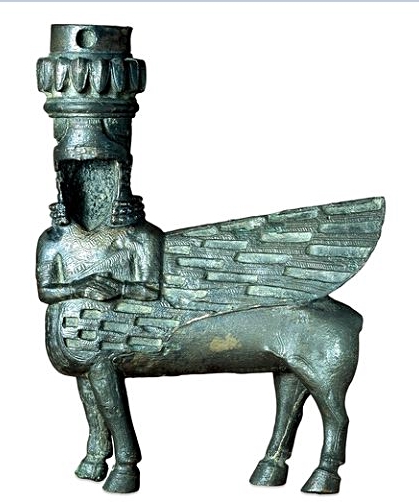
Urartian, around 700 BC
From Toprakkale (ancient Rusahinili), eastern Anatolia (modern Turkey)
A fine bronze from a throne
This bronze figure of a winged bull with a human torso and head was part of the decoration of a throne. It would have supported the arm-rest or seat. It comes from Toprakkale (ancient Rusahinili) in Urartu, the site of a major temple of the god Haldi, and was acquired in 1877. The missing face and horns were probably made of ivory, and the sockets in the wings once contained inlay, while the bronze itself was covered in gold leaf. Only the front of the wing was inlaid: presumably the back was not meant to be visible. The original effect must have been both rich and colourful, which seems to have been typical of important ancient furniture.
Urartu, centred on Lake Van, was the northern neighbour and rival of the Assyrian empire during the ninth to seventh centuries BC. It had disappeared before 600 BC, possibly destroyed by raids of horse-borne warriors known to the Greeks as Scythians, associated with the Medes from western Iran. The name survives, however, in that of its highest mountain, Ararat.
We know from Assyrian documents that the peoples of eastern Anatolia exploited the rich copper deposits found there. In the first half of the first millennium BC the Urartian kingdom had the most highly developed bronze production of Anatolia and the ancient Near East. The tin required for the production of bronze was probably imported from Afghanistan
 khaled gamelyanl blogger