
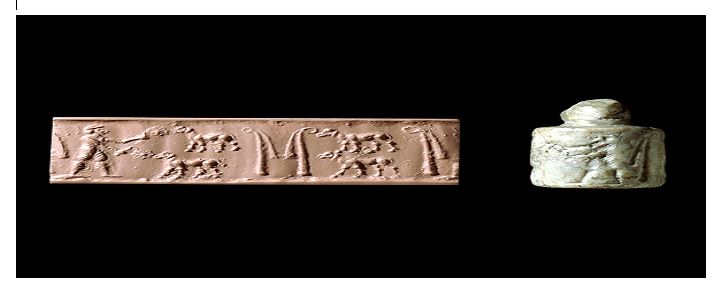
White and cream calcite (marble) cylinder seal
From Uruk, southern Iraq
About 3200-3100 BC
One of the tools of a Mesopotamian bureaucrat
At the time this seal was made, Uruk was one of the largest settlements in the world, estimated at around 250 hectares
(about 620 acres).
Such a large centre, with several thousand inhabitants, required sophisticated means of administration; this seal may have belonged to one of the most important officials. They were rolled across damp clay to seal vessels or doors with a mark of authority.
The figure depicted here is often referred to as a priest-king because he undertakes activities which could be described as religious and royal (although there was no clear division of these functions in the ancient world). The beard, net-like skirt and wide band around his head distinguish him from other representationsof humans. The poles with loops were probably actually made from reeds bound together and are the symbol of Inana, a goddess of fertility and the patron of Uruk.
Large seals of this period are generally unpierced and often have an animal carved as part of the seal or cast in metal and fixed on top. These contrast with contemporary smaller schematic seals which appear to show workers, perhaps connected with the production of textiles and pottery and rows of animals.
 khaled gamelyanl blogger