
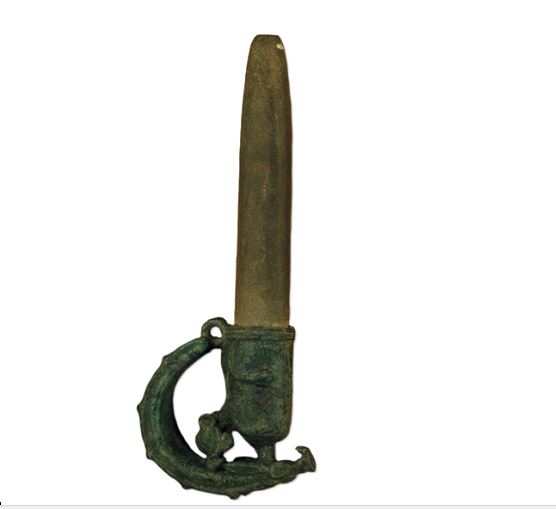
Whetstone with bronze handle
Luristan culture
about 1000-700 BC
This is a whetstone, used to sharpen weapons and tools of bronze and iron. It dates to the early first millennium BC. Although by this time the use of iron had become widespread, bronze remained one of the most commonly used metals. Normally they were very simple tools: just a stone perforated at the top and fitted with a metal ring, for suspension from a belt. This example, however, comes from Luristan in western Iran where, as nowhere else in the Near East, whetstones had richly decorated bronze handles. The combination of animals in the decoration is known earlier in Elam in south west Iran and this may have been a source of inspiration for the Luristan metal workers.
The region of Luristan was home to a rich metalworking tradition in the early part of the first millennium BC. Most surviving examples come from ancient cemeteries plundered by local tribesmen from the 1920s onwards. Others seem to have been deposited as votive offerings at shrines. Large numbers of Luristan bronzes are now found in museums across the world.
 khaled gamelyanl blogger