
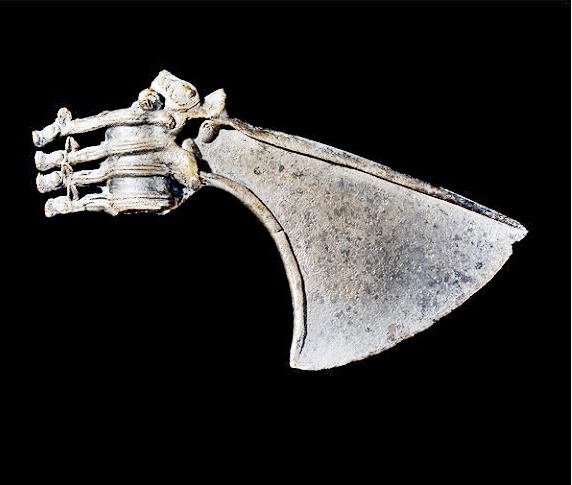
Bronze axe-head
Luristan culture
10th-7th centuries BC
From Luristan, western Iran
The style of this cast bronze axe-head links it to the region of Luristan in western Iran. Bronzes of this kind were plundered from the cemeteries and shrines of the area from the 1920s onwards. Many of the graves were rich in bronzes, and even the poorest male graves appear to have contained a few weapons.
The blade of this axe is set at an angle that made it impractical for use, so it was presumably made specially to be left either in a grave or as a votive offering in a shrine or sanctuary. The symbolism of the animal forms is a mystery, as there are few inscriptions from this region. Similar spike-butted axes are known from the twelfth century BC, but spikes tipped with bird, human or, as here, animal heads developed between 1000 BC and 700 BC. In this example the blade emerges from the jaws of an unidientified animal.
The mountains of western Iran were home to a long tradition of metalworking. By the first millennium BC the kingdom of Elam, which had dominated Luristan, was weakened and the bronze workers of Luristan were free to develop their industry. The decline in the production of Luristan bronzes, some time in the later seventh century BC, was possibly due to the growing political unity of the Medes and Persians and their increasing influence on the area.
 khaled gamelyanl blogger