
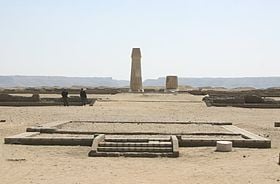
Akhetaton, meaning the horizon of the sun disk.
It is an ancient city called Tel el-Amarna in Minya, Egypt.
It is located east of the Nile
Built in 1365 BC
King Akhenaten to be the capital and seat of the Aten monotheistic belief
After his death, its palaces were demolished and plundered
Tutankhamun transferred his successor the capital again to Thebes to revive the Amun doctrine
Tell el-Amarna
Date of Establishment
1346 BC, and 1370 BC
Coordinates
27 ° 39′42 ″ N 30 ° 54′20 ″ E
Tell el-Amarna
(Its name was “Achhataton”, meaning: “the horizon of Aton”)
It is the new capital established by King Akhenaten,
It is located at a distance of forty-five kilometers south of the Bani Hassan Cemeteries in Minya Governorate
Remains of the ancient capital still exist today. In the Middle Ages, after that region was devastated since Tutankhamun rose and changed the capital, the Amarna tribe came and lived there for a long period that included the centuries and its age. After they deserted and returned to their areas, the area was called Tel Al-Amarna because those who returned to life were the Amarna tribe because it was a hill. Ruin, but Tell became a habitable city
Some of the demolished homes of the elite are still present at the northern end of the site, facing the outer wall of the royal palace. The Egyptian Museum includes beautiful examples of the plaster ground cover, which was the source of these dwellings
A group of tombs have also been discovered in Tell el-Amarna, the most important of which are located to the north, such as the tombs of Meri-Ra, Ahmose, Bento, and the royal family cemetery, which is believed to have been excavated for the king and his family.
Site
Tell el-Amarna is located in Deir Mawas, Minya Governorate, in northern Upper Egypt. It stretches along the eastern shore of the Nile for a distance of approximately five miles. And when Akhenaten realized that there was no possibility to continue in Thebes after the priests of Amun showed hostility to his new vocation, which he tried to introduce instead of the religion of Amun and other beliefs in Egypt, he had to search for a new location to move to and invite him to his Lord Aton, that idol that the king wanted – According to some specialists – the unification of the Egyptian gods complex
Thus, King Akhenaten established his new city, and in the fourth year of his reign, he moved to his new capital, the sister of Aton, the “Aten horizon / sun disk”. This place where he settled and is now known as Tell el-Amarna, and is located ten kilometers from Mallawi, on the eastern mainland of the Nile. Leaving both Memphis and Thebes, which were the capitals of Egypt at that time and the royal headquarters in summer and winter
The city of Amarna extends over an area of twenty-five kilometers from Sheikh Saeed in the north to Sheikh Abdul Hamid in the south.
It is an area surrounded by mountain chains on three sides, east, north and south, while its western borders are bounded by the Nile River.
Four villages are built on its ruins:
Al-Houta Al-Sharqiya, affiliated to the Dairout Center in Assiut Governorate, “Al-Amariah Al-Sharqiya, Al-Hajj Qandil, Al-Tal Al-Sharqi, or Tell Al-Amarna, and the three villages belonging to the Deir Mawas Center in Minya Governorate
The label
The name Tell el-Amarna comes from the Bani Omran tribe who lived in the area and established some settlements.
The ancient Egyptian name was the sister of Aton.
English Egyptologist Sir John Gardner Wilkinson visited Tell Amarna twice in the 1820s and called it alabaster, after the contradictory names of the Roman authors Pliny the Younger and Ptolemy, although he was not sure of its location and suggested Kom al-Ahmar as an alternative location.
The city area was an emerging site, and as Akhenaten described this city as the seat of the first celebration for Aton, which he built for himself so that he could rest in it.
Perhaps the hieroglyphic representation of the Royal Canyon with the horizon showed this to be the right place for the founding of the city
The city was built as a new capital for Pharaoh Akhenaten,
To devote his new religion to the worship of Aton.
Construction began on or around the fifth year of his reign (1346 BC).
It may have been completed by the year 9 (1341 BC),
Although it became the capital two years earlier. And in order to hasten the construction of the city,
Most of the buildings were constructed of mud and white brick. And the most important buildings are covered with local stone
It is the only ancient Egyptian city that preserves great details of its internal plan, largely due to the result of the abandonment of the city after the death of Akhenaten, when Ibn Akhenaten decided,
King Tutankhamun, leaving the city and returning to his hometown of Thebes (modern Luxor). The city appears to have remained active for a decade or more after his death, and the Horemheb shrine indicates that it was at least partially inhabited at the beginning of his reign, solely because it was a source of building materials elsewhere. Once deserted, it remained uninhabited until Roman settlement began along the edge of the Nile. However, given the unique circumstances of its creation and desertion, it is doubtful how these ancient Egyptian cities were in fact. Amarna was built in haste and covered an area of about 8 miles (13 km) of land on the eastern bank of the Nile. On the West Bank, the land was allocated to provide crops for the residents of the city. The entire city was surrounded by a total of 14 boundary plates detailing Akhenaten’s conditions for the founding of this new capital of Egypt. It is known that the earliest dated plaque from the new Akhenaten city is the boundary plate (k) dating from the fifth year, of the Bert chapter (or eighth month) , The thirteenth day of Akhenaten’s reign. (Most of the original 14 boundary panels are badly eroded.) It preserves the narrative of Akhenaten’s founding of this city. The document records the pharaoh’s desire to establish several temples to Aton in it, in addition to the establishment of many royal tombs in the eastern Amarna hills for himself and his wife, Queen Nefertiti and his eldest daughter Merit Aton, in addition to his explicit order that when he dies, he should be returned to Amarna for burial.
The boundary panel (k) provides a description of the events celebrated at Tell el-Amarna:
His Majesty climbed on a large carriage of electrum, just as Aton ascended to the horizon and filled the earth with his love and took a wonderful path towards the sister of Aton, the place of origin, which [Aton] created for himself. Perhaps he is happy in it. His son was conscious that Ra [meaning: Akhenaten] who built it as a tomb for him when his father ordered him to make it. The sky was joyful, the earth was pleased, and every heart was filled with elation when they looked at him
Statues to the left of the (U) boundary board in Amarna
Then this text continues to indicate that Akhenaten has made a great sacrifice to the god Aton. ”This is the theme of the [celebration] which is evident in the crescent portion of the painting where he stands with his queen and his eldest daughter before an altar stacked with offerings under the Aton, while he shines upon him, returning the youth to his body through his rays. . “
And that city that Akhenaten ordered to build includes:
Two royal palaces (the northern palace and the southern palace), – the temples of Aton – the residential quarters of the homes of the nobles and a village for the craftsmen – the royal cemetery located in the northeast of the city – 25 of the individual cemeteries divided into two groups (north and south) located in the far north of the city and including 25 graves of high-ranking state employees during the reign of Akhenaten. The king has defined his city with fourteen boards known as “panels of borders”.
This was found in the city on the letters of Tell el-Amarna.
Ancient life in Tell el-Amarna
Much of what we know about the founding of Tell el-Amarna is due to a series of memorial plaques in the vicinity of the city. These paintings record the events of the Aton sister from the founding until just before her fall
To move from Thebes to Amarna, Akhenaten needed the support of the army. Ay, one of Akhenaten’s chief advisors, had a great influence in this region because his father Yuya was an important military leader. In addition, all members of the army grew up together, and they were part of the richest and most successful period in the history of Egypt during the reign of Akhenaten’s father, so the loyalty between them was strong and steady.
Religious life
Although Akhenaten’s reforms were directed towards a kind of unification. Archaeological evidence indicates that other deities were also revered, even in the Aten cult center, at least by the people who lived and worked there.
the art
The Amarna art style broke well-established Egyptian traditions. In contrast to the strict idealistic formalism of Egyptian art in earlier stages, art in the Amarna era portrayed subjects more realistically. These included casual scenes, such as portraying the intimate passion within the royal family and playing with their children, and they no longer portrayed women as being lighter than men. Art also had a realism that sometimes limited cartoons.
Rediscovery and exploration
The explorations of the eighteenth and nineteenth centuries
A piece of limestone. Akhenaten era. From Amarna, Egypt. Petrie Museum of Egyptian Archeology in London
The city was first mentioned in the West in 1714 by Claude Sicard.
He was a French Jesuit priest who was traveling through the Nile Valley,
He described the memorial plaques in Amarna.
Napoleon scholars visited the city in 1798-1799,
They prepared the first detailed map of Amarna, which was later published in the book The Description of Egypt between 1821 and 1830.
European exploration of the city continued in 1824 when Sir John Gardner Wilkinson explored and mapped the remains of the city
A Prussian expedition led by Carl Richard Lepsius visited the site in 1843 and 1845, and recorded the visible monuments and terrain of Tell el-Amarna on two separate visits over the course of twelve days using graphics to create an improved map of the city. Although these drawings were less accurate, they were considered the basis for knowledge of the city and the interpretation of many scenes and inscriptions in private tombs and some memorial plaques for the rest of the century. Records recorded by teams of early explorers were of great interest because many of these remains were later destroyed or lost.
Explore the king’s tomb
Between 1891 and 1892 Alessandro Barsante discovered the king’s tomb, although it has been known to locals since about 1880. Around the same time, Sir Flinders Petrie worked for one year in Amarna. He excavated mainly in the central city, undertaking work on the Great Temple of Aten, the Great State Palace, the King’s House, and the Pharaoh’s Correspondence Office.
.
Twentieth century explorations
In the early years of the twentieth century (1907 to 1914), the German East Institute expedition, led by Ludwig Borchardt, undertook extensive excavations throughout the northern and southern suburbs of the city. The famous Nefertiti statue, now in the New Berlin Museum, and which was found among other sculptures was discovered in the workshop of the sculptor Thutmose. The outbreak of World War I in August 1914 ended the German excavations
From 1921 to 1936, an expedition returned to the excavations at Amarna under the direction of Sir Leonard Woolley, Henry Frankfurt. This mission focused its work on religious and royal structures. During the 1960s, the Supreme Council of Egyptian Antiquities carried out a number of explorations in Amarna
Twenty-first century explorations
The exploration of the city continues to the present, under the direction of Barry Kemp who is Professor Emeritus of Egyptology, University of Cambridge, England.
In 1980, a separate expedition led by Geoffrey Martin described and copied the inscriptions from the Royal Cemetery, and later published the mission’s findings.
History of Excavations at Akhet-Aten (Tell el-Amarna)
Numerous operations were carried out to reveal the capital of “Akhenaten” and the center of his religious mission, after it had fallen into oblivion.
In the year 1714 AD:
Description of a French Jesuit priest
Claude Sicard
Cloud Sicard ‘border panels
In the year 1798-1799 AD:
The French expedition, led by Napoleon Bonaparte, visited the site and drew a map of the city.
In the years 1824 AD and 1826 AD:
Visit
Gardner Wilkinson’
Gardner Wilkinson ‘English Egyptologist twice signed, and defined it like
Alabastron
Classical Roman Writers
.
In the years 1843AD and 1845AD
the Prussian Expedition
The “Prussian” excavation mission headed
Karl Richard Lepsius
Karl Richard to Pseus, visited the site, and recorded and published many scenes and inscriptions of the Amarna tombs carved into the rocks.
———–.
In the year 1887 AD:
An Egyptian peasant discovered 337 plaques (small stela) of dried clay inscribed with cuneiform inscriptions
(Vernacular Akkadian language) – ‘Tal al-Amarna letters’, which represent international diplomatic relations (foreign policy)
From exchanged correspondence between Egypt and the princes of Upper Syria, Palestine, Babylon and others loyal to Egypt,
During my reign, he “gave me the third” and his son “gave me the fourth” (Akhenaten).
This discovery drew attention to that forgotten city
The years 1891-1892 AD
: Alessandro Barsanti
Alessandro Barsante ‘from
Egyptian Antiquities Service
The Egyptian Antiquities Authority cleaned the tomb of King (Akhenaten) in Amarna
————-.
The years 1891-1892 AD:
William Mathew Flinders Petrie
William Matthew Flinders Petrie discovered parts of the city, including the palace
Royal, and prepared a comprehensive survey of the area with the help of
Howard Carter
Howard Carter
The outcome of this campaign was 132 boxes that found their way to the Ashmolean Museum.
In the British city of Oxford
1892 AD: He visited
Howard Carter
Howard Carter, the Royal Cemetery, has copied and published some of the scenes
The year 1893 AD:
Petrie cleaned the rock tombs.
1902 AD: The Egypt Exploration Society begins
(EES) “The Egyptian (Archaeological) Findings Society” in London, its work on the site
————–.
The years 1903-1908AD: He rose
Norman de Garis Davies
Norman de Garis Davies publishes individual gravesites
Amarna in six parts
(Davies 1903; Davies 1905a; Davies 1905b; Davies 1906; Davies 1908a; Davies 1908b)
.
1907-1914: Discover the German expedition of the Deutsche Orient-Gesellschaft
(DOG = German Oriental Society)
The German Oriental Society ‘under supervision
Ludwig Borchardt
Ludwig Borchardt ‘parts of the city, I revealed
The eastern neighborhood of the city in the years 1911-1914 AD.
And in 1912:
They found the head of the famous Queen Nefertiti, which is now on display in the Berlin Museum
The years 1921-1936 AD: Excavations
Egypt Exploration Society (EES)
The Egyptian (Archaeological) Discovery Society, under the supervision of many specialists
Thomas Eric Peet
Thomas Eric Pitt
Leonard Woolley
Leonard Woolley
Francis Newton
Frances Newton
Henri Frankfort
Henry Frankfurt
J.D.S. Pendlebury
‘.D.s. Gundlebury
Since 1977 AD: Mission excavations
Egypt Exploration Society (EES)
The Egyptian (Archaeological) Lists Association, headed by
Barry J. Kemp’Barry چ. Km ‘,
Its work is still continuing until now
References
“Information about Tell el-Amarna on d-nb.info.” d-nb.info. Archived from the original on December 15, 2019.
“Information about Tell el-Amarna on ne.se.” ne.se. Archived from the original on January 26, 2020.
Information about Tell el-Amarna on geonames.org. geonames.org. Archived from the original on March 18, 2020.
“Amarna”.
http://www.ucl.ac.uk.
Archived from the original on August 2, 2018. Retrieved January 06, 2021.
Sir John Gardner (1828).AAldred (1988), p. 48
Turner, Philip (2012-10-24).
“Seth – a misrepresented god in the Ancient Egyptian pantheon?”
[Thesis]. Manchester, UK: The University of Manchester; 2012
“Mapping Amarna – Survey.”
- Recent Projects
- Amarna Project “.
http://www.amarnaproject.com.
Egypt Exploration Society – Fieldwork –
Tell El-Amarna “. Web.archive.org.
Basem Samir Al-Sharqawi, Minya Governorate:
Archaeological sites and religious shrines, contributed to the preparation d. Hoda Abdel-Maqsoud Nassar and the archeology of Maryam Kamel Boutros, reviewed by Prof. Suad Abdel Aal, Presented by: Prof. Zahi Hawass, Supreme Council of Antiquities Press, 2008 AD.
 khaled gamelyanl blogger