
The Alien god belonging to the house of Osiris Medjed

the one very peculiar god:
Medjed.
WE ARE MEDJED
the mythology of Medjed, ,
it says:
“(…) Do not speak of your false justice.
We do not need the spread of such falsehood.
We are the true executors of justice. (…)
If you reject our offer,
the hammer of justice will find you.
We are Medjed.
We are unseen.
We will eliminate evil.”
he is a very minor god.
let us learn a little bit about this god.
The main source of knowledge on
Medjed
is the so-called
Greenfield Papyrus
where he appears twice.
If the name of the papyrus seems a little awkward,
that is because it is common for ancient Egyptian artifacts (especially papyri) to be named after the collector who owned it during the heyday of Egyptomania.
In this case, this particular papyrus belonged to Mrs. Edith M. Greenfield,
who donated it to the British Museum in 1910.
The curator’s comments on the online collection of the British Museum summarizes it nicely:
The ‘Greenfield Papyrus
is one of the longest and most beautifully illustrated manuscripts of the ‘Book of the Dead’ to have survived. Originally, over thirty-seven metres in length, it is now cut into ninety-six separate sheets mounted between glass. It was made for a woman named Nestanebisheru, the daughter of the high priest of Amun Pinedjem II. As a member of the ruling elite at Thebes, she was provided with funerary equipment of very high quality. Many of the spells included on her papyrus are illustrated with small vignettes, and besides these there are several large illustrations depicting important scenes.”
―British Museum (2017)
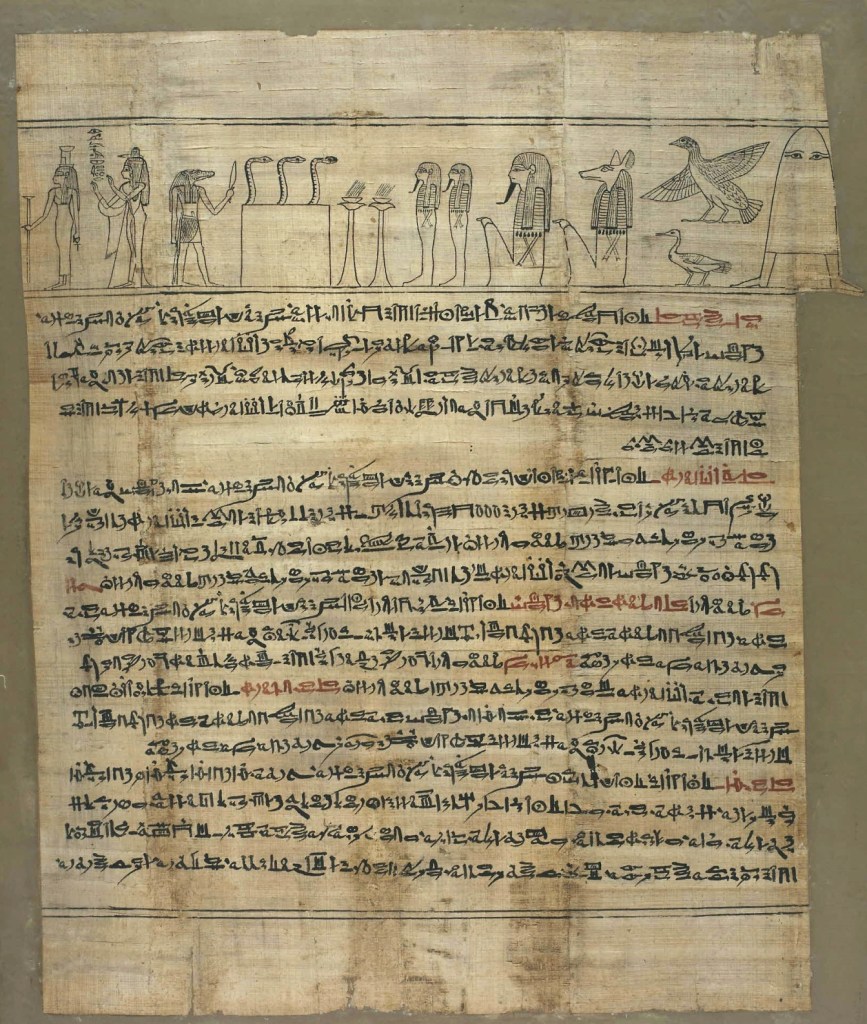
The Greenfield Papyrus dates from the historical period known as New Kingdom, possibly from the end of the 21st Dynasty or the beginning of the 22nd, around 950–930 BCE
(British Museum, 2017).
The vignettes mentioned in the description above appear on top of each sheet in a manner resembling — a comic strip
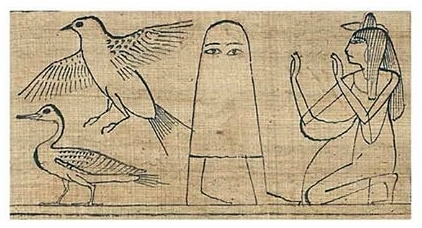
Majeed was mentioned in the papyrus
Figures 2 and 3.
So let’s take a closer look at it:
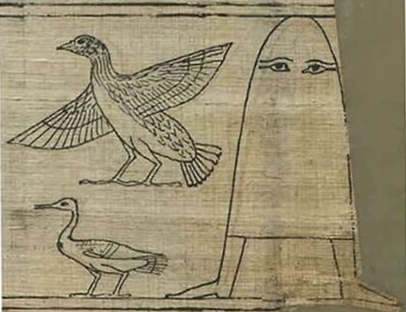
It is a shrouded form
Like ghost animation
(Figs 4 and 5),
But sometimes it is described as
Hill with eyes and feet
(British Museum, 2017).Because of its peculiar appearance, it is impossible to miss and / or ignore it even for the least aware.Close-up of Sheet 12 of Greenfield Papyrus
Text on papyrus
He calls it glorious
(Sometimes written as “michit” in ancient literature)
He says he “shoots from his eyes
But he himself is not visible
And that it “turns in the sky within a flame that results from its mouth.”
While its special form is not visible. “
This translation is according to Budge (1912);
This was the only translation of Greenfield’s papyrus
That I was able to reach. Regardless ,
Much agree with subsequent research on Majeed.
The above section is part
Chapter 17 (or spelling 17)
From the Book of the Dead.
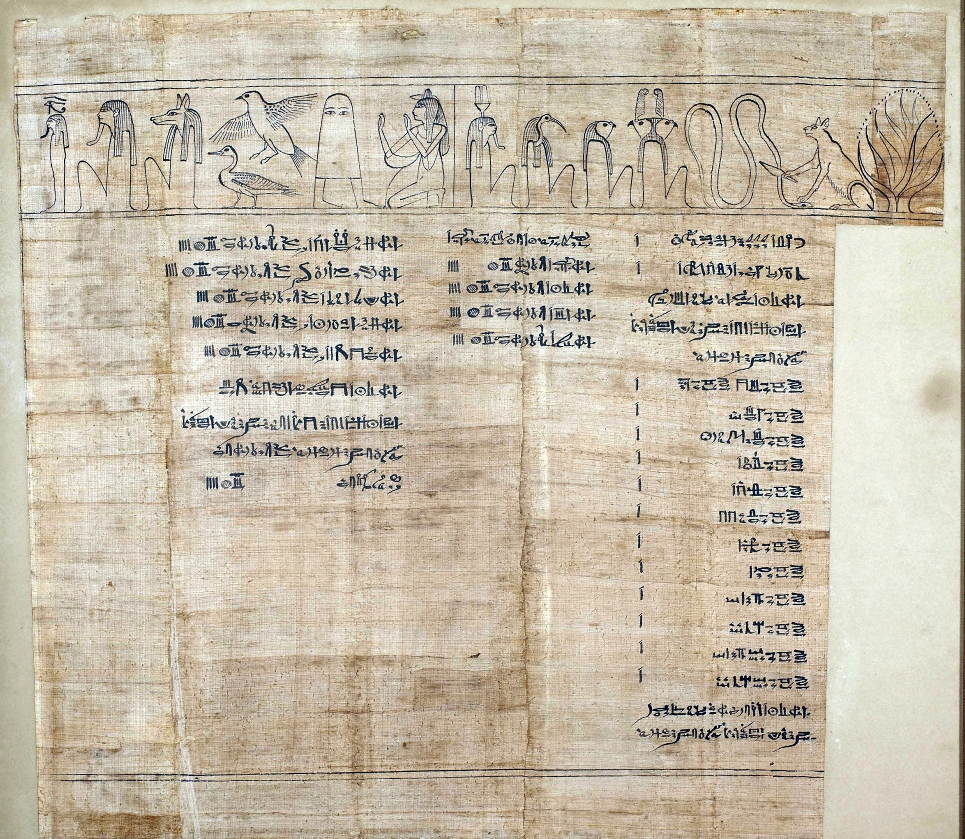
Another place to look for glorious
It is the same spelling of 17 other versions of the Book of the Dead
(It varies, as I will explain later).
As expected, we can find references to Majeed
In the New Kingdom papyri (and later releases),
Including a group of well-known papyri
In the name of “The Good Recitation of the Book of the Dead”.
17 of these papyrus mantra are similar to Greenfield Papyrus
But bear some differences.
According to Budge (1898):
“I know that I walked [glorious] who is among them in the house of Osiris, shining light rays from his eye, but who is himself invisible. It revolves around the paradise stolen by the flame of his mouth, and he commands Habi [the god of the annual flood of the Nile],
But himself remains invisible. “
A new translation of this passage is provided by Faulkner et al. (2008) and Goelet et al. (2015):
“I know the name of this smartest among them who belongs to the house of Osiris, who shoots with his eyes, but he is not visible. The sky is surrounded by a fiery explosion in his mouth and Happy issues a report, but it is not visible.” Glorious his name here is “the smartest”,
Or his name may be translated to “smarter.”
This translation explains Majid, and turns it into “smartest” only:
Nearly all deities (and humans) were vulnerable to hitting enemies.
To summarize all the above information
Glorious invisible
(Hidden or invisible)
Can fly,
It can fire light rays from his eyes,
Can breathe fire
It can strike other objects.
Beside that
Nothing else is known about this deity.
Anywhere else
Lists Majeed (or) Mashit
In a chapter on
“Various deities”,
But whether this refers to the same deity
Lists
The gods who protect Osiris during 12 hours of the day and 12 hours of the night; one of them is glorious.
Majeed watches Osiris during the first hour of the day and twelve o’clock at night. This is in line with the passage
In spelling 17
It is said that Majid belongs to the house of Osiris
THE BOOK OF THE DEAD
Now let us make a brief pause to talk a little about the Book of the Dead.
The most important questions to address are:
(1) What is it?
(2) How it came to be?
(3) Is it a single book or is there more than one?
The Book of the Dead is a collection of funerary texts; its use was widespread and lasted for over one and a half millennium .
The Egyptians called it
the “Book of Coming Forth by Day”,
but “Book of the Dead”
was more appealing to the modern audience.
The book contained hymns praising the gods and several magical spells
to protect and guide the deceased through the perilous journey through
the Duat, which is the Egyptian underworld
The journey to a nice afterlife was riddled with dangers, fiends and tests, and the deceased needed all the help he/she could get.
The Book of the Dead was not a new invention, however. On the contrary, it has a long history, as it is derived from older writings. During the Old Kingdom, starting in the 5th Dynasty, funerary texts were written on the walls of the burial chambers inside the pharaoh’s
(and later also the queen’s) pyramid
These texts, written in hieroglyphic script, are called “Pyramid Texts” — a rather uninventive name, maybe, but efficient nonetheless. They were meant to help the deceased king to reach his rightful place among the gods in the afterlife. Later on, the right to an afterlife ceased to be a royal privilege and first the elite and then everyone was granted access to it
During the Middle Kingdom, the spells started to be written on the inner side of the coffins
(sometimes also on walls and papyri).
They are called, as you may have already guessed, “Coffin Texts”. Many new spells were added to the repertoire and they were, for the first time, illustrated. Afterwards, new spells were developed and everything started to be written on papyrus; the Book of the Dead thus came into being. The spells could be written either in hieroglyphic script or in hieratic
(a cursive form of the hieroglyphs)
and were usually richly illustrated.
The oldest known Book of the Dead is from Thebes (around 1700 BCE)
during the Second Intermediate Period, and by the New Kingdom, the Book had already become very popular
The most important thing to understand is that there is not a canonical Book of the Dead: when a person commissioned his/her own copy of the Book, they could choose the spells they wanted. Also, there are some differences among books even for the same spells, which can be due to poor copyediting, deliberate omission of parts of the spell or simple evolution through time.
To the modern public, the best-known scene from the Book of the Dead is the Judgement, or the “weighing of the heart” (Fig. 6).
This was the most critical step of the journey to the afterlife.
The heart of the deceased was weighed against the feather of Maat, the goddess of truth, balance and order. If the person behaved in life in accordance with the principles of Maat, he/she would be granted access to the afterlife.
Otherwise, his/her heart would be devoured by Ammit, a goddess whose body was a mix of crocodile, hippopotamus and lioness.
This so-called “second death”was permanent and thus much feared by the Egyptians.
Spell
for being transformed into a phoenix
I have flown up like the primeval ones,
I have become Khepri,
I have grown as a plant,
I have clad myself as a tortoise,
I am the essence of every god,
I am the seventh of those seven uraei who came into being in the West,
Horus who makes brightness with his person, that god who was against Seth,
Thoth who was among you in that judgement of Him who presides over Letopolis together with the souls of Heliopolis
the flood which was between them.
I have come on the day when I appear in glory with the strides of the gods
for I am Khons who subdued the lords.
As for him who knows this pure spell
it means going out into the day after death and being transformed at will
being in the suite of Wennefer
being content with the food of Osiris
having invocation-offerings, seeing the sun
it means being hale on earth with Re and being vindicated with Osiris
and nothing evil shall have power over him
 khaled gamelyanl blogger