

TT6, the tomb of Neferhotep (I) and his son, Nebnefer .
TT6 is a family tomb which clearly dates from the time of Ramesses II (according to Hofmann). Neferhotep and Nebnefer are father and son, and they succeeded one another in the post of foreman, in the “”Place of Truth””. Their descendants continued to belong to the right-side gang of the (royal) tomb during the greater part of the nineteenth dynasty, making this one of the most influential families of Deir el-Medina.
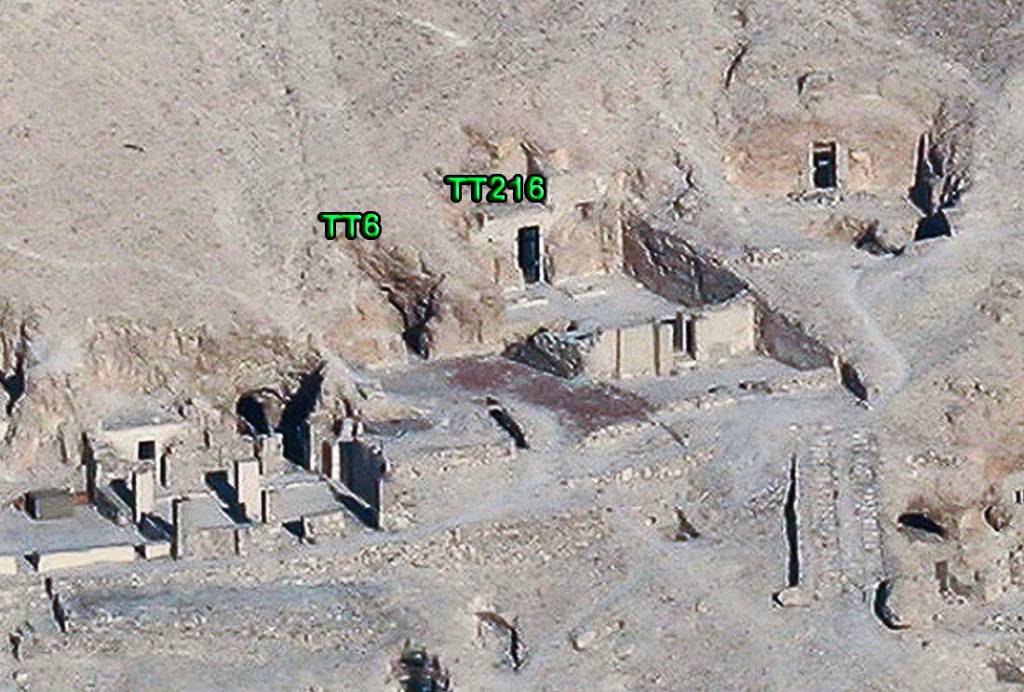
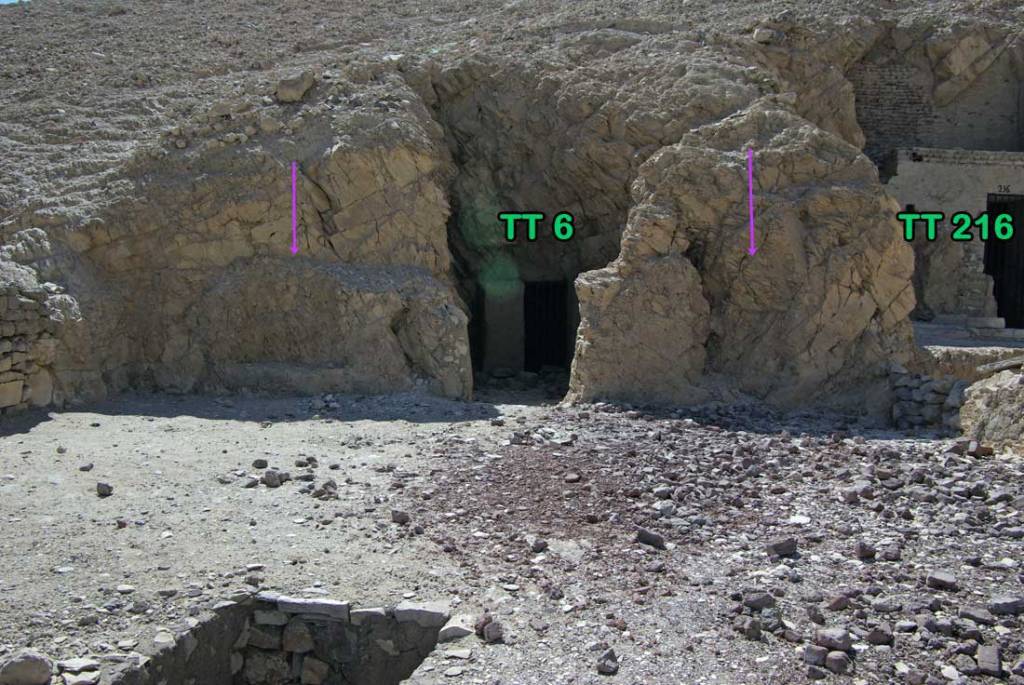
It should be noted that tomb TT216, adjoining that of TT6, is that of another Neferhotep, son of Nebnefer thus grandson of the TT6 Neferhotep, which is the largest and best located in the necropolis of Deir el-Medina. The Neferhotep of TT6 will be referred to as Neferhotep (I) and his grandson as Neferhotep (II).
It should be remembered that the work in the royal tombs was done in parallel by two teams, one for the right-hand side and one for the left, there were two foremen (and only two) who exercised authority at the same time, one for each side, Neferhotep was foreman of the right.
Inscribed monuments are very rare for Neferhotep (I), although an offering table in his name was found by Bruyère in the courtyard of tomb TT216. This table refers to “”[…] Neferhotep, foreman of the Lord of the Two Lands, Djeserkheperure-Setepenre “”. Neferhotep was thus in office under Horemheb, probably from year 7 of his reign and remained there at least until year 5 of Rameses II. He appears with his wife, Iyemuau, in the chapel of the scribe Ramose, TT250.
TOMB OWNERS
Neferhotep (I)
No tomb belonging exclusively to Neferhotep has been discovered, and it is thus necessary to follow Cerny when he suggested that he was buried in tomb TT6, with one of his sons and successor Nebnefer.
Only one wife of Neferhotep is known, Iyemuau, who gave him several other children besides Nebnefer. However, not all of the children stayed in the village: Nakhy (son) was “”an army scribe of the Lord of the Two Lands and chariot warrior of His Majesty””; Mose (son) was “”transport officer of His Majesty, horse groom and porter of the temple of Usermaatre Setepenre (Ramesses II)””. At least a fourth son is known, named Turo, and a daughter, named Tuya, existed.
The foremen (or team leaders) had a very important social standing, probably greater than that of the scribes. They were at same a time members of the team of the tomb and accepted it. They are supposed to supervise and co-ordinate the activities of workers, in the manner of a foreman on a current excavation site. They are the ones who represent the team in front of the upper authorities. They must also arbitrate the disputes and litigations and these are the main characters of the courthouse of the brotherhood, which they preside over; they act as witness for the vows and the transactions. They are present at the time of the divine processions. They are also the ones responsible for the tools and necessary supplies for work in the royal tombs. They are usually referred to as “”chief of the team”” or “”team leader”.”
Neferhotep, chief of the team on right of the tomb, had for colleagues the head of the team on the left, Baki then Pached. He was a contemporary of the worker Sennedjem, possessor of the famous tomb, TT1, recovered intact. Some of the similarities proves to be interesting as will be seen below.
Nebnefer
This was the son of Neferhotep and Iyemuau. His wife was called Iy, daughter of the lady Isis. Both are represented in tomb TT250 of Ramose, however only Nebnefer is present in the funeral procession of Kasa (and Penbui) in the TT10 chapel.
Nebnefer remained in office from year 5 until year 30/40 of the Ramesses II, whereas Paser and then Khay occupied the post as vizier. He then maybe became the foreman of the left-hand side of the Pached tomb (the same as his father), but especially Kaha and, maybe, Ankherkhauy.
The couple’s children included Neferhotep (II), Henutmehyt and Iyemuau. Neferhotep (II), who succeeded his father around year 40 of the reign of Ramesses II, accommodated the largest tomb at Deir el-Medina, TT216, which adjoins the tomb of his father and grandfather, TT6. The place is ideally located: at the top of the hill overlooking the village to the west, with a view of the entire site and to the north the Ramesseum, the Temple of a Million Years of Ramesses II (see tb-ramesseum aerial photo).
The inscriptions of the tomb have a dual distribution: those on the right half are of Nebnefer, who was the recipient of offerings (which did not prevent his father Neferhotep being mentioned several times). Entries, specifically of Neferhotep, occupy the walls of the left side. This division also exists for the inscriptions of the ceiling.
OUTSIDE AREA AND COLLAPSED ENTRANCE PASSAGE
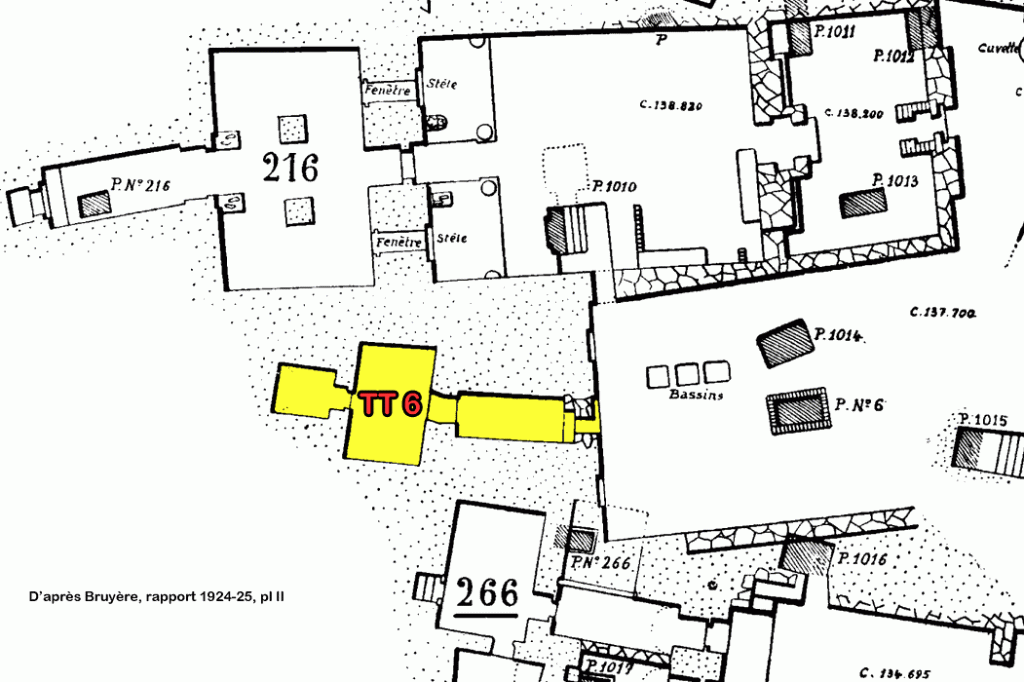
As seen in the image opposite, tomb TT6 is preceded by a terraced rectangular courtyard, adjoining the one of TT216, which is located to the right. Tomb TT216 belonged to Neferhotep (II), who was the grandson of Neferhotep (I) and son of Nebnefer.
In the middle of the courtyard is a shaft which descends to the burial chamber. The burial chamber is described at the end of page 2.
A pyramidion has been found, and it is known that a small pyramid overhung the entry to the chapel.
The original facade, carved into the rock of the hill, had two stelae, the locations which can still be seen (these are marked by arrowheads in the picture above).
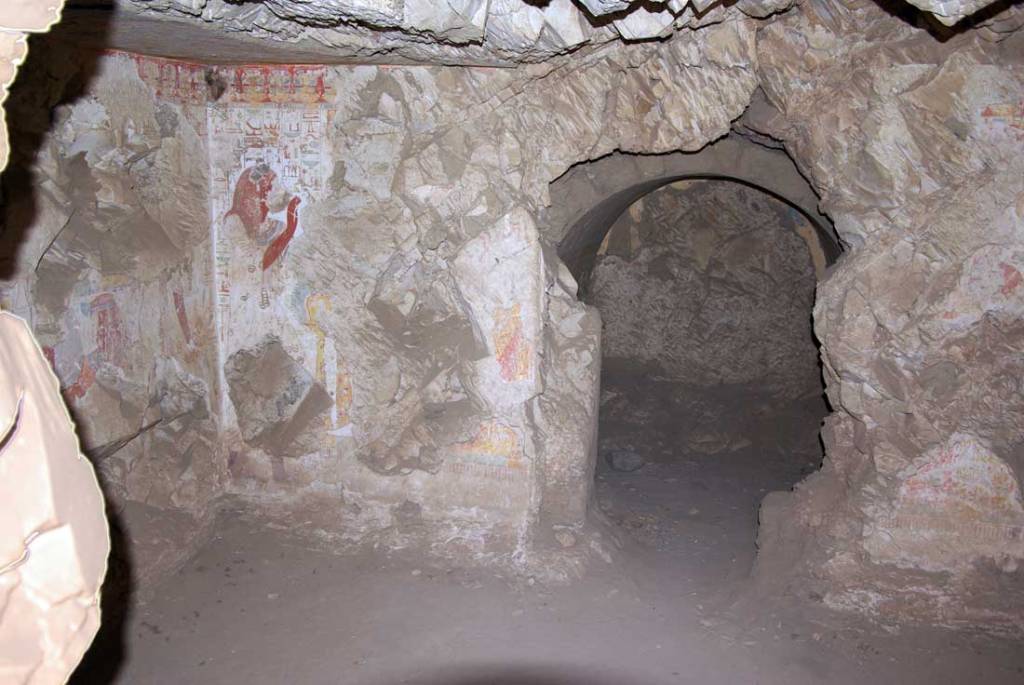
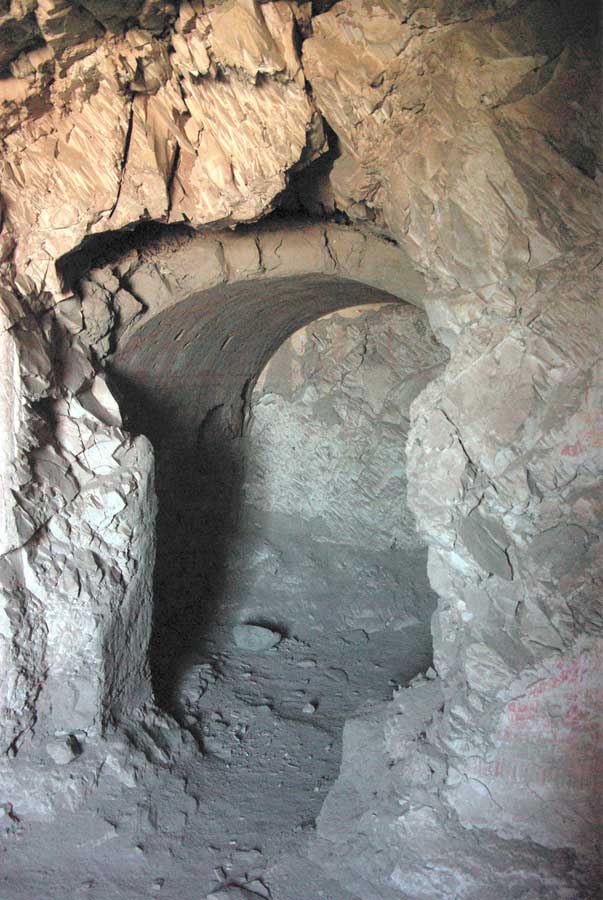
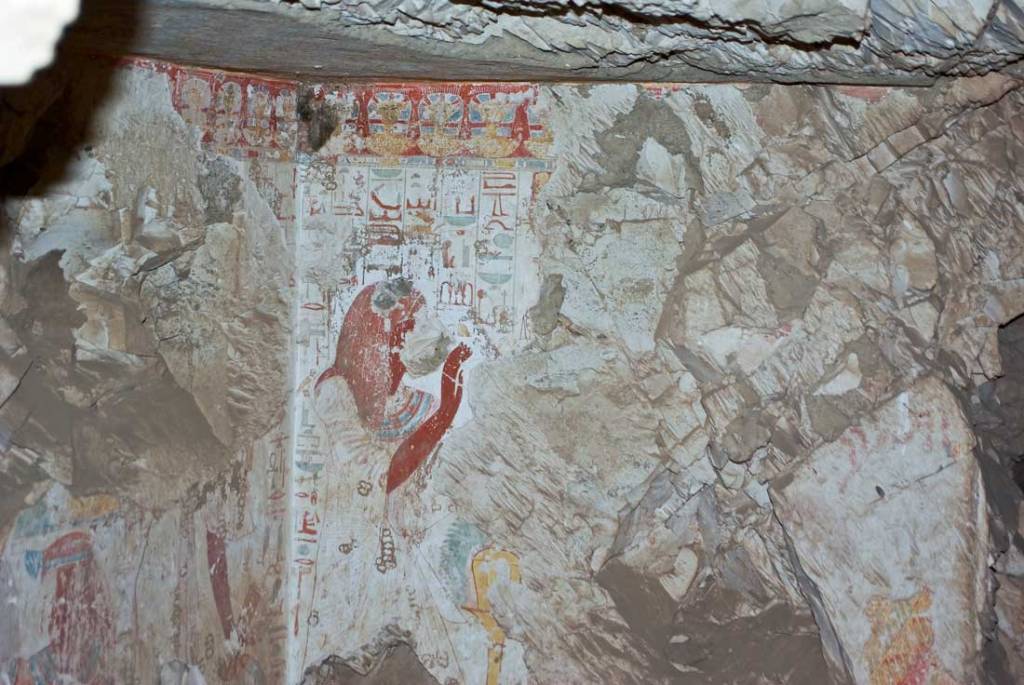
Today the tomb is entered by a collapsed corridor, of which only two small fragments still exist, one with a piece of the ceiling and some hieroglyphs forming the name Neferhotep (see tb-1708), the other with jars, amphorae and a shrine (see image to the right).
Today, the entrance to the tomb is into the main transverse chamber, through the passage which originally linked this chamber and a preceding corridor (see tb-1702).
TRANSVERSE CHAMBER
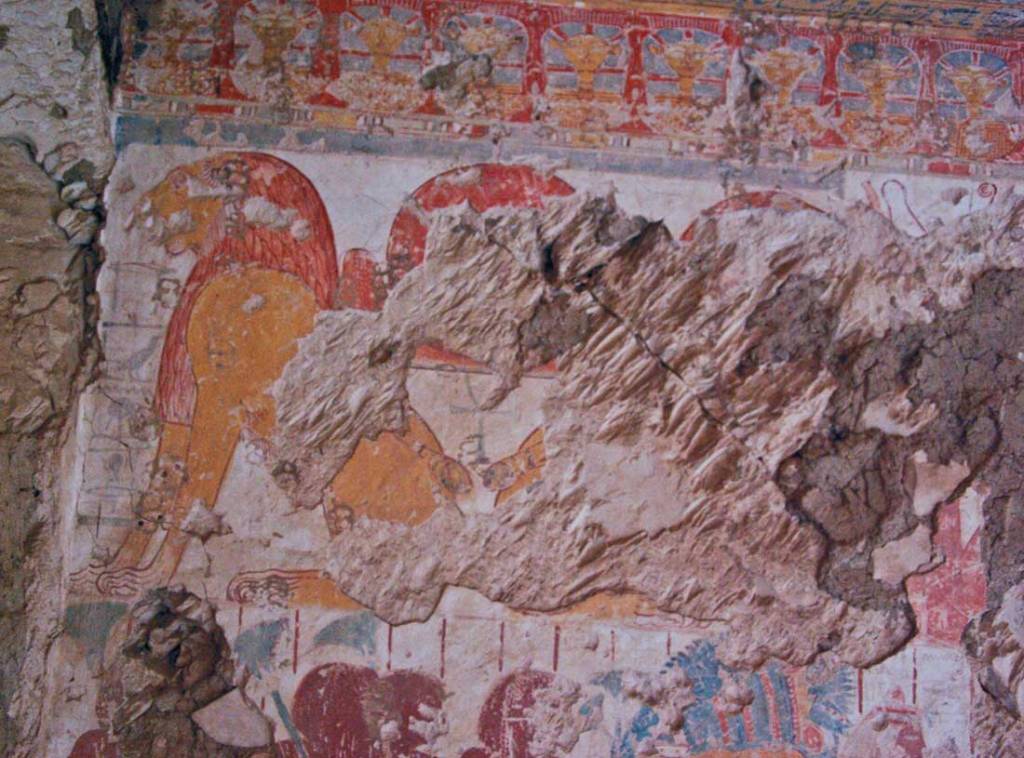
Upon entry it can be seen that the chamber is very damaged, but what has survived is of good quality.
CEILING AND UPPER FRIEZE
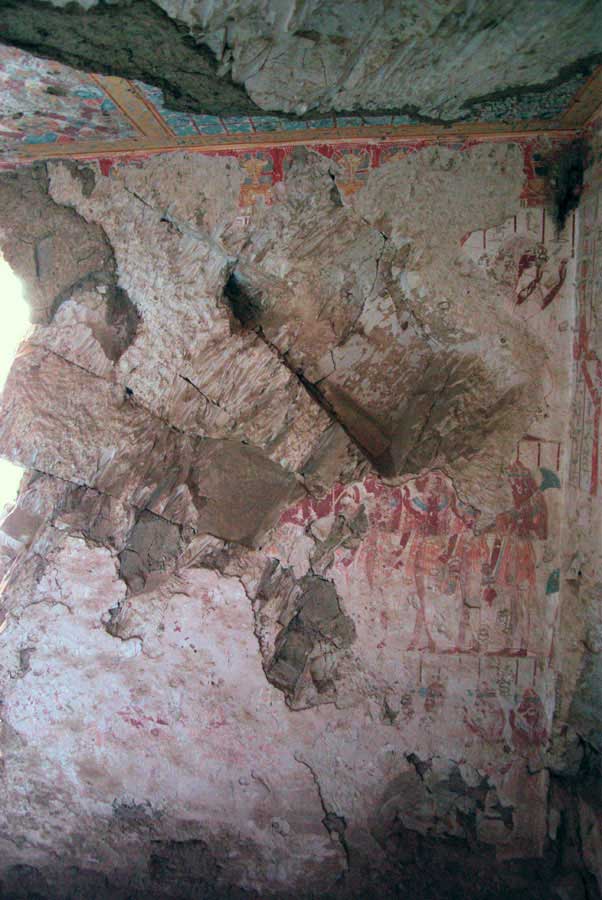
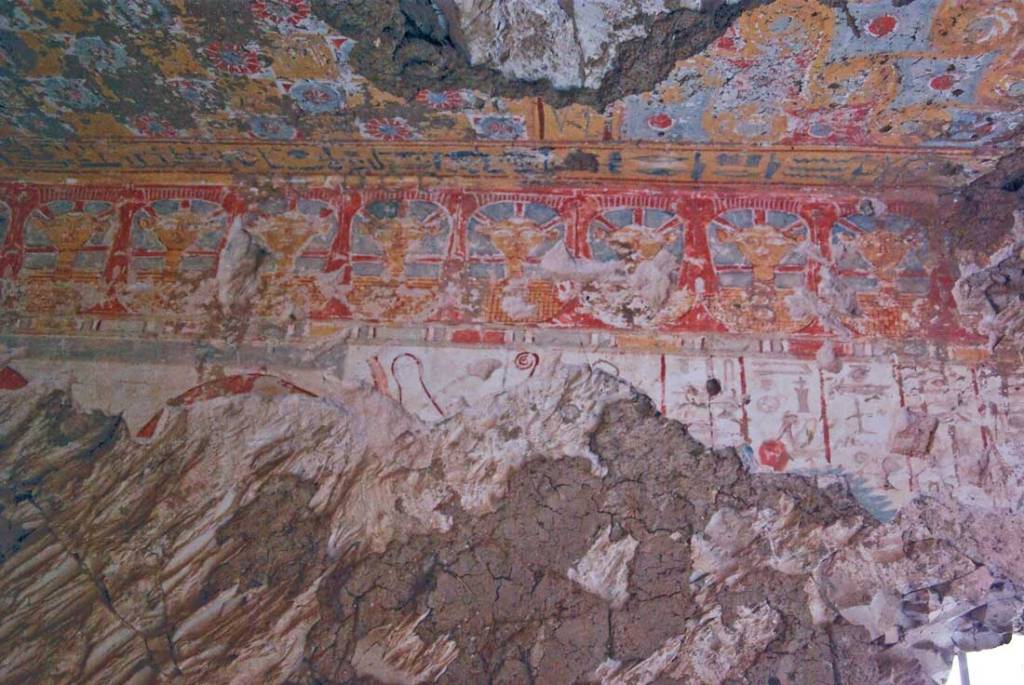
The ceiling is divided into rectangular areas by yellow bands edged with one or two red lines and having blue hieroglyphs. The patterns of the enclosed areas are varied, containing circles, rosettes, leaves, etc. (see tb-1728, tb-1727 and tb-1726).
At top of all the walls runs a frieze. This consists of a red background on which are images of the goddess Hathor with the head of a cow with horns, surmounting a woven basket. The frieze is separated from the underlying scenes by classical band formed of alternating coloured rectangular patterns.
The walls were covered with a thick coating of mud which had been painted white. As is often the case in the Ramesside period, the same scene is no longer limited rigidly to a single wall, but may extend to the adjacent wall.
LEFT SIDE OF THE TRANSVERSE CHAMBER (SOUTH)
1)- East wall – south section
This includes three registers.
Upper register
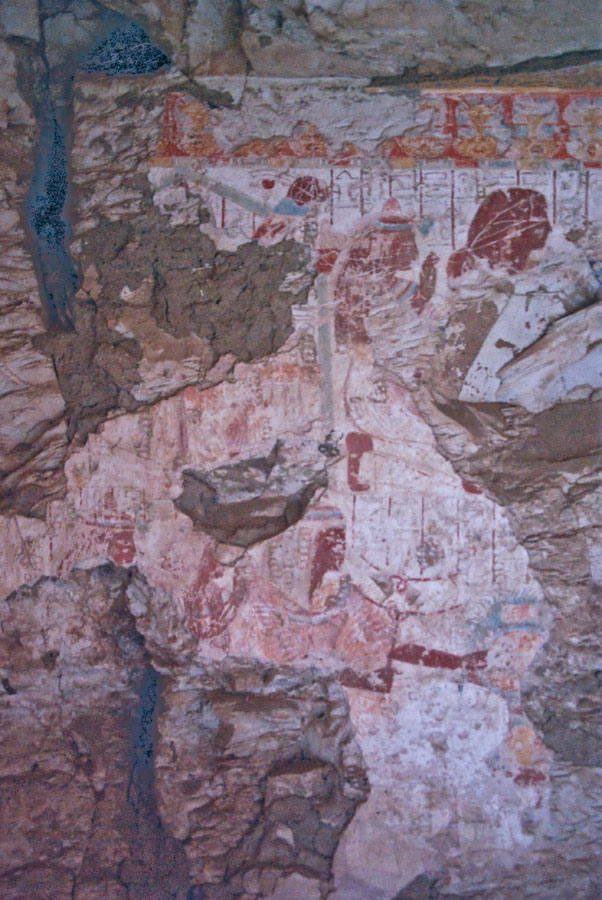
(See Wild, pl.5.) This is almost completely destroyed, see the left side of the image opposite. At the extreme right, a man is seen in adoration before the ka sign, which is actually located on the adjoining south wall.
Middle register
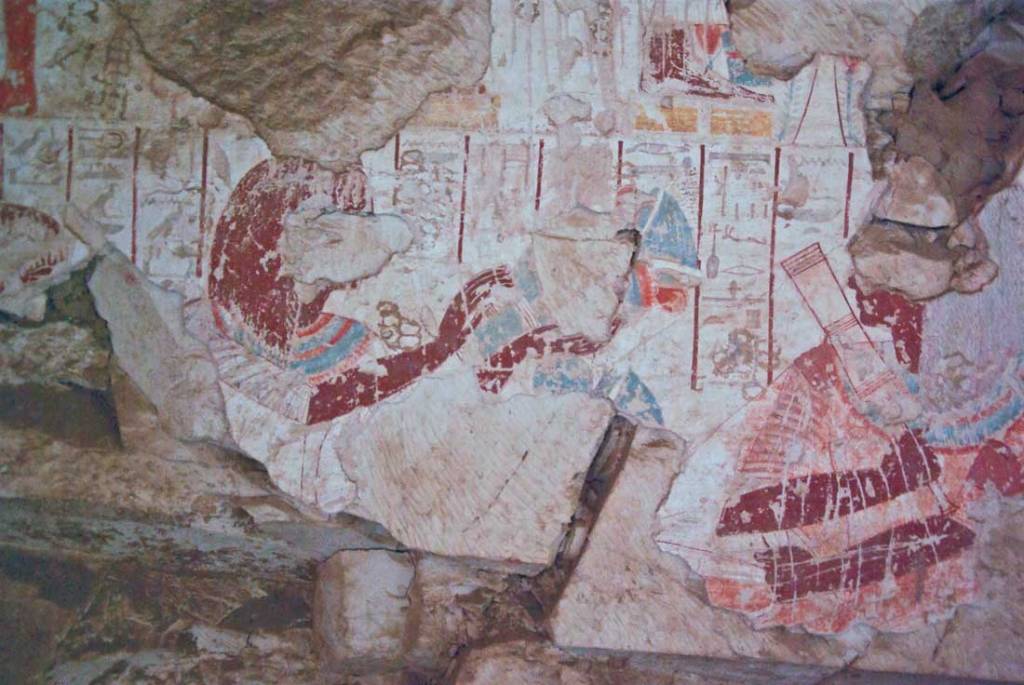
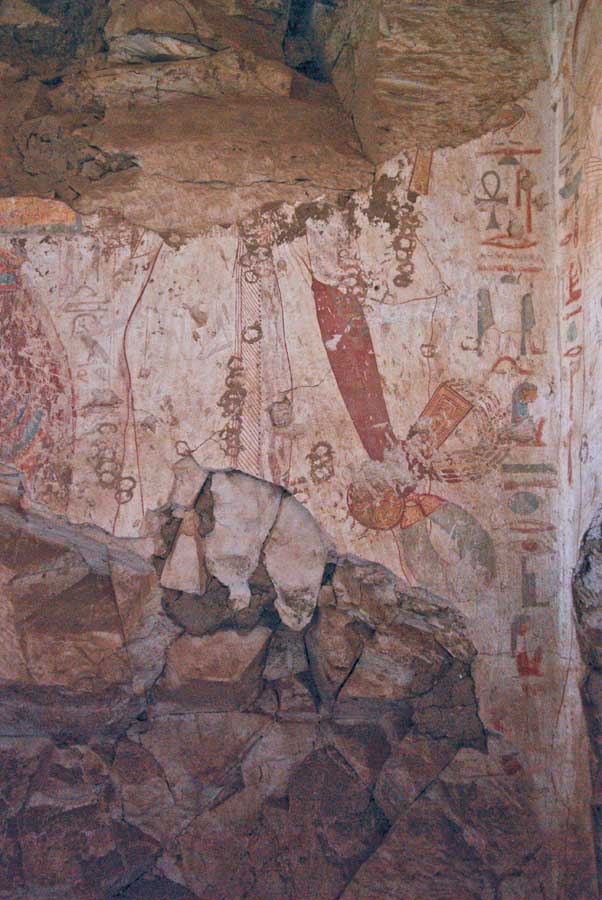
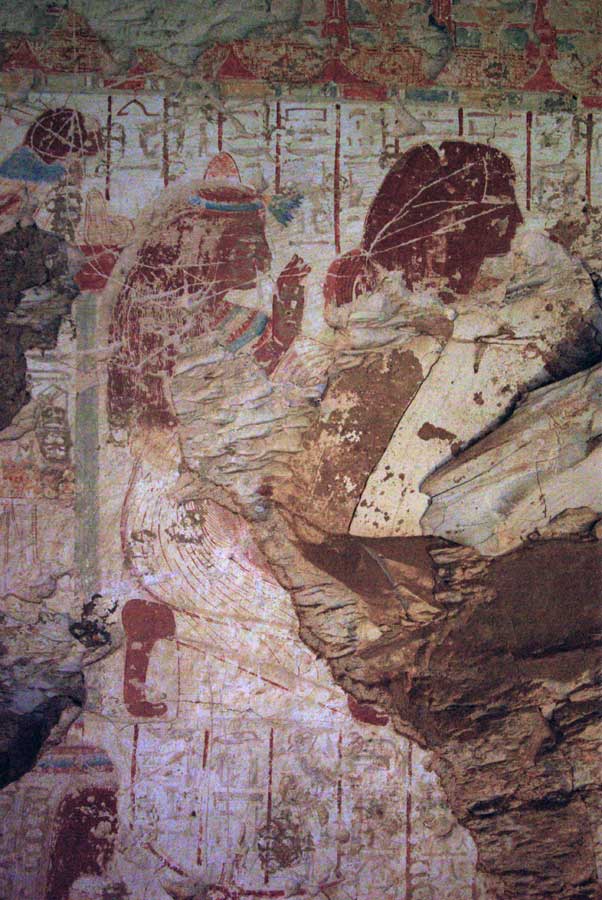
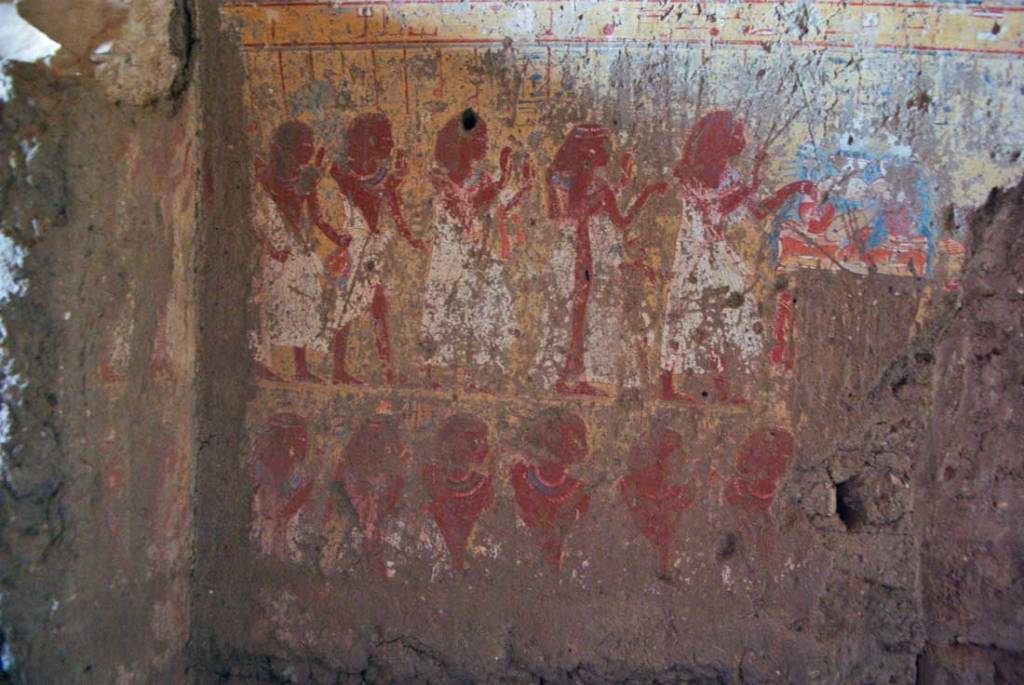
(See Wild, pl.7.) A seated couple receive the homage from four men followed by four women (the seated couple and the most of the image of the four men have disappeared). The women are dressed in a large fringed tunic with bouffant sleeves and wear a wide collar. The one which is furthest to the right is the best preserved, and she holds in one hand a large stem of blue papyrus and in the other a basket or bag. This basket is a little better seen with the woman who precedes her (see tb-1723-01). The basket appears to be divided into four parts, each containing round objects: this is a way of representing different fruits (?) for the dead, sometimes similar partitioning in baskets are found placed on tables.
Bottom register
(See Wild, pl.8 and tb-1724.) This scene is also very damaged. The left side is hardly recognisable, but what remains are of three seated couples and the two or three men who pay them homage, followed by better preserved three women.
2)- South wall
(See tb-1714)
This includes two registers on the left, but on the right the wall shares a full height image with one on the south end of the west wall.
Upper register
Adoration of the ka.
The ka, which represents the vital strength of the individual, is closely dependent of the food offerings. It is presented here on a pavois, as a symbol. As already mentioned, the image of a man on the adjoining east wall is also connected with this scene. One can see the close relationship between image and writing, since it is also about the hieroglyph , Gardiner D29. The ka remains in the tomb, unlike the ba it doesn’t have the possibility to pass from one world to the other. The representation refers to Chapter 105 of the Book of the Dead: “”Formula to make favourable to Neferhotep his ka”” or “”Formula to satisfy the ka””; sometimes the space between the two open arms contains victuals; sometimes a libation or incense are carried on the sign. The plural of the word ka, kau, designates the food offerings, showing the close relationship between one and the other.
If the individual succeeded in uniting his person’s different components (mummy, ka, ba, name and shadow) it becomes an efficient mind, an Akhu. The text of Chapter 105 goes farther, it offers to wash his ka of blemish: “”I have brought you natron and incense so that I may purify you (…) These evil things which I could hold, these evil sins which I could have committed, which are not returned to me (…) I am quite flourishing and my ka (is quite flourishing) as are those (the inhabitants of the horizon), the food of my ka is like theirs”.”
Worship of the serpent Sa-to (or Sa-ta, sata).
The name literally means “”Son of the Land””. Many snakes inhabit the Egyptian imagination, sometimes lending their protective functions – like the snake Mehen which surrounds and protects the sun on its nightly journey, sometimes destructive – as Apophis trying to capsize and destroy the solar boat every night. They are beings of the earth, particularly wetlands, which live in burrows, from where they emerge in the light of day. In addition, during the moulting period, they seem to revive themselves, the illusion of a perpetually renewed life and and undergoing transformations, during the sun’s nightly journey.
The inhabitants of the village of Deir el-Medina show some commitment to the serpent deities, as shown by the numerous stelae and the devotion to the worship of the goddess Meretseger (“”she who loves silence””) represented as a cobra.
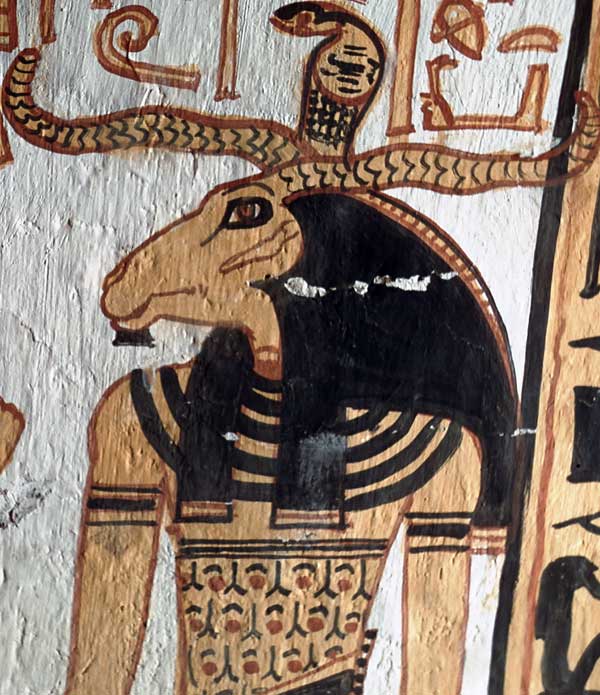
Among the many avatars of these ophidians, the one who adores Neferhotep takes the form, rarther strangely, of the head and the inflated hood of a cobra raised on human legs, an uraeus which walks, associating the idea of mobility to that of transformation. The explanation of this figure is available in Chapter 87 of the Book of the Dead: “”Formula for taking the form of a serpent – sata:” (followed by the words spoken by Neferhotep, the deceased) “‘I am a snake, sata, rich in years, and I spent the night be in the world, every day I’m a snake – sata, who is in the bosom of the earth. I spend the night to come into the world, to be renewed, to be rejuvenated, daily'” “. Barguet made the following commented: “”The text strongly suggests that the snake, sata, is a form of the sun, the one which takes it into the underworld during its nightly journey during which it is again formed, and formed the new sun every day, the creation of the sun (and the world) recurring every morning.”.”
Chapter 87 is found in only five tombs, all Ramesside: TT290, TT183, TT214, TT359 and this TT6.
On the wall to the right, today much destroyed, showed a seated couple.
Bottom register
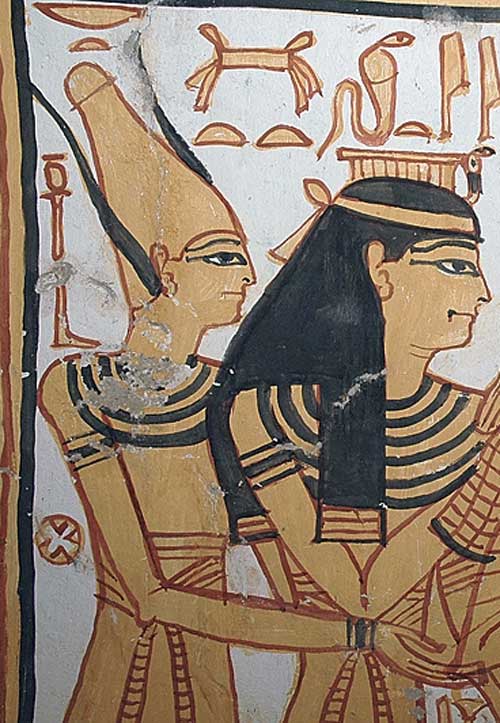
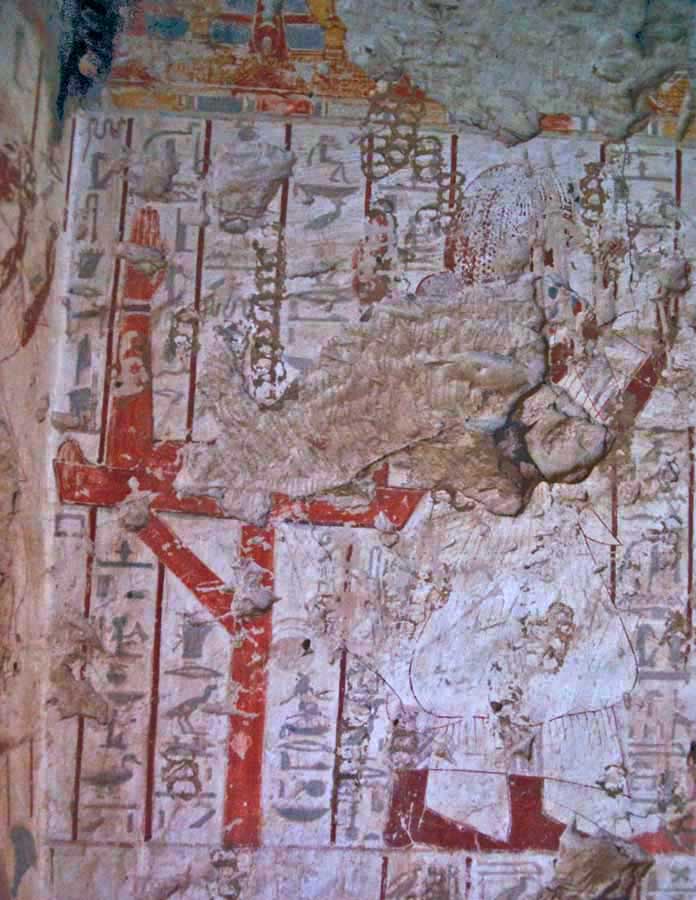
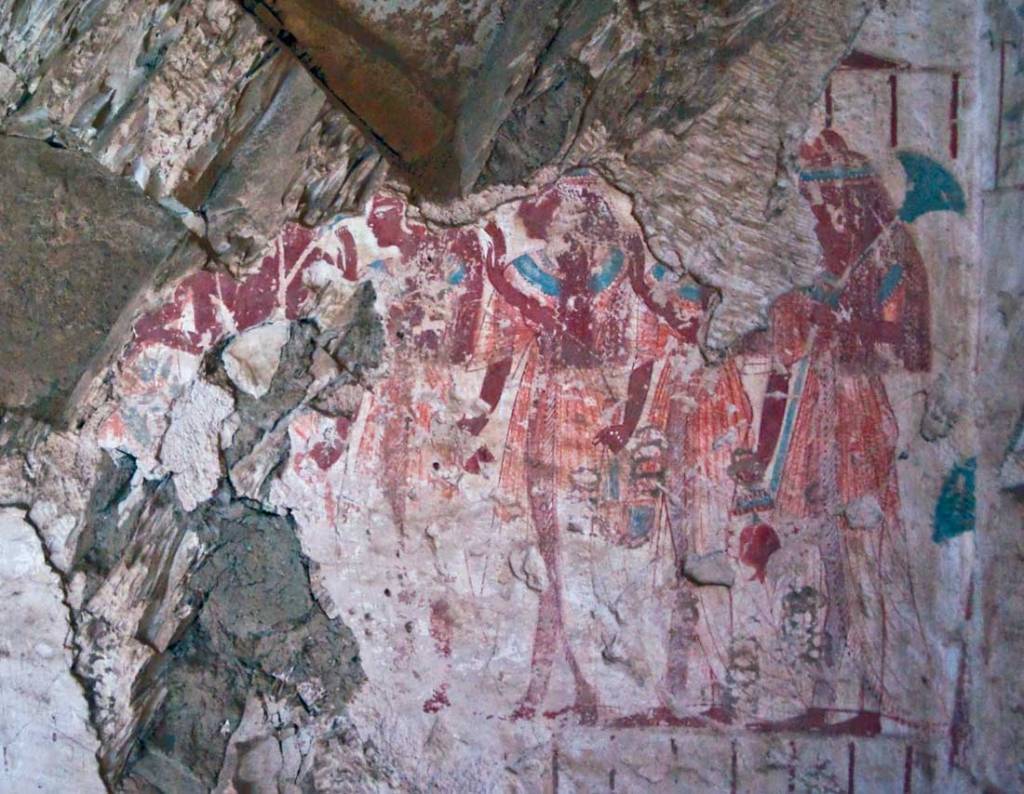
Three sons and two females, standing on the left, pay homage to Neferhotep and his wife. Neferhotep holds in his left hand a folded piece of cloth whilst in his right hand he grasps a Sekhem sceptre. He wears a large necklace of multicoloured beads. His wig is white, streaked with black (see tb-1720) which doesn’t necessarily indicate an advanced age, but rather his status as ancestor of a vast family (a similar representation is in the tomb TT290 of Irynefer (see is-19). Iyemuau, his wife, surrounds his shoulders with her arms. She also wears a broad necklace; her black wig is decorated with a headband and a stem of lotus, but without a festive cone. The first son holds out a bouquet to his parents.
Extreme right
(See Wild, pl.4 and tb-1715.) Only part of the the image of the lady Iy, the wife of Nebnefer, remains and she is standing behind her husband who is actually portrayed on the south end of the west wall. “”His daughter, who makes his name live, Iy, ‘True of Voice’ by Osiris […]””. It is also on the west wall that the explanatory text, painted in beautiful coloured hieroglyphs, which ends in front of Iy, begins: “”To bring all good and pure things for your ka, the Osiris, master of the west, Un-nefer, master of the Sacred Land, the foreman of the team of the Place of Truth, Neferhotep. His son, who makes live his name, the foreman of the team of the Place of Truth, Nebnefer, ‘True of Voice’ by the great god. His sister, the chantress of Khnum, Satet and Anuket.”.”
Iy holds in her hands two instruments with Hathoric connotations: a sistrum in her right hand, a Menat necklace and its counterweight in her left hand. According to the custom of the Ramesside period, her dress is full, occupying a significant space in the composition.
3)- West wall – south section
(to the left of the entrance to the shrine)
(Also see tb-1707)
The right-hand side is occupied by the beginning of the scene which has just described, with Neferhotep carrying a brazier, in worship of the kiosk of a seated a divinity – or rarther, where one sat, because Osiris has disappeared completely. Behind Osiris stood the goddess of the west, who protected him with her winged arms. In front of the kiosk are still the remnants of a pedestal on which was placed a golden ewer surrounded by a plant crown.
RIGHT SIDE OF THE TRANSVERSE CHAMBER 5NORTH)
West wall – north side
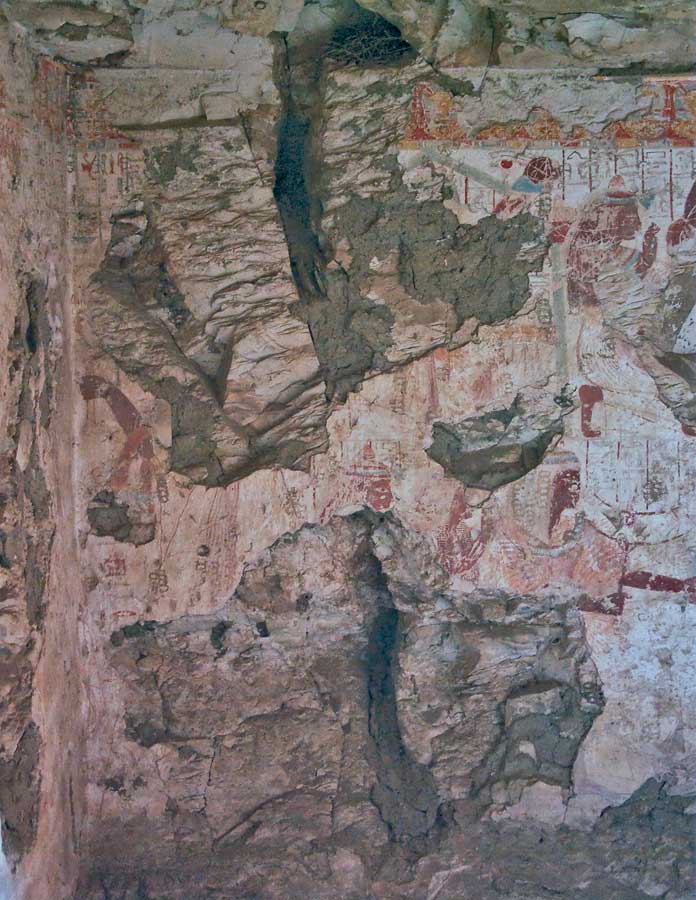
This is almost completely destroyed. Henry Wild recognised however, that immediately to the right of the opening leading towards the shrine (see tb-15) was the image of Re-Horakhty sitting under a kiosk, as Osiris does on the other side of the opening. The kiosk is surmounted with a complicated motif including, at the summit, a row of solar cobras (see tb-45). Toward him advances Nebnefer with a brazier in his hand, followed by his wife, Iy, who is actually on the north wall. In the text above him is mentioned Neferhotep (II), their son: “”making live his name”” (probably meant to be ‘their names’).
North wall
(See tb-1733)
1)- The lady Iy
This lady has already been mentioned, in the fact that she follows her husband, who is on the connecting west wall. Her image is almost the full height of the wall, with text above her, but after her the wall is divided into two registers. Very little remains of her image, but part of her dress can be seen and her right forearm waving a Hathor sistrum, whilst lotus stems hang from her elbow. Above her, the columns of text state: “”For his sister, his beloved, the hostess, Iy, the highly praised by Hathor, mistress […]””. Before her, there was also the text “”Her son, who makes live the name of his father, Neferhotep.””. As already mentioned, rest of the wall, to the right of Iy, is divided into two registers.
2)- Upper register
(See Wild, pl.11-01)
A couple sit in front of a table, playing the board-game senet
(See tb-1730-01.) This is connection with Chapter 17 of the Book of the Dead: “”Formulae for transfigurations and glorifications, for going out of the empire of the dead and return to him; to be a blessed in the good West; going out by the day, taking any form desired to be taken, to play the board-game senet sitting in the pavilion; to leave in the living ba, the Osiris, Neferhotep, after his death.”” (Barguet). In the Ramesside period, the game of senet had only one player, the deceased, without a visible opponent in front of him. But the opponent exists, it is death, forgetfulness, failure in the course in the hereafter, and finally it is a summary of the path which the deceased follows in the underworld, he must emerge victorious. This is illustrated, for example, in the commentary accompanying the identical scene in the tomb of Inerkhau, TT359: “” (…) May I move the pieces by placing them where I want (…) May I fight like a god against the opponent and see Neith (…) let my heart be insightful without being negligent, may my heart be clever to guess the game (the opponent) against me and his pawns turn around (against him), can his fingers become disturbed, and his heart leave the place so that he doesn’t know (how) to respond.”” (Cherpion). This idea to play his destiny against death will be taken by Ingmar Bergman in the movie “The Seventh Seal” (see screen capture) : here also death is invisible for all the characters, except for the knight who seems to play alone.
As often in this type of representation, two ba-birds are found: they are perched in front of the right-hand part of the roof of the structure, in front of the small bowl containing bread; a Wedjat eye was added to fill the space (see tb-1730-02).
Adoration of Nebnefer and his wife at sunrise
Nebnefer and Iy are kneeling in adoration, and recite a solar hymn which begins: “”Worship Ra at sunrise on the horizon in the form of a disk…””. A large area of damage has removed the rest of the imagary of the wall except a few traces which allowed Henry Wild to reconstruct the presence of the goddess Nut welcoming the deceased into it, one of the three vignettes from Chapter 17 (see Wild, pl.11-02).
3)- Bottom register
(See Wild, pl.12 and tb-1731-01.) All of the right-hand side is destroyed, it still shows Nebnefer sitting alongside his wife, Iy, and her mother, Isis. He holds in his right hand a small billowing sail, symbolising the air which the deceased hopes to breathe again, the breath of life, but also the gentle north wind, which he enjoyed during his lifetime, it is also the hieroglyphic sign (Gardiner P5). His left hand is stretched toward offerings. In the destroyed area must have been a couple of people standing in adoration, three other couples are on the lower register of the east wall.
East wall – north side
(See tb-1736)
1)- Upper register
The two lions
(See Wild, pl.13-01)
The two lions, positioned back to back, seem to support the image of the sun rising between two hills, forming the akhet hieroglyphic sign (Gardiner N27), which designates the horizon. It is also a vignette of Chapter 17 of the Book of the Dead. They are called “yesterday” and “tomorrow”; the naming indicates the ageing sun, which sets in the western horizon, so that the young sun can rise in the eastern horizon, symbolising death and rebirth of the star, and thus, by assimilation, life of the deceased being constantly renewed, which is reflected in the ankh sign of life hanging from under the image of the horizon.
The Benu bird
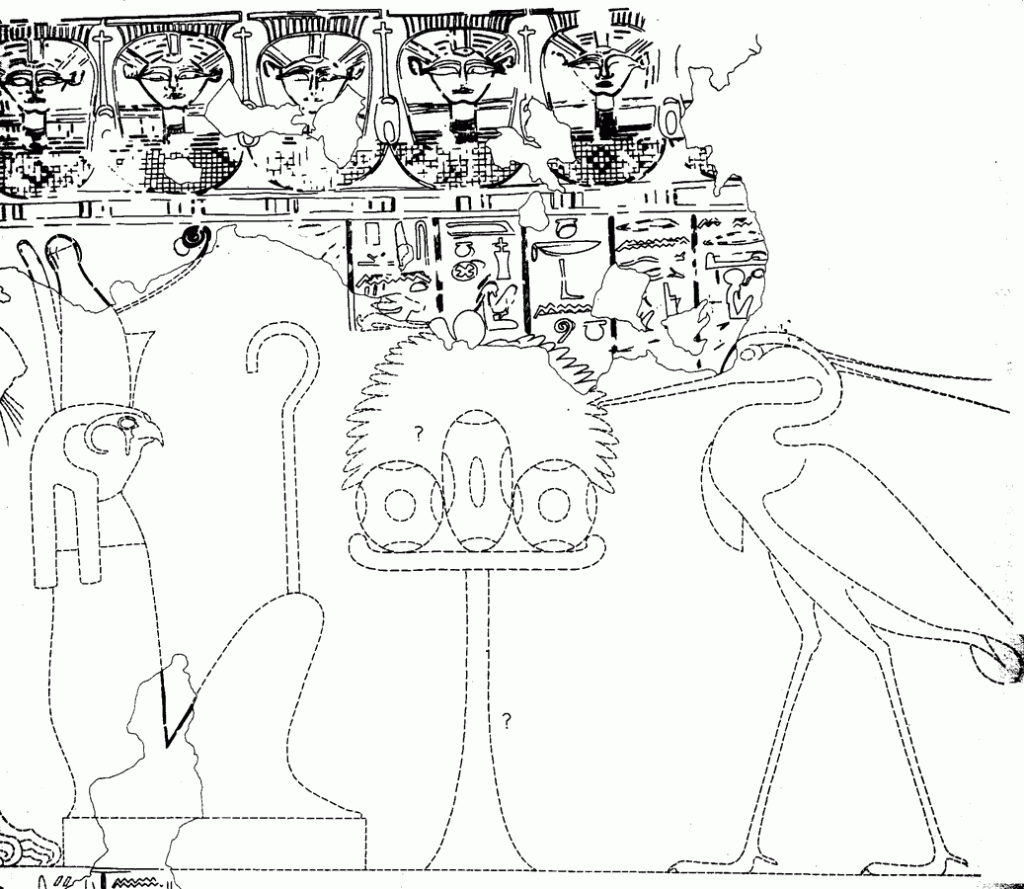
Further to the right, the wall is destroyed, but it is certain that it contained the image of a seated god of high authority, wearing the double crown (see tb-1739) and a wading bird, a grey heron, with a fragmentary text which refers to the transformation of the deceased benu bird (later the Phoenix of the Greeks) in Heliopolis. It is a theme which can be found in Chapter 83 and secondarily in Chapter 17 of the Book of the Dead, this transformation is one of those which the ba (soul) of the deceased hopes to accomplish. The deceased is often seen adoring the bird (as in the tomb of Inerkhau for example, tomb TT359), but not here.
The ba of Ra, the sun, is a benu bird, whose principal place of worship is Heliopolis and it is known that the sun always evokes the eternal return, it is also the ba of Osiris, referring to the victory over death and rejuvenation; finally, it is a being which comes from itself into existence.
2)- Middle register
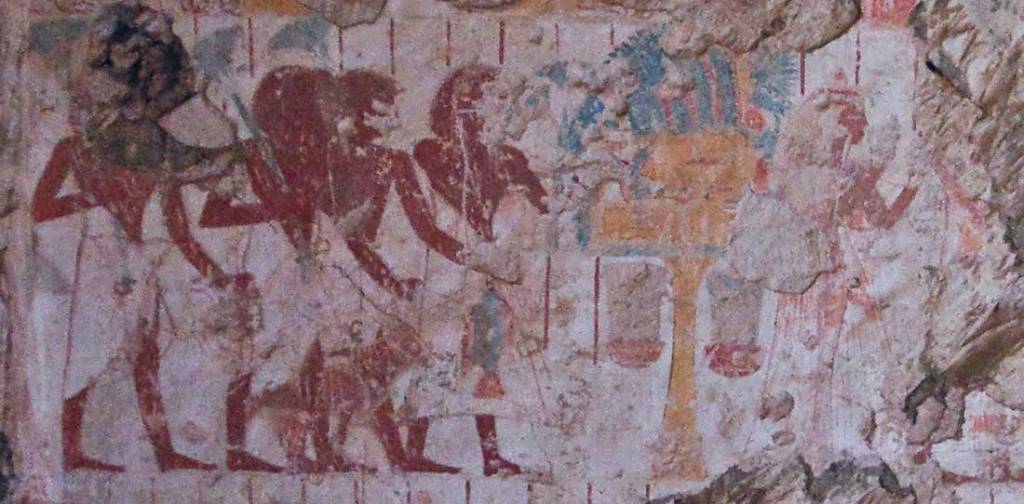
Nebnefer and Iy worship a female deity, they are followed by four men (including the military) who bring offerings (one of them even holds a calf on a lead), which will be added to those already placed on a monopodal table. The table is flanked on each side by a pedestal supporting a large vase. The columns intended for the descriptive text are empty.
3)- Bottom register
(See tb-1736-02)
This is the extension of its counterpart on the north wall. Three couples, heading towards the left, are bringing offerings. Again, the columns to the text remained empty.
THE SHRINE
The entry to this is in the middle of the west wall (see tb-04). It is fully lined with mud bricks, with a vaulted ceiling. The whole shrine has suffered damage. Thus there is nothing left on the rear west wall of the four statues which occupied it, which were, from left to right, Satet, Osiris, Ra-Atum-Horakhty and the goddess of the West.
THE CEILING
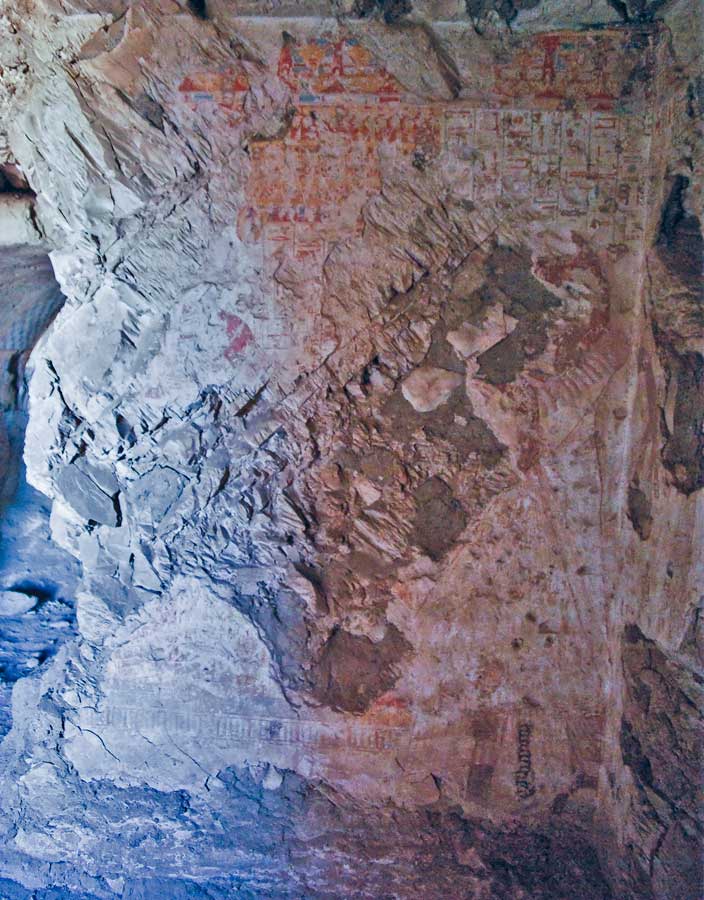
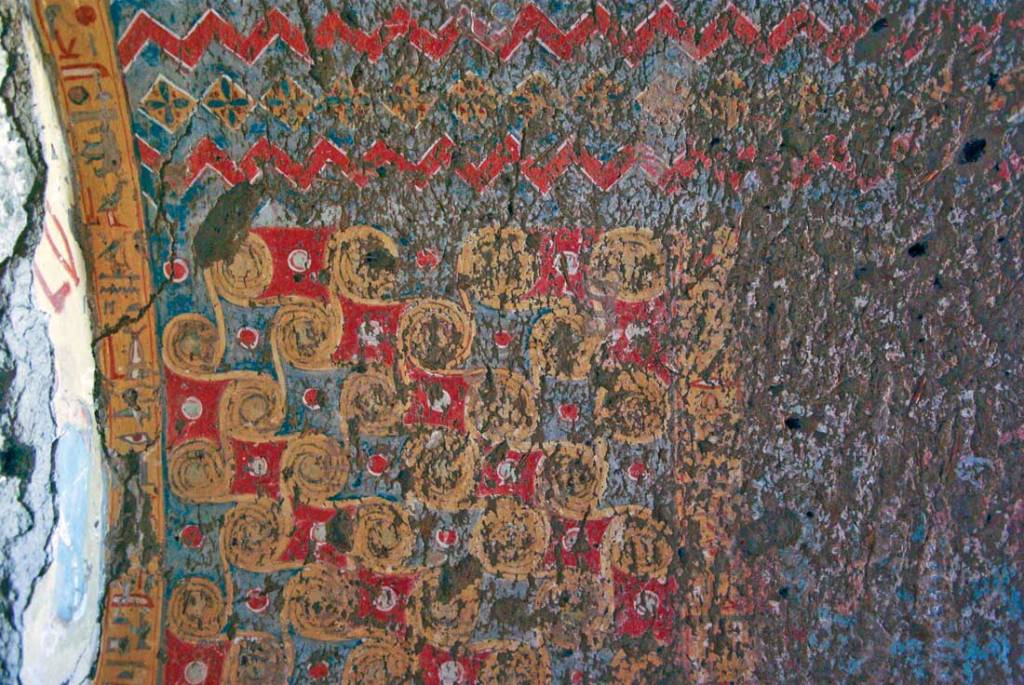
This has a vaulted surface, extending down to the two side walls to about a quarter of the full height of the chamber. Even the upper surface of the side walls are slightly curved at the top (see the image to the right). The ceiling is centred, from the entry to the rear wall, by two side-by-side text columns of hieroglyphic text on a yellow background; each column being edged with a red line and a blue one. At each side of the two texts is a motif formed of zigzag lines of different colours (see tb-1746 and tb-1747). On either side, north and south, are four rectangular areas. The two outer rectangles are decorated with geometric patterns.The middle two, although difficult to examine, actually contain scenes. All the four sections are edged with a column of text on a yellow background. At the junction of the ceiling and the side walls there is another row of coloured text, again on the usual yellow background (see the bottom of tb-1747).
On the southern half of the ceiling
(See Wild, pl.21-01 and tb-1745)
In the two scenic areas: to the left is found the deceased with a tree goddess who provides his subsistance and to the right are represented four baboons sitting around with food, surrounded by date palms.
Move mouse pointer over image
On the northern half of the ceiling
(See Wild, pl.23-01, tb-1741 and tb-1743)
The two central areas show, on the left side, the deceased crouching under palm trees in the process of quenching his thirst (as in the tomb of Pashed, TT3) and on the right side, the deceased is fed and watered by the goddess of the sycamore who is kneeling beside the tree.
SOUTH WALL
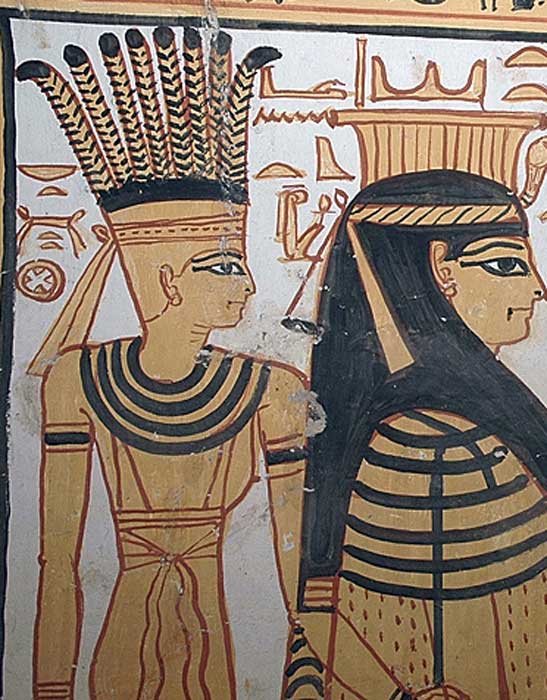
This wall is divided into two registers, but possibly containing similar scenes, the lower one is almost lost. In the upper one Neferhotep and his wife, Iyemuau, are offering to the goddess Anuket and Horus son-of-Isis, they are accompanied by their children and grandchildren (see tb-1744 in which an arrow points to the feathered headdress, characteristic of the goddess Anuket; also see Wild, p.20-01 for detail). Horus is in the form of a falcon wearing the Double Crown, with a flagellum stuck in his back, whilst at his feet rises a cobra wearing the white crown. Behind Horus, two wings spread around the solar disk which are appropriate to Horus Behedet (also known as Behedety), who was a god of the midday sun in the Delta, but would be quickly assimilated with Horus of Edfu.
NORTH WALL
This wall was constructed in a similar fashion to the facing one, also having two registers, which here constitute a single theme. This time it is consists of Nebnefer and his wife, Iy, who dedicate some offerings, followed by members of their family (see tb-1749, tb-1752 and tb-1755). Recipients are, this time, Harseisis and Anuket, who are associated here with the two other members of the triad of the cataract, Satet and the ram god Khnum.
The triad of Elephantine: Satet (Satis), Anuket (Anukis) and Khnum
These three divine entities protect the region of Aswan, south border of Egypt and are the guards of the first cataract. All three are associated with the Nile and its nutrient and fertilising flood, specifically the rise, but also with the withdrawal of the water after the flood.
Satet was the lady of Sehel, the warrior goddess, the goddess of the inundation and guardian of the borders of the south. As mistress of Elephantine, which was the principal place of her worship, she became the consort goddess of Khnum and the mother of Anuket. When Khnum was associated with Re (Khnum-Re), she became the eye of Re. The goddess was also associated with Sothis (the Sirius star) whose heliacal rising announces the flood. She was almost always depicted as a woman wearing a tight dress and head on the white crown of Upper Egypt, associated with two antelope horns and a uraeus.
Anuket was also a goddess of the cataract at the level of Aswan, protective of the southern border. In the Middle Kingdom, this former divinity was incorporated into the triad of Elephantine as the daughter of Khnum and Satet. She was considered as the Goddess Mother of the sovereign. She was more often represented in a very recognisable way, in the form of a woman wearing on her head a low and flat crown surmounted with high ostrich feathers (reminiscent of its African origin) and holding a papyrus sceptre. Her sacred animal was the gazelle. Her cult, centred on Elephantine and Aswan, also concerns the whole of Lower Nubia.
Khnum was one of the main ram gods of Egypt. Creator God, he shaped living things on his potter’s wheel. He was associated with the flood he held under his sandal and was considered as lord of the cataract, a mythical place where the flood was supposed to come from the caves of Hapi, the fertilising stream. Demiurge, lord of crocodiles, the ba of Ra when he appears as Khnum-Ra, the god is most often represented as a man with a ram’s head, wearing a short kilt and wearing a tripartite wig, sometimes topped with the Atef crown – which is readily associated with a pair of horizontal horns – or the white crown. Besides Elephantine, one of the important places of worship was Esna.
This triad of the south is found in the tombs of some of the craftsmen of Deir el-Medineh, but it is especially Anuket who is venerated, because she was associated with Hathor, the main divinity of the village.
How did this cult become installed in Thebes? It is only one of the multiple cults imported which one finds in the village and that testify to the mobility of the craftsmen. When a newcomer was admitted into the community, he brought with him his beliefs and his gods and goddesses. On the other hand, it is known that the workers of the village were mobile. This is how one finds their traces in some tombs of Bubastion of Saqqara. Nothing prevents one thinking that some could also go to their work in the region of Aswan and discover the divinities from there, which they then integrated in their personal pantheon.
THE BURIAL CHAMBER
This was originally entered by a shaft in the courtyard. This may have been modified into a ramp (see the area photo), but can anyone confirm this? The entry to the chamber is on the east side (see tomb plan). The chamber is decorated with sketches on a white background. No photos are currently available.
Turning to the left on entering the chamber, on the south part of the east wall and the south wall, the tomb owner and his wife pay homage to squatting gods.
Now, turning to the right on entry, on the north side of the east wall is the text from the “Book of the Dead” and images of the deceased, his wife and more squating divinities.
Proceding to the next wall, the north one, this is divided into five registers. Even though, as stated, no photographs of this chamber are currently available, comparison between the two photographs in the Eva Hofmann publication (p.80) shows that this wall is almost identical with the famous wall of the tomb of Sennedjem, TT1. It includes the painting of the harvest in the fields of “Iaru”, the land of the hereafter (see ogdb-75). In it, the deceased ploughs, harvests, eats, drinks and can live on, in the circle of his family.
Finally, the west wall, the one facing the entry, is divided into two registers. It includes pictures of the Book of Gates which are guarded by five fire-breathing snakes with knives. The upper register has the deceased and the lower one has his wife. There appears to be a niche at the south end of this wall.
 khaled gamelyanl blogger