
TT2 of Khabekhnet at Deir el-Medina
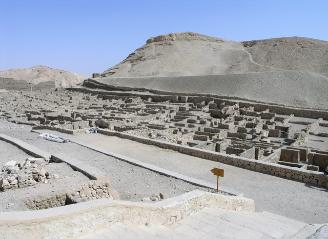
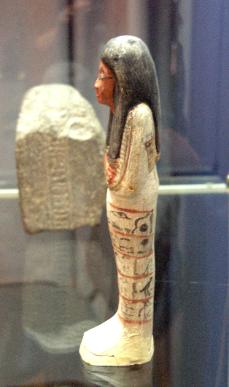
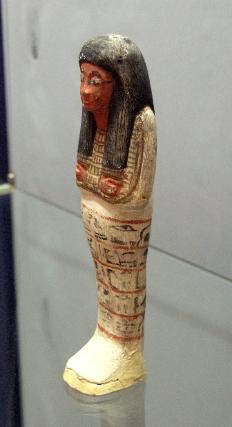
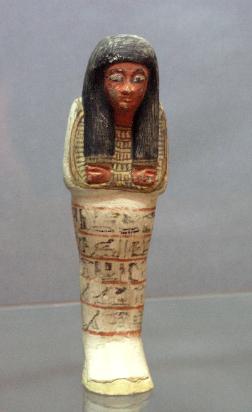
Khabekhnet was buried along with his wife,Sahte, and their family in a tomb in theabove and slightly to the south of hisfather’s tomb.Khabekhnet’s family was as extensive asSennedjem’s family. A stela found in thecourtyard of the tomb contains the namesof Khabekhnet, his brother Khons andseveral children: Mose, Anhotep,Amenemheb, Isis and Henutweret.Benedict Davies suggests they all wereKhabekhnet’s offspring (Davis,1999,45).Shabti for KhabekhnetFrom TT2, the Western cemetery at Deir el-MedinaLimestone, painted19th dynasty, reign of Ramesses IIHeight: 20.8 cmThe Náprstek Museum collection, Prague, Czech Republic, P6125Khabekhnet was the eldest son of Sennedjem (TT1).He lived during the 19th dynasty when Ramesses II(1279-1212 BC) was on the throne. His title was”Servant in the Place of Truth”. He lived in Deirel-Medina and worked in the royal tombs at theValley of the Kings.Khabekhnet’s house was located in the southwesternpart of the village. It stood next to the house ofhis father Sennedjem (Théby,2007,276).
Khabekhnet was buried along with his wife,Sahte, and their family in a tomb in theabove and slightly to the south of hisfather’s tomb.Khabekhnet’s family was as extensive asSennedjem’s family. A stela found in thecourtyard of the tomb contains the namesof Khabekhnet, his brother Khons andseveral children: Mose, Anhotep,Amenemheb, Isis and Henutweret.Benedict Davies suggests they all wereKhabekhnet’s offspring (Davis,1999,45)
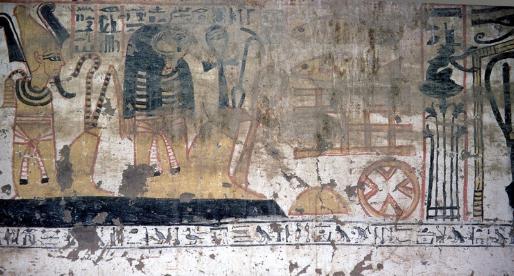
Another group of children of Khabeknet is listed in a register on the north wall of the hall of his tomb:sons Sennedjem (ii), Piay, Bakenanuy and Kha and the daughters Webkhet, Mutemopet and Nofretkhau(Davis,1999,45).Inscriptions on a statue of Khabekhnet and Sahte preserved the names of their three more daughters:Roy, Nodjemmut and Wabet as well as the names of the grandchildren Mose, Khaemseba and Mutkhati(Davies,1999,46).The substructure of the tomb contains decorations and scenes of the gods Ra, Osiris, Hathor and theking, also of Hapi and offerings and scenes of various other deities.
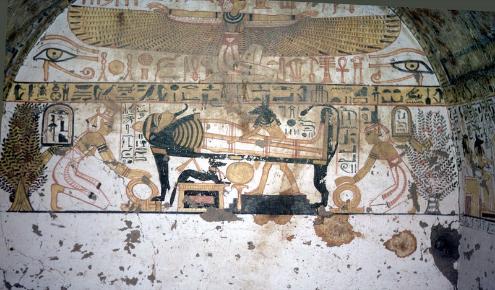
The goddess Isis spreads her protective wings above the bed, where the mummy of the deceased is laidout on the bed and the priest with the mask of Anubis cares for it. It represents Chapter 151 fromthe Book of the Dead. The goddess Isis and goddess Nepthys both kneel beside the bed.
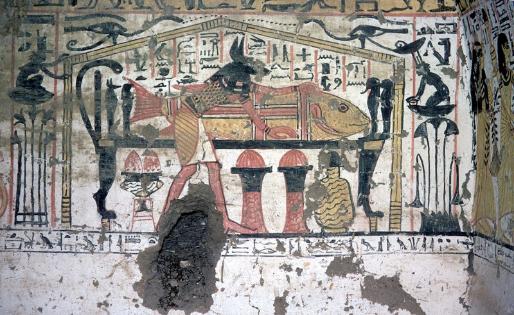
Another wall shows a similar scene in slightly modified form: Anubis, the jackal-headed embalmer, isattending to the dead Khabekhnet, who is depicted here as a mighty fish, rather than the usual humanmummy, lying on a lion-legged couch. The following words accompany the scene: “Anubis, the imy-wt,says: I come and I am your protector of eternity, oh abdw-fish from true lapis lazuli”. The four sonsof Horus (Imset, a human headed deity responsible for the liver, Hapi, a baboon headed deityresponsible for the lungs, Duamutef, a jackal headed deity responsible for the stomach and Kebechsenefwith a head of a falcon responsible for the viscera of the lower body) flank the fish at the head andfoot of the bed. The whole scene is framed by a tent, by the sides of which Isis and Nepthys kneel onclumps of lilies and papyrus plants. This large “abdw” fish is unidentifiable. The painting remains so farunparalleled.
The fish has been identified as the Nile perch (Lates niloticus) and was explained as a symbol of thedeceased awaiting rebirth (Germond,2001,143).Patrick Houlihan admits that the precise meaning of this fish mummy is uncertain, but he thinks that itprobably represents the deceased, who associates himself with the god Osiris (Houlihan,1996,132).Ingrid Gamer-Wallert (Gamer-Wallert,1970,131-132) suggests that the abdw-fish is related totilapia, a fish that in ancient Egyptian art symbolises rebirth. She argues that in this painting, the fishrepresents the followers of Re and his boat or is even a manifestation of the sun god himself. Could itbe that the dead man, regarding his continued existence to be secured by the presence of the solarbark and the tilapia and abdw-fish, might also have felt the desire to transform himself into one ofthese fish, and thus into one of the manifestations of Re? Why Khabekhnet chose the abdw-fish in thiscase and not the usual tilapia, we will probably never know.
Shabti for KhabekhnetFrom TT2, the Western cemetery at Deir el-MedinaLimestone, painted19th dynasty, reign of Ramesses IIHeight: 20.8 cmThe Náprstek Museum collection, Prague, Czech Republic, P6125
The shabti has a blacktripartite wig and a widecollar around his neck.
There are five lines of hieroglyphicinscription from a chapter of theBook of the Dead.
“Sehedj, Osiris, servant in thePlace of Truth, Khabekhnet, iscounted, when people are called toall works that should be done inthe necropolis…”(Théby,2007,273)
 khaled gamelyanl blogger