
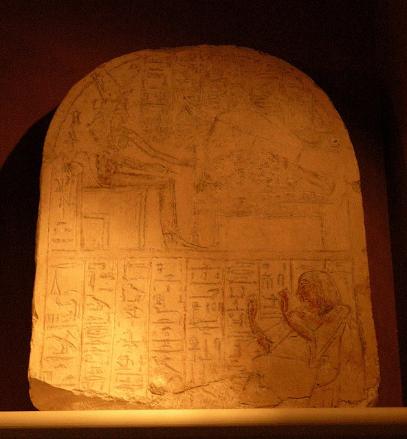
Bankes stela no. 3.
Stela of Ramose
From Deir el-Medina
Limestone
19th dynasty
Height: 46 cm
Width: 32 cm
This round-topped stela consists of 2 registers. In the top register a goddess sits on her throne facing right. She wears a double crown of Upper and Lower Egypt and is described by the inscription as Mut, the great one, lady of Isheru, mistress of the House of Amun, beautiful of face in Hut-sekhem. Protection, life and dominion be around her every day. Mut’s most favoured epithet among the artisans 2009, 120). The same epithet appears also on Bankes stela no. 9. Hut-sekhem is situated south-east of Abydos, it is the modern Hiw. In Greco-Roman Period the town was known as Diospolis Mikra or Diospolis Parva (Baines, 1996, 114). Mut is sitting in front of an offering table piled with ox meat and large lotus bouquets. Offering all good and very pure things to the lady of the Two Lands, the mistress of the House of Amun. In the bottom register a man is kneeling, facing the goddess, his hands in the adoration pose. Around him and above him there are 9 columns of hieroglyphic inscription: Giving praise to Mut, lady of heaven, [mistress of] the House of Amun, with beautiful hand carrying the sistra, sweet of voice. Singers, be content with all she says, pleasing(?) to (your) hearts. May she give life, prosperity and health, intelligence, [favour] and
love to the soul of the scribe in the Place of Truth, Ramose, true of voice with the great god. Ramose is one of the best documented officials from Deir el-Medina. Although he was not born in the village, he became one of the richest men who ever lived there. He was a son of lady Kakaia and a retainer Amenemhab (someone who delivered messages to officials in the Theban area). Ramose was born around 1314 BC (Booth, 2006, 185). He must have attended scribal schools before he became a scribe at the temple of Tuthmosis IV. He then moved to Deir el-Medina, where he married Mutemwia, the “lady of the house, whom he loves”. He was appointed by vizier Paser as “scribe of the tomb” in year 5 of Ramesses II (O.CGC 25671). He served in the rank at least until year 38 of Ramesses II (O.CGC 25809) (Davies, 1996, 98). As Ramose and Mutemwia continuously failed to conceive a child they petitioned various deities associated with childbirth and fertility. Stela 50066, now in Turin, is dedicated to Qudshu, the Asiatic goddess of love. There are many stelae and statues recording their plea, but the couple remained childless. In the end they adopted Kenherkhepshef, like Ramose, most probably a new arrival in the village, to be an apprentice who would take the role of the eldest son, take over Ramose’s profession and perform burial rites for them. Ramose’s family occupied a house in the northern part of the village. He also owned some land outside Deir el-Medina and there are 3 decorated tombs attributed to him – TT7, TT212 and TT250.
Ramose was contemporary with the foreman Kaha of the Bankes stela no. 2.
The next stela also belonged to Ramose.
 khaled gamelyanl blogger