
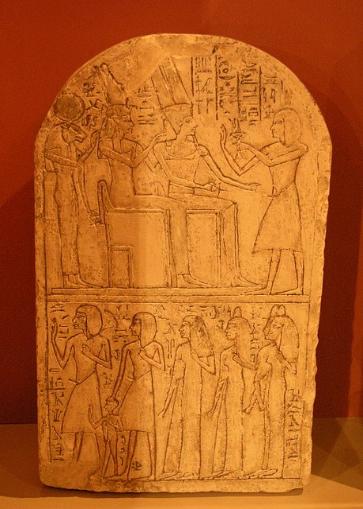
Bankes stela no. 2.
Stela depicting Huy
From Deir el-Medina
19th dynasty, the beginning of Ramesses II reign,
1270s BC
Limestone
Height: 46 cm
Width: 28 cm
This round-topped stela is divided into 2 registers. In the top register, two deities seated on their thrones, are described This round-topped stela consists of 2 registers. In the top register, two deities seated on their thrones, are described in the hieroglyphic inscriptions together with their epithets. The first one is Amun-Re, lord of the Thrones of the Two Lands, residing in Waset, foremost of the Westerners, the great god. Behind Amun-Re sits his daughter Mut, lady of
heaven, mistress of the Two Lands. A goddess with a head of a lion stands behind Mut’s throne. Jaroslav Černý translated the inscription that identifies her as Daughter of Re, the cobra. Jan Kunst, a Dutch Egyptologist, points out that to translate the name as “The Cobra”, there would have to be
the feminine definite article tA, instead of the masculine pA. He suggests that the goddess might perhaps be Wadjet. Wadjet is sometimes referred to as “Eye of Re” and can be depicted in leonine form or as a lion-headed woman, just like Bastet, with whom she was strongly associated. Moreover, she was strongly associated with Mut, which might explain her
presence in this otherwise unusual combination. One of her epithets is “She of Pe”, py.t, which might somehow (but not fully) explain the pA. The cobra hieroglyph is likely to be the determinative for a goddess, rather than an ideogram, Jan Kunst explains in our private correspondence.
A man stands in front of the divine triad. His hands are raised in adoration while he makes an offering burning incense in a holder placed in his left hand. The inscription says: Made by the servant in the Place of Truth, Huy, true of voice. The bottom register contains a procession of 2 men, 4 women and a small child. They all face the triad and are meant to be following Huy. The columns of inscriptions around them give us their names, sometimes their titles
and their relationship to Huy. The first man on the left – directly behind Huy in the procession – is Kaha, who was most probably responsible for the setting up of this stela. The inscription reads Made by the servant in the Place of Truth, Kaha, true of voice. Behind Kaha is his brother Paherypedjet. Paherypedjet’s hand touches the head of the child standing between Kaha and himself, his son Khuru. He is depicted as a small naked boy. This stela, with representatives of three generations of the same family, is an example of the valuable sources of information helping Egyptologists to reconstruct chronological frameworks of the work force at Deir el-Medina.
Behind Paherypedjet stands his mother Tanehsy, followed by his sister, lady of the house, Tuy. The procession is closed by two women standing side by side, his son (sic.sister) Takhat and his sister Na’ay, true of voice. Huy served as a distinguished official at Deir el-Medina in the early 19th dynasty. His title was “chief craftsman in the Place of Truth in West Thebes” (Davies, 1996, 15). Tanehsy, who is the first lady from the left, is Huy’s wife. She is the mother of Kaha, who stands behind his father Huy in the procession – the first to stand on the left on the lower register of the stela. Kaha was a foreman for the “left side” of the crew at Deir el-Medina during the reign of Ramesses II (1279-1212 BC). From a stela recovered from the court of his tomb TT 360 his title was “chief workman of Usermaatre-setepenre in the Place of Truth”. Kaha’s status was reflected in the fact that he occupied one of the largest houses in the settlement (N.E.VIII) built in the 18th dynasty (Davies, 1996, 16). As Kaha’s title on this stela does not state he was a foreman, it could be dated to the very beginning of Ramesses II reign as it is thought Kaha was appointed to the foremanship during the early years of the reign. The family relations as stated in the inscriptions relate to Kaha as a dedicator of the stela rather than Huy, the dedicatee. Kaha’s wife Tuy is the lady standing behind Kaha’s mother Tanehsy. They are believed to have had a large family with Kaha of at least 6 sons and 5 daughters (Davies, 1996, 16). One of the sons depicted here is Khuru, the little boy, standing near his uncle – Kaha’s brother – Paherypedjet. Takhat and Na’ay are both identified as Kaha’s sisters, but I have not found evidence for a sister named Na’ay. We know that Na’ay was a name of Kaha’s daughter, but a daughter would not have been a grown up lady as show on the stela at this time of Kaha’s life. In this particular case, the inscription definitely bears a mistake as the feminine ending for “snt” is missing and the word displays as the masculine form “sn”. The word is usually translated as sister, but it does not designate only a sister in ancient Egyptian relations. Sometimes it also means a wife, a niece, an aunt, etc. The word “sn”, usually translated as “brother”, is also used for male relations between people of different generations that are related directly (an uncle, a nephew, etc.) or by marriage (a brother-in-law).
 khaled gamelyanl blogger