
Sennedjem’s tomb no 1
at Deir el-Medina
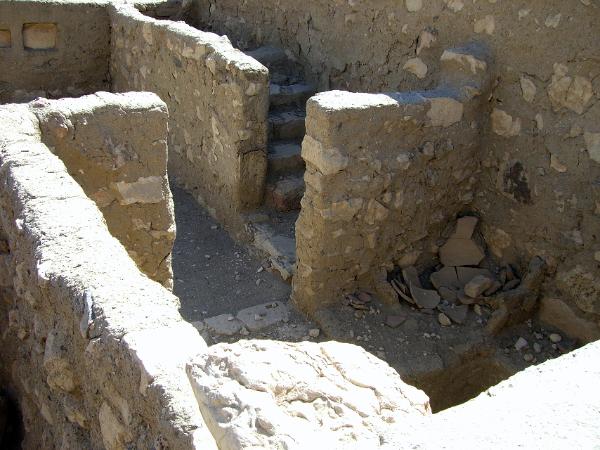
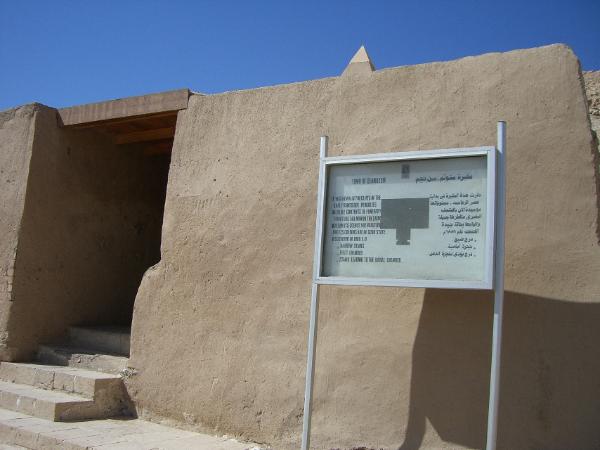
The tomb lies within the Western cemetery. It was discovered intact in 1886. The opening and
clearing of this intact burial place was overseen by Gaston Maspero, the head of the Antiquities
Service at the time. Twenty mummies, nine of which were in coffins and eleven only wrapped in linen,
were found inside the vaulted burial chamber which measures 5.12 m by 2.61 m, and 2.40 m high.
The tombs owner was Sennedjem, a “servant in the place of truth”, who lived in the village at the
beginning of the 19th dynasty and then shared this “house of eternity” with his wife Iyinofreti, their
son Khons and daughter in-law Tamakhet and the lady Isis, wife of their second son Khabekhnet,
together with their grandchildren. Both Sennedjem and his wife lived well into an old age. Iyinofreti’s
mummy, now in the Metropolitan Museum in New York, is that of a woman of approximately 75.
Sennedjem’s house lies in the south-western corner of the settlement. It neighbours a house of his son Khabekhnet.
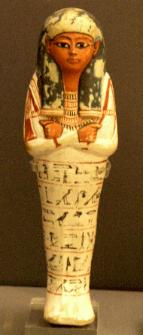
Shabti of Sennedjem
Fitzwilliam Museum, Cambridge E.9.1887. Limestone with
pigment
Height 21.5 cm.
From Deir el-Medina, Tomb 1 of Sennedjem
New Kingdom, 19th dynasty, reign of Seti I, 1294-1279 BC
The shabti holds a broad bladed hoe against his right shoulder
and a hoe with pointed blade against his left shoulder. A basket
for seeds is depicted on his back, slung by a rope over his right
shoulder. The text invokes the shabti as a servant, literally
“hearer of the call”, to act on behalf of Sennedjem if required
at any of the works which are done in the necropolis.
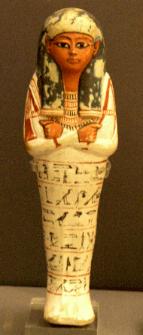
Shabti of Sennedjem
Kunsthistorisches Museum Vienna, Egyptian –
Oriental Collection, Inv AE_INV_6614
New Kingdom
19th dynasty, around 1300 BC
From Deir el-Medina, Tomb 1 of Sennedjem
Limestone, painted
Height: 28.3 cm
Width: 9.95 cm
Depth: 8.8 cm
For the translation of the hieroglyphic inscription
 khaled gamelyanl blogger