
The first deity is the
falcon-headed Ra-Harakhty,
followed by a human-headed Atum.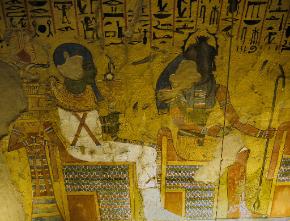
Atum is followed by the scarab-headed Khepri (the
morning form of the sun god), and the god Ptah.
Djed-pillar stands behin Ptah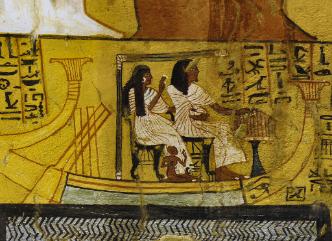
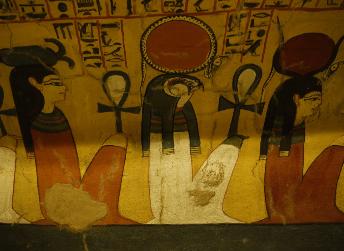
On the right side, there are:
Hathor, Ra-Harakhty, Neith…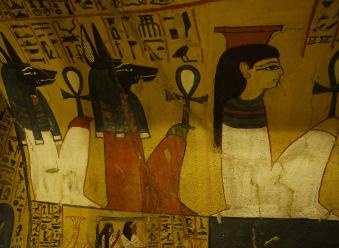
.Geb, Anubis and Wepwawet. 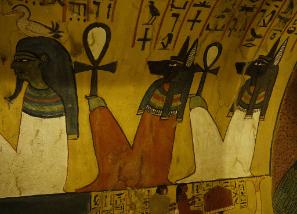
…Serqet, Anubis and Wepwawet. 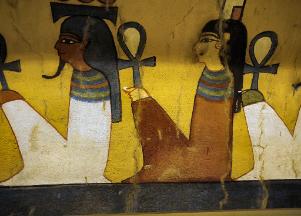
…Nun and Nepthys… 
There are sixteen deities on the
vaulted ceiling of the innermost
burial chamber, eight on each side.
On the right side, there are:
Osiris, Isis and Nut…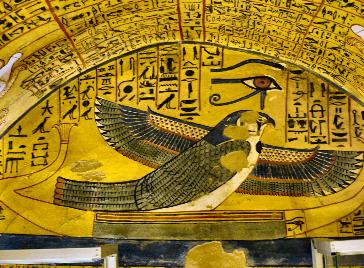
Pashedu’s tomb no. 3 at Deir el-Medina
The owner of the tomb 3 at Deir el-Medina was Pashedu, who lived in the settlement during thereigns of Sety I and Ramesses II. He had the title “Servant in the Place of Truth on the West ofThebes”. He might have also been a “foreman”, if he is to be identified with the person named in aninscription translated by Kitchen (Kitchen, 1993, p. 270). He was a stone mason, responsible forcutting the corridors, chambers and pillared halls of the royal tombs in the Valley of the Kings.Pashedu was a son of Menna and the lady Huy. He had five sons and daughters with his wife, calledNedjem-Behdet. Pashedu’s son Menna, was without any doubt named after his grandfather. Frominscriptional evidence in the tombs it seems that Kaha also was Pashedu’s son (Davies, 1999, p. 166).TT3 was discovered in 1834 by Egyptian army draftees. Scottish artist Robert Hay visited the tombshorty afterwards and recorded its decorated walls (Weeks, 2005, p. 464).
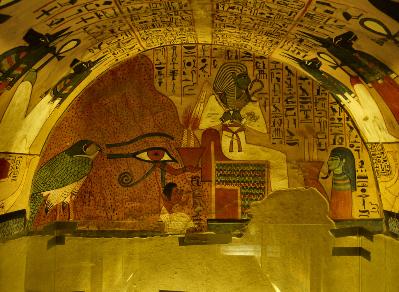
At the bottom of the entrance stairs there isan entrance into the first burial chamber,behind which the second burial chamber lies.A short vaulted passage leads into the third,innermost burial chamber. Anubis jackals thatlie on top large white shrines with cavettocornices are painted on both sides of thepassage walls. There is the godPtah-Sokar-Osiris in the form of a falcondepicted within the vaulted area above thedoorway. His elaborately painted wingsstretch out below a wedjat-eye. The falconsits in a boat. There are 15 lines of ahieroglyphic inscription. Pashedu’s sons Mennaand Kaha both kneel beside the boatworshipping gods depicted (out of the picture).
The rear wall of the innermost burialchamber shows the godOsiris-Onnophris, the ruler of thekingdom of the dead, on his throne withthe mountain of the West behind him.Osiris wears a nemes-crown and holds aflail and scepter. A seated god beforehim presents a bowl with burningtapers. The inscription written incolumns of black hieroglyphs containsspell for “lighting a lamp for Osiris”(Málek,2003,222). Behind the throneof Osiris a small figure of Pashedu isdepicted kneeling
Pashedu and his wife sit before an offeringtable in a small boat of the Abydospilgrimage. One of their daughters sits atNedjem-Behdet’s feet. They both wearelegant pleated costumes made of fine linenand have long and elaborately coiffed hair.
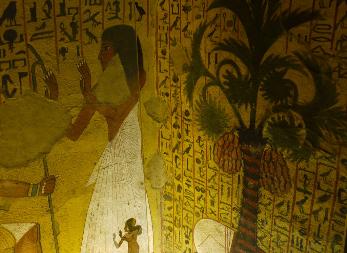
The image on the left records two cornerscenes. The scene on the right comes fromthe left front wall of the burial chamber. Itis one of the best known scenes in Thebes.Pashedu kneels and bows down beneath adom-palm at the edge of a pond. There are21 columns of text around him. 17 come fromchapter 62 of the Book of the Dead, theChapter for Drinking Water in God’s Domain.The left scene comes from the right wall ofthe burial chamber. Pashedu and his daughterNebnefret stand before four male deities anda djed-pillar. The first deity is thefalcon-headed Ra-Harakhty,followed by a human-headed Atum.Atum is followed by the scarab-headed Khepri (themorning form of the sun god), and the god Ptah.Djed-pillar stands behin Ptah.
There are sixteen deities on thevaulted ceiling of the innermostburial chamber, eight on each side.On the right side, there are:Osiris, Isis and Nut…
 khaled gamelyanl blogger